

Handling
High-precision movement of lifting tables
High-precision positioning systems - in the form of lifting tables, for example - are required in order to precisely position car body components for processing in robot welding lines. Gearboxes and precision cardan shafts play a 'supporting' role here so that the robot does not reach into the void.
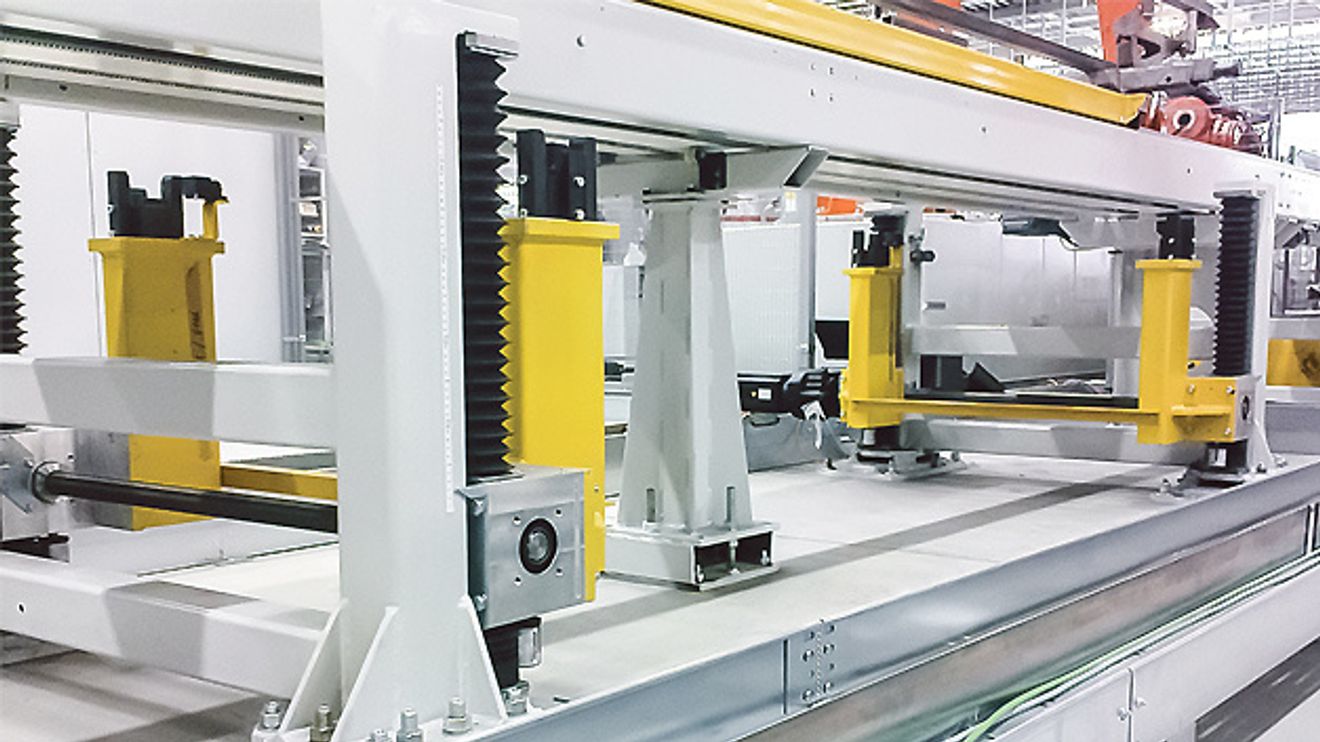
Before complete vehicles roll off the production line in the automotive industry, hundreds of work steps are required and thousands of spot welds have to be made. For example, up to 700 different sheet metal parts have to be joined together before a vehicle body is finished. The underbody or the front end are first joined together as modules. Industrial robots carry out this work highly efficiently in dedicated production cells: They load and unload component containers containing the sheet metal parts from the press shop and finally join and weld the parts together.
As flexible as a robot is in this process, each part must be in a precisely defined position so that its grip does not come to nothing when picking up the component. This is ensured, for example, by specially designed lifting tables based on rack and pinion gears, which pick up the component containers and bring them into the specified position and to the required working height - with the highest possible repeatability. Alternatively, these lift tables can function as a variant for empty stations and lift car bodies attached under a high-speed conveyor into a parking position. In short: lift tables are cost-effective alternatives to lift/lower conveyors and work with a positioning accuracy of ± 0.01 mm, even with high loads and high speeds.
Leantechnik is a company that has been working with rack and pinion lifting gears for 20 years. "The Oberhausen-based company was looking for an alternative to the cardan shafts previously used in the lifting tables, as their intermediate joints led to unsteady running and therefore impaired the precision of the lifting movement," recalls Christopher Monka, Area Sales Manager North-West at R+W Antriebselemente in Klingenberg.
The vibration problem was finally successfully solved with backlash-free and vibration-damping cardan shafts from R+W's EZ2 series. To compensate for vibrations and torque shocks, these are equipped with elastomer rings, which also compensate for axial, lateral and angular misalignments.
Precision required for power transmission
The connection is made via split clamping hubs, which enable easy radial assembly. The two coupling bodies are firmly connected with an aluminium tube optimized for concentricity, designed for bore diameters from 5 to 140 mm and for peak torques of 25,000 Nm. The elastomer spiders are made of TPU (polyurethane) and have different Shore hardnesses: The 'A' version has good damping at 98 Sh A, while the 'B' version is more torsionally rigid at 64 Sh D.
"The cardan shaft solution is a plus for us in two respects," explains Reinhard Meltsch, Head of Design at Leantechnik: "Firstly, it ensures the desired torque transmission in the lift tables we produce and achieves high concentricity from the drive shaft to the respective gearbox. Secondly, this approach saves time and money during installation and maintenance. This is because the precision drive shafts can not only bridge large shaft distances, but also compensate for shaft misalignment." The shafts can be assembled or disassembled using the removable intermediate tube without moving the already aligned machines.
More effective with rack and pinion gearboxes
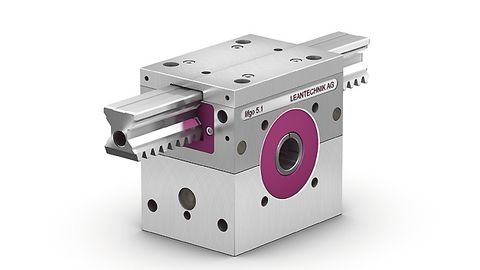
Size 5.1 rack and pinion gearbox with linear guided rack: Any number of racks can be arranged side by side in order to cope with long travel distances during horizontal and vertical lifting.
© Lean technologyAt the heart of a lift table are four so-called Lifgo rack and pinion gearboxes, which are mounted in such a way that vertical strokes of up to 125 cm can be performed. The gearboxes are synchronized via a lifting system consisting of a transfer gearbox and the aforementioned cardan shafts, which ensure a force-fit connection between two opposing gearboxes. They are driven by an electric geared motor. Depending on the type of application and the space required, the motor can be located in the middle of the lift table structure or on the outside. The component containers are picked up via four pick-up points located on the top of the gearboxes. After engaging, the four gears move synchronously in a vertical direction to bring the component containers to the required working height.
In addition to the size 5.1 with a lifting force of 3800 N that is normally used for the lift tables, sizes 5.0 and 5.3 are also available for the rack and pinion gearboxes. They also lift even heavy bodyshells at a speed of up to 3 m/s and can effectively compensate for the lateral forces that occur. In addition to the standard version, the gearboxes are available with two parallel racks, as a linear version for long lifting distances such as those found in gantries and as an eccentric version with adjustable tooth flank clearance.
The fourth size 5.4 - Leantechnik's largest gearbox to date - is specially designed for heavy loads. It can handle loads of up to 2.5 tons and is used, for example, in a new lifting and lowering conveyor that the Leantechnik engineering team has developed together with Bleichert Automation. The solution for the automotive industry can be seen for the first time at Automatica.
Author:
Marcus Hirschen is responsible for marketing at Leantechnik.


You might also be interested in
Easy to implement
Leantechnik rack and pinion gearboxes can be used to design all types of lifting and positioning systems. Integration into the application is easy thanks to the 3D product configurator from Cadenas.
 read more...
Positioning accuracy up to 2 µm
The 'lifgo hp' rack and pinion gearbox from Leantechnik enables long, precise and dynamic strokes. According to the manufacturer, the absolute positioning accuracy is up to 2 µm, a fraction of the thickness of a human hair.
read more...Rack and pinion gearboxes for positioning systems
The lifgo and lean SL rack and pinion gearboxes from Leantechnik are particularly suitable for applications in which precise synchronous positioning tasks need to be performed.
read more...Conrad continues Growth Course with new Management
Conrad Electronic is continuing its transformation from a traditional retailer to a B2B platform. The new managers Dr. Daniel Saga and Guy Dann strengthen the strategic focus on different customer segments.
read more...Ergonomic workstation solutions with linear technology & co
RK Rose+Krieger is presenting components and system solutions from the fields of linear technology, profile technology, connection technology and module technology at Motek. One current example is the 'RK Easymount' assembly table.
read more...New workpiece carrier system
IWB Industrietechnik expands the Minitrans conveyor belt program with a workpiece carrier system.
read more...Corner connector for cable trunking system
RK Rose+Krieger has developed corner connectors for the existing 'KK-40x40' and 'KK-80x40' cable duct profiles of the 'Blocan' cable duct system made of anodized aluminium.
read more...Electronic Direct becomes part of the Conrad Group
The Electronic Direct Group, which focuses on the special procurement of electronic components, has been part of Conrad since the beginning of February 2024. The full-service provider's main customers are companies in the industrial, automotive and...
read more...Production and manufacturing technology in one place
Organized by Messe Stuttgart and the VDW, NORTEC is the trade fair for production in northern Germany and covers all stages of the metalworking value chain with numerous national and international exhibitors.
read more...