

Ethernet
What comes with Single Pair Ethernet?
Single Pair Ethernet - SPE for short - is a hotly debated topic in industrial data transmission. Why is this Ethernet variant such an important component of future automation technology?

Ethernet was developed in the 1970s as a non-standardized software protocol for the company-internal and locally limited transmission of data packets in wired computer networks (LAN - Local Area Network). The Institute of Electrical and Electronics Engineers (IEEE) specified the software protocol and the physical layer - including the physical interfaces such as connectors and cables - over the following two decades and laid the foundations for the modern Internet with the introduction of various protocols such as 802.4 (Token Bus), 802.5 (Token Ring) and finally 802.11 (WLAN).
Common language
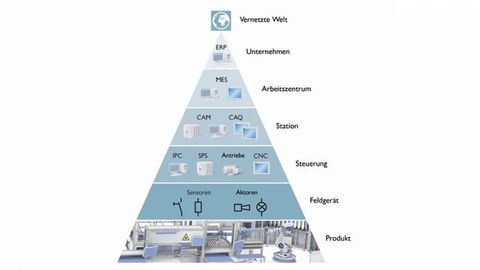
Figure 1: A paradigm shift: SPE turns the conventional automation pyramid on its head.
© Phoenix ContactAt the same time, fieldbus technology developed in the 1980s, driven by the increased use of electrical automation technology. The basic idea was the same: Different communication participants were to communicate with each other in an organized manner and in a common system. However, the various fieldbus protocols such as Interbus, DeviceNet or Profibus were not used to network computers at company level, but for the serial or parallel connection of sensors and actuators to the control and management level.
Ultimately, the parallel development of the two transmission protocols established the form of the automation pyramid that is still in use today. The top levels represent locally limited computer networks that are used for rough and detailed production planning. The lower levels comprise signal, data and power transmission for recording, controlling and regulating the physical production process(Figure 1).
The shape of the pyramid is primarily the result of the hierarchical and logical arrangement of the different levels. However, it also represents the current framework conditions for industrial data transmission: High transmission rates and short distances using Ethernet, low transmission rates and long distances using fieldbus.
Turned upside down
So why this digression? Industrial Ethernet and, above all, Single Pair Ethernet are turning this automation pyramid on its head. With the development of Ethernet-based protocols such as Ethernet/IP, Profinet or Ethercat, Ethernet-based real-time data transmission moved from the corporate to the field level.
The physical interfaces became more powerful, but also more complex in terms of electrical engineering, as data transmission had to be protected from interference such as dirt, vibration and electromagnetic radiation. Manufacturers of connection technology therefore developed special IP6x-protected Ethernet interfaces to meet these increased requirements at field level. For the top of the automation pyramid - the company and operating level - IP20 solutions were still sufficient.
Data transmission to the power of two

Figure 2: Standardization: Data transmission rates at field level and in data centers are gradually being standardized.
© Phoenix ContactUp to now, standardization efforts have been limited to ever higher data rates and higher demands on cabling technology. These requirements were defined by ever higher performance classes in copper-based cabling - the categories.
Single Pair Ethernet does not once again define higher bandwidths or transmission distances, but forms the normative framework for cabling that is reduced in line with the application. The IEC 63171-2 (IP20) and IEC 63171-5 (IP67) standards focus on lower transmission rates of 10 to 100 Mbps. Data cabling with just one wire pair nevertheless enables transmission distances of up to 1000 meters. For the first time, SPE therefore allows areas of use and applications that were previously not possible with conventional Ethernet, such as in process technology(Fig. 2). The advantage for system operators is that data cabling can be carried out consistently on the basis of the Ethernet protocol, and identical interfaces and mating faces can be used in different environments.
Another advantage is that single-pair interfaces are significantly more compact than two- or four-pair device and cable connectors. SPE therefore supports the ongoing trend towards compact, decentralized devices in industrial automation, process technology, building automation, telecommunications and infrastructure applications. SPE can therefore become the DNA of the Industrial Internet of Things (IIoT) in an application-neutral way.
New mating face, familiar reliability

Figure 3: Efficient cabling: single-pair and four-pair MICE interfaces are used for cabling IP20 and IP6x applications.
© Phoenix ContactThe IEEE has formed working groups to standardize different applications with transmission rates of 10, 100 and 1000 Mbit/s to ensure the universal compatibility of all interfaces. Corresponding standards have already been adopted for 100-Base-T1 and 1000-Base-T1; 10-Base-T1 standards are to follow by the 3rd quarter of 2019.
Together with other companies - Weidmüller, Reichle & De-Massari, Belden and Fluke Networks - Phoenix Contact is developing protected and unprotected mating faces for single-pair and four-pair cables. The MICE model describes their mechanical robustness (M1 or M2/3), IP protection (I1 or I2/3), chemical and climatic resistance (C1 or C2/3) and electromagnetic safety (E1 or E2/3)(Figure 3).
The compact plug-in faces are ideal for efficient cabling of numerous communication devices - either via a single wire pair or via four wire pairs for four devices that share a common cable and interface. Thanks to the common interface, single and four-pair cabling concepts can be mixed with each other, as can IP20 and IP6x solutions. Possible applications include splitting eight-wire cabling concepts into four individual SPE strands for four different communication devices or dimensioning individual pairs within the eight-wire device interfaces. The two-wire technology also allows the application-specific supply of end devices with power of up to 60 W via the same wire pair (Power over Data Line - PoDL).
The future of communication technology

Figure 4: Information technology (IT) and operating technology (OT): New communication standards are the basis for end-to-end networking from the sensor via the machine and higher-level systems to the cloud.
© Phoenix ContactHowever, as a mega trend in industrial data transmission, SPE cannot be viewed independently of other standardization efforts. The basic framework for the future of industrial communication technology is being developed in parallel in various committees and projects. New communication standards such as the Open Platform Communications Unified Architecture (OPC UA), Time-Sensitive Networking (TSN) or 5G are the basis for end-to-end networking from the sensor via the machine and higher-level systems to the cloud.
The new standards will be superior to previous protocols and interfaces in terms of costs, data throughput, latency and deterministics and pursue one goal: nothing less than a new, cross-manufacturer communication standard for automation.
OPC UA is already used today as a superimposed communication standard in systems. OPC UA is now being expanded to include standardized application profiles in the field - for I/O, safety or drive applications, for example. In addition, standardized device models are defined for uniform configuration and uniform diagnostics of the devices in the network(Figure 4).
Author:
Verena Neuhaus is Manager Product Marketing Data Connectors at Phoenix Contact in Blomberg.
Single Pair Ethernet - at a glance
- Single Pair Ethernet (SPE) describes the physical interfaces for the single-pair transmission of data and power between different communication participants.
- The IEEE develops standards for different applications with data transmission rates of 10 (802.3 cg), 100 (802.3 bw) and 1000 Mbit/s (802.3 bp) and cable lengths of 15 to 1000 meters.
- Together with Weidmüller, Reichle & De-Massari, Belden and Fluke Networks, Phoenix Contact develops standardized mating faces for IP20 and IP6x environments.
Single Pair Ethernet - the relevant standards
- IEC 63171-2: SPE mating faces for IP20
- IEC 63171-5: SPE mating faces for IP67
- ISO/IEC 11801-1: General requirements for twisted pair and fiber optic cables


You might also be interested in
New Automation Management Board strengthened
New Automation, the training association for industrial companies in the field of automation technology, has expanded its board and set up new projects for young talent.
 read more...
Monitor and protect DC microgrids
Sustainable production using renewable energies begins with the establishment of an industrial DC grid. A multifunctional DC switching device is responsible for switching, protecting, monitoring and precharging DC sectors.
read more...The e-paper of issue 08/2024
How can data centers be cooled for AI? How successful is malware programmed with WormGPT? And how can virtualized control systems be integrated into production using TSN? Computer&Automation issue 08/2024 provides answers to these questions and...
read more...Frank Stührenberg hands over to Dirk Görlitzer
Frank Stührenberg will hand over the chairmanship of the Phoenix Contact management board to Dirk Görlitzer at the end of the year. Until then, there will be dual leadership.
read more...Frank Stührenberg hands over to Dirk Görlitzer
At the end of the year, Frank Stührenberg will hand over the position of CEO of Phoenix Contact to Dirk Görlitzer. Until then, there will be dual leadership.
read more...New production facility in Mexico
In order to meet the growth potential of the North American market, Phoenix Contact is planning a new building for electronic and electromechanical production in Mexico. Production is scheduled to start after the first construction phase at the end...
read more...The top articles in April 2024
The most-read articles in April demonstrate the innovative strength of the automation industry and its ability to adapt new technologies.
read more...Phoenix Contact at the Hannover Messe
Strategic technology partnership with Festo
Festo will use PLCnext Technology, the open ecosystem from Phoenix Contact, in future intelligent devices. In this way, both companies want to combine their innovative strength with the aim of taking industrial automation to a new level.
read more...Phoenix Contact at the Hannover Messe
Charging with power
The 'Charx connect universal' CCS vehicle charging sockets from Phoenix Contact now also enable high-power charging with a continuous 375 kW.
read more...