
Communication via WLAN
How wireless sensor networks work
To date, wireless systems in industry have mostly been point-to-point connections. If these are expanded into a network with a connection to higher-level IT systems, completely new infrastructures can be set up - for e-kanban systems, for example.

After initial reservations, wireless solutions have now become established in automation technology. This even applies to sensitive areas of application such as functional safety and potentially explosive environments. In the course of this development, wireless switching devices are also increasingly being used - for example position switches, pull-wire switches or foot switches, but also contactless switching devices such as inductive, magnetic and optical sensors. However, these are mostly stand-alone solutions with their own evaluation devices, which are only integrated into the user's IT solutions at the level above. However, the discussion surrounding Industry 4.0 in particular shows that further developments and new standards will be required in the future in order to better exploit the advantages of wireless communication at store floor level.
The American term 'Internet of things' makes it even clearer than 'Industry 4.0' what this is all about: when machines, tools and (semi-finished) products communicate with each other, point-to-point connections will not be enough. Instead, wireless networks must be available that are ideally equipped with interfaces to the company's IT, such as ERP systems or warehouse management software, and can communicate directly with these systems.

Kanban racks are a typical application of wireless networks. If a container is removed, a signal is sent to the control system and replenishment is requested.
© Steute switchgearHowever, the term 'Internet of things' is also somewhat misleading, as it assumes that in future every tool and every product will be accessible via its own IP address. Such a solution is often difficult to implement for cost reasons alone. However, it is not even necessary - at least as long as communication takes place within production - as current examples and projects show.
One of the first such projects implemented by Steute was an e-kanban system in which radio position switches in roller conveyor racks report that replenishment is required. The position switch automatically sends a radio signal in real time to a communication unit, which can trigger an order process in the higher-level ERP system via WLAN. If the stored goods are particularly light or if the racks are so compact that it is not possible to retrofit the wireless rockers, a wireless light scanner can be used as an alternative. Operating systems that can be used to request material or confirm its removal / provision can also be integrated into such networks. The aforementioned E-Kanban system is now in use in the assembly plants of automotive suppliers, among others.
Polling versus event
At this level of description, replacing wired switches or sensors with wireless ones sounds quite simple. However, it is not that simple. In order to set up a wireless network suitable for industrial use, the power supply for the participants must be clarified. A wireless sensor that has to have its battery replaced once a month is useless in practice. This is why low-power architectures and energy management play a key role in wireless sensors.

Conventional wireless switching devices with a point-to-point connection between the switching device and receiver are already used in many areas of industry. In the future, these will increasingly be integrated into extensive wireless networks.
© Steute switchgearIn addition, the type of data query is fundamentally different. Automation engineers are used to a control system working cyclically. If an analog or digital sensor is connected, the sensor data can be scanned with the cycle of the control system. This is different in wireless systems. With a digital sensor, it makes sense from an energy consumption point of view to only transmit data when there is actually a change in status. If the signal is not critical, such as with a pull-wire switch for door opening functions, the sensor can be equipped with an energy generator so that completely energy-autonomous operation is possible. In practice, solutions based on Enocean technology are often used to cover this application.
However, if greater reliability is required, confirmed communication is necessary. Steute achieves this using sWave technology in the 868 or 915 MHz SRD band, which has been specially developed for this purpose. The switches and sensors can then absorb enough energy via small buffer batteries or energy generators to send the event several times with confirmation. The advantage of this technology is that the switch or sensor makes every effort to reliably transmit the switching status to the radio receiver.
If it is important for the process to permanently monitor the radio switches for their operational readiness, there is no way around a 'live signal'. The sensor and receiver then exchange status information in a local cycle, with the sensor taking on the active role for energy reasons. Devices in this category can only be operated sensibly with batteries.
How the wireless network works
Such energy-saving yet reliable communication is not possible with standardized wireless technologies - hence the in-house development of sWave wireless technology. It provides a radio protocol that reaches the respective receiver unit with high reliability and transmission quality under the often unfavorable environmental conditions of industrial production.
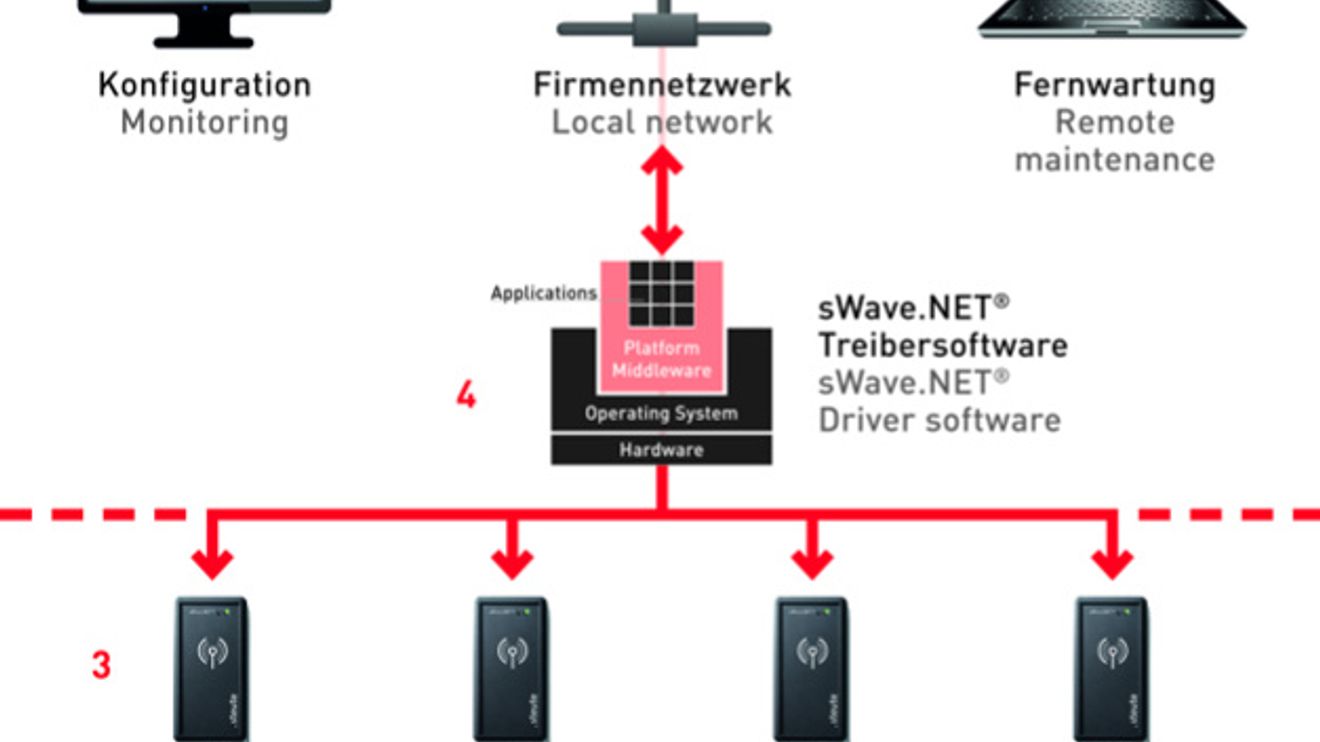
The wireless switching devices and sensors are connected at field level via newly developed access points. These work like a network router and receive the signals from the wireless switching devices, bundle them and send them to one or more application servers via Ethernet or WiFi, for example. A database runs on this server, which 'collects' all the information from the field level and forwards it either directly or via middleware to the user's IT platform (ERP, production data acquisition/BDE, condition monitoring/CMS, warehouse management/LMS, etc.).

The new access points form the switching point for the user-specific wireless networks, which are set up in such a way that individual access points can be bypassed in the event of transmission errors.
© Steute switchgearThe automation pyramid then consists of clearly separated levels in which the switching devices and sensors are 'connected' to a controller or middleware via the wireless network. The controller processes these signals into data, passes them on to higher-level control levels and ultimately everything can be processed at the MES-ERP level via web services. In principle, this model is based on the assumption that the radio transmitters are 'stupid' from a communication perspective and only ever respond to requests 'from above'. The higher level is basically designed as a client and initiates data requests, while the lower layer works as a server and is therefore only active reactively.
At the hardware level, the access points specially developed for the new radio system form the 'backbone' of the network. They are installed throughout the transmission area, whereby each access point can receive signals from up to 100 wireless switches. When a radio switch sends a message, it proceeds according to a defined sequence of access points. If the transmission to the first access point fails, it sends the signal to the second and so on. This ensures a very high level of transmission reliability.
The network configuration
The access points in the so-called sWave.Net network can be adapted to the respective requirements via a web server. Changes to the network can also be easily implemented in this way. The proven 868 kHz standard with which the network operates offers the advantage of a comparatively long range: Up to 700 m is possible in an open field. Depending on the application, one battery can supply the energy for up to 1 million radio transmissions. One of the reasons for this is that the wireless switching devices are not permanently ready to receive and transmit during operation, but 'wake up' ad hoc and only then establish communication with the access point.
Even though the radio system described was only introduced a few months ago and is now gradually opening up various areas of application, the developers are already asking themselves how the system can be further differentiated and which fields of application are possible.
In order to answer these questions from a scientific perspective, Steute has collaborated with the Institute for Industrial Information Technology (inIT) in Lemgo in a transfer project of the "Intelligent Technical Systems - it's OWL" cluster of excellence. The engineers configured various network topologies to ensure high transmission reliability (multihop function via subscribers and repeaters), as well as different frequency ranges (sub-GHz and 2.4 GHz band). They also calculated and measured the latency of various wireless networks.
This work provided the basis for evaluating the investigated networks in terms of their suitability for machine safety. The 'Trusted Wireless' radio technology developed by Phoenix Contact for radio communication in industrial environments was used as the 'backbone'. The latency times were both calculated and measured. The result: at over 100 ms, the signal propagation times are currently too long to be used for safety-relevant tasks. This means that machine safety cannot yet be integrated into the configuration of such low-power networks.
This result may sound negative, but the gain in knowledge is nevertheless great, because both the application limits of current wireless technologies and network topologies as well as concrete optimization potential of existing wireless networks were shown.
Author:
Andreas Schenk is Product Manager Wireless at Steute Schaltgeräte.


You might also be interested in
Hans Seifert to Become Chief Sales Officer
Sigmatek has appointed Hans Seifert as Chief Sales Officer (CSO). His area of responsibility includes international sales, marketing, application engineering, and support.
 read more...
CC-Link certification for modular I/O system
Weidmüller has received the CC-Link Partner Association (CLPA) certificate for its modular I/O system 'u-remote'. This makes u-remote the first modular I/O system with official CC-Link IE safety certification for CC-Link IE TSN.
read more...Profibus & Profinet International
MTP Specification 2.0 published
Profibus & Profinet International (PI) announces the official release of the Module Type Package (MTP) Specification 2.0. The MTP 2.0 standard creates the basis for true cross-industry interoperability as well as more flexibility and efficiency...
read more...New analog input modules
MicroControl is launching the next generation of compact analog input modules. The new modules are µCAN.4.ai-BOX for voltage/current, µCAN.4.sg-BOX for strain gauge sensors and µCAN.4.ti-BOX for temperature sensors.
read more...Profibus & Profinet International
Profinet leads the field in industrial Ethernet protocols
A recent analysis by the market research institute Omdia confirms that Profinet is the leading technology in the field of industrial Ethernet protocols. In addition to its broad market penetration, Profinet's consistent focus on security is...
read more...Dual leadership in Shanghai
Stefan Becker has been appointed Managing Director of Eckelmann Automation Technology in Shanghai and will manage the subsidiary together with Zhongwei Huang.
read more...Smart control cabinets thanks to new Ethernet/IP technology
Rockwell Automation is launching an Ethernet/IP control cabinet solution. The aim of this further development is to meet the growing demand for smarter, faster and better networked production processes.
read more...Softing Industrial Automation takes over Delta Logic
Softing Industrial Automation has acquired 100% of the shares in Delta Logic Automatisierungstechnik in Schwäbisch Gmünd.
read more...Single-axle drive module for high performance
The modular, dynamic multi-axis servo system 'DIAS-Drive 2000' from Sigmatek has been reinforced: The 'MDP 2200-L-01' single-axis module for controlling synchronous servo motors provides up to 20 A rated current.
read more...