
System as a Service / SaaS
How SMEs can benefit from I 4.0
Industry 4.0 is driven and implemented more by 'upper' SMEs and corporations than by small and medium-sized enterprises. What is the reason for this and what new approaches can be used to give SMEs easy access to Industry 4.0?

Looking back: Back in 2013, a study by Acatech describing the use cases of Industry 4.0 was presented to German Chancellor Angela Merkel at the Hanover Trade Fair to great media acclaim. Since then, there has been constant puzzlement as to why the undoubted benefits have not been adapted by small and medium-sized companies, while many large corporations are already working more or less intensively with the technologies of the fourth industrial revolution.
Examples of internal processes: The Daimler company, for example, has already been using a driverless truck for internal transport at its plant in Berlin Marienfelde for some time, which shuttles between the various halls and supplies them with parts - replacing a monotonous and unpopular activity on the few hundred meters of driving distance. On the other hand, digitalization is already providing many companies with insights into the user behaviour of their customers through corresponding 'online products'. Komatsu, a Japanese industrial group and the second largest construction machinery manufacturer in the world, has already been networking its headquarters with its machines for almost ten years. This allows Komatsu to understand how the machines are used, which errors occur, when they work best and operate most efficiently. The information is used in development to derive recommendations for future products.
Starting points for I4.0 solutions
In order to understand the starting points for production optimized according to Industry 4.0 principles, it is necessary to clarify what I4.0 is and why companies are making changes to their production processes. Industry 4.0 involves the use of data from machines, systems, employees and goods in order to optimize the company's production processes with the results analyzed from this data.
In principle, changes in production processes are always implemented when a short amortization period for investments can be expected or when it is necessary for safety reasons. The optimization of production is based on the seven general types of waste in a company. Although many companies have been fighting these for years, it is difficult to counteract some of them without digitalization. The types of waste include
1. transportation
Transportation does not add value and is only a means to an end. The longer the distances between the individual production stations, the less efficient the production process. In the vast majority of companies, however, it is not even clear which routes the materials take. The distances and the associated times are difficult to measure and therefore difficult to optimize.
2. the stocks
Every euro spent on semi-finished or finished materials is tied up and not free for other tasks. Inventories should therefore be minimized to an economical level. An inventory is usually only carried out once a year - the rest of the time, companies only know the stocks of semi-finished materials very vaguely.
materials only very vaguely.
3. movement / searching
In order to maintain production, it is necessary to have the material and tools at the workplace - but employees often search for them. Wouldn't it be better if the wire mesh box with the required material came to the worker or at least 'told' them where it was?
4. the wait
The times when employees are unable to work are as unnecessary as they are costly. In most companies, the largest proportion of throughput time is waiting time. This is where communication is of immense importance. In most factories, however, communication is not up to date, but is carried out by shouting or 'paperwork'. Digital media are hardly used at all - in private life it is often quite different.
5. overproduction
If more is produced than customers buy, the material goes into storage. Incorrect or insufficiently flexible sales planning is usually costly for the company. Here too, solutions can be found through interlinked production and faster processes supported by digital media.
6 Incorrect processes / technologies
Key figures show whether work processes or production methods for the end product are more complex than necessary. Such production-based key figures are collected through measurements. Most companies today still have simple input/output key figures (goods purchasing and sales), but these cannot be used to optimize production. The following applies here: what cannot be measured cannot be improved. Live data from the machine or manual workstations is therefore necessary.
7. rejects / rework
Duplication of work is not worthwhile. Many company bosses shrug their shoulders when it comes to rejects and rework. Who can say online that something is going wrong in production? How much would a signal from production help, telling you that a parameter on the CNC machine is getting out of hand, for example? You could intervene immediately before rejects are produced. There are billions in lost value here due to a lack of communication and information.
The list shows that there are starting points for improvements through Industry 4.0 for every type of waste. The issue of 'search effort', for example, is a type of waste that occurs in almost all companies worldwide. The question arises: does it have to be? And what does it mean to reduce or even eliminate the search effort in a company?
An example: a production facility covering 5000 m² with 150 employees. The search time per employee for parts and tools is five minutes a day - a conservative estimate. The search times add up to a total of two employees who do nothing but search and are therefore virtually 'unproductive'.
As easy as it is to analyze the cause, finding a solution that reduces or even eliminates the search effort is complicated. You need to know what is located where. To do this, you can use so-called 'indoor localization systems', which are established on the market in large numbers. These are based on different technologies and are offered for sale as a combination of software and hardware. The costs per square meter of hall space are around 10 to 15 euros (plus project costs) - in the example given, this would be a total amount of around 100,000 euros plus 20% maintenance costs per year. This would correspond to an amortization period of around two years. In addition, the company's own IT department would be occupied for several months with the implementation of such a solution.
With this in mind, Smartly Solutions - a start-up in the field of Industry 4.0 - conducted a study into the question of why companies are not taking advantage of the benefits of Industry 4.0 and came to these conclusions:
- Manufactures always need a calculable return on investment (ROI) to implement a solution. Even if many Industry 4.0 solutions are 'nice to have', manufacturing companies should focus on measures that can be amortized quickly, at least since the second industrial revolution. This is not yet the case, for example, with a 'production cockpit', i.e. a corresponding display of key figures.
- Projects with an Industry 4.0 character are technologically highly complex. The entire chain from sensors to data digitization, aggregation and storage through to complex server structures must be mastered in order to implement an appropriate solution. The IT departments of smaller companies almost always lack the necessary resources.
- IT departments are chronically overloaded. Day-to-day business is usually the main focus. Companies with a turnover of 100 million euros often only have around five employees in IT. Every day, they are fully occupied with the administration of PCs, networks, telephone infrastructure, existing servers and the ERP system. There is no time for a complex new project, which often also includes further training for IT staff.
The conclusion from these findings: In order to give SMEs in particular access to Industry 4.0, it is important to offer solutions that overcome an existing challenge in the company without the 'bottleneck' of IT. Solutions of this kind have been available for years under the name 'Software as a Service' - SaaS for short. In this case, no software is purchased, only rented, and users benefit from the resulting service. This is already common practice for CRM, project management and accounting systems. Microsoft is now also taking this approach with its Office suites.
The 'System as a Service' model
For industrial applications, however, the corresponding hardware plays a very important role alongside the software. This is where a new business model from Smartly Solutions comes in: The model is called 'System as a Service' and corresponds to a consistent further development of the 'Software as a Service' concept with the innovation that, in addition to the rented software from the cloud, precisely coordinated hardware is also included in the service model. The advantage for the user is that they do not have to make any investments and - if the hoped-for savings do not materialize or priorities change - they can return the system at the end of the rental period at the latest.

Schematic representation of the Sintra system consisting of mobile devices, active transmitters and the position calculation in the backend.
© Smartly SolutionsThe company Altrad Plettac Production from southern Brandenburg is already using two of these system solutions: One is the 'Sintra' system, an indoor localization solution based on commercially available hardware. The second is the 'SCIP' system, a further development of the paper-based production board. Thanks to the new business model and the use of the hardware, it is possible to reduce the costs for such a solution to 10% of the currently available solutions and to achieve amortization times in the weekly range in some cases.
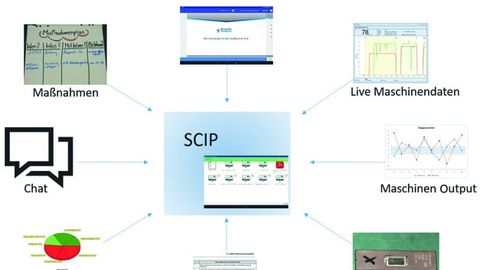
Schematic representation of communication automated by SCIP: All information is available on mobile devices at all times.
© Smartly SolutionsSpecifically, the Sintra solution marks the load carriers with an active transmitter. This can be localized to within a few centimetres using the system used. Information is posted to the transmitter (raw, semi-finished and finished material), making each load carrier a separate storage location. These storage locations are displayed via a mobile device (smartphone, tablet) or PC as a position in the room. The fact that the load carriers are linked to a material means that you know where a particular material is located. The search process is completely eliminated. The SCIP system, on the other hand, reduces waste in terms of communication. Compared to communication in administration, communication in production today is still archaic, i.e. determined by paper, shouting and hearsay. This is exactly where SCIP comes in - an app that enables communication from management to production and from production back to the responsible departments with minimal effort. This makes communication faster, works without media discontinuity and suddenly makes data available that was previously only available with a significant delay. In practice, it has been found that companies save over 10,000 euros per year for each substitution of a paper-based board.
Originally intended for SMEs, German DAX companies are now also testing the 'System as a Service' model for its potential applications in production and logistics. The starting points range from simple milk run optimization to 3D control of drones in warehouses.
However, these system solutions are not only used in industry itself. A number of hospitals are already using them to optimize their logistics processes.
Author:
Dr. Karsten Königstein is Managing Director of Smartly Solutions.


You might also be interested in
The first steps towards digitization
Real-time transparency in the material flow: this was the goal set by Miba when it set out to digitalize its internal logistics processes. But how successful was the close link between ERP and MES in the end? - A field report.
 read more...
How will the IoT change companies in 2020?
How will network technology in companies change in 2020? Axel Simon, Chief Technologist at HPE Aruba, takes a look into the crystal ball
read more...Digital twin revolutionizes maintenance
As virtual representatives of real machines, digital twins open up new possibilities for maintaining and servicing complex industrial plants and systems. A project report.
read more...You can't do without Edge and Swarm
The IoT has changed the requirements for processing data provided by machine sensors and actuators. This needs to happen as quickly as possible - preferably where the data is generated. Edge nodes and swarm computing systems take on this task.
read more...Online machine data under control
Turning huge amounts of data into valuable information - how can this smart industry approach be implemented? Linking PC-based controllers with Matlab and a cloud-based IoT analytics service can be a viable approach.
read more...From modeling directly into the PLC
Despite digitalization and I4.0, the technical functions in a process plant do not become simpler if you break them down to the smallest detail. Nevertheless, the high level of difficulty can be overcome by combining the right tools in the right way.
read more...Where are the new business models?
The necessary new business models are repeatedly cited as the hallmark of an Industry 4.0 environment. But to date, very few companies have seen any of this. Schneider Electric now has a few models up and running.
read more...Why predictive maintenance?
Investments in predictive maintenance systems are worthwhile in order to proactively detect damage. Not only does this increase the service life of a machine, it also opens up new business models for machine manufacturers.
read more...First customer projects via BaSys 4.0
The BMBF project 'Basissystem Industrie 4.0' expired at the end of June 2019. Together with NetApp and Objective Partner, Fraunhofer IESE now offers Industry 4.0 solutions with support and adaptation to customer systems on the basis of this project....
read more...