

60 years of the Elysée Treaty
Franco-German test
60 years ago, the former wartime enemies Germany and France signed the Elysée Treaty, a friendship for Europe. Recently, however, there has been quite a bit of friction between the neighbors. The anniversary now offers the opportunity for a new start.
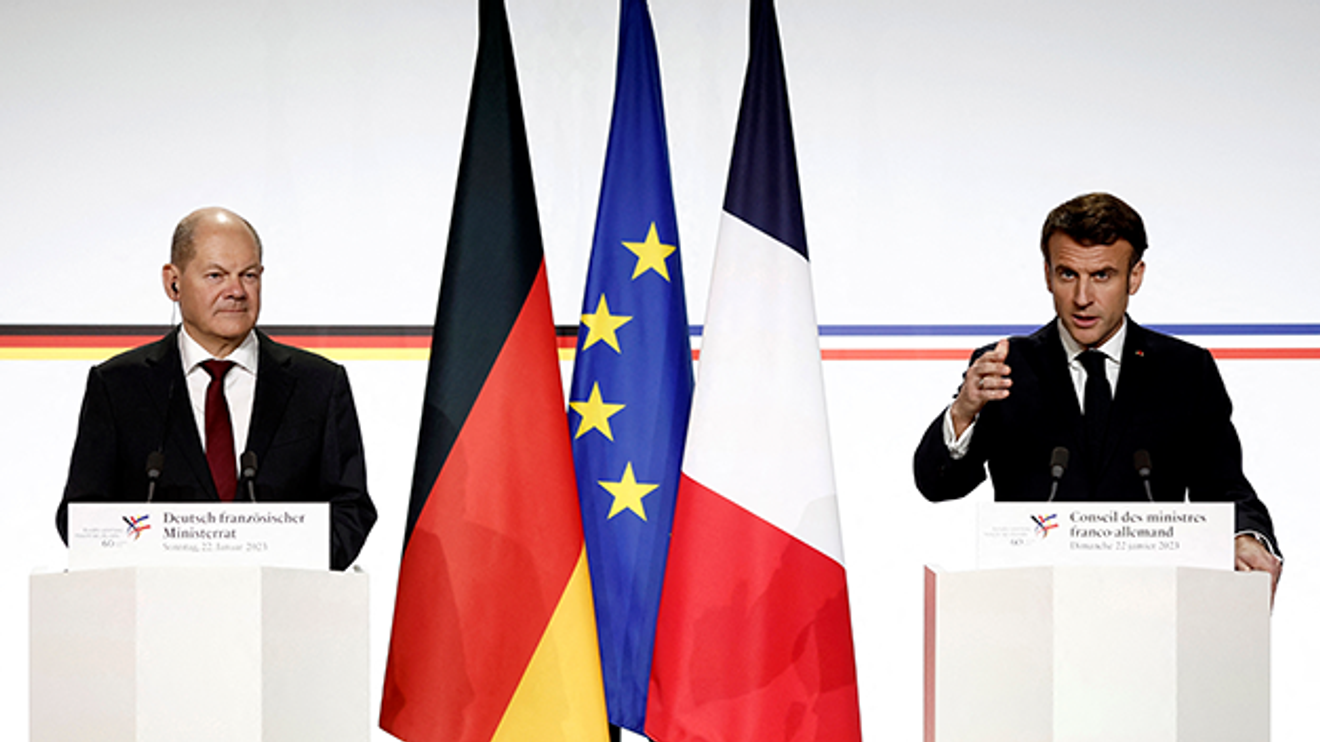
Germany and France want to move closer together again after considerable tensions in recent months. To this end, Federal Chancellor Olaf Scholz (SPD) and his cabinet set off for Paris on Sunday morning, where the consultations with the French government that were postponed in October will be rescheduled on a historic date. The Élysée Treaty was signed 60 years ago to reconcile the two former wartime enemies. It is still regarded as the basis for Franco-German friendship today.
To mark the anniversary, the two parliaments will hold a ceremony at the renowned Sorbonne University, which will be attended by the governments. At the subsequent joint cabinet meeting, the topics of economy and energy, security and defense as well as Europe will be on the agenda. The result should be a joint declaration outlining a vision for the future of Europe.
In a joint article for the 'Frankfurter Allgemeine Zeitung' and the 'Journal du Dimanche', Scholz and French President Emmanuel Macron wrote that they wanted to make the EU an "even stronger leading power of hope". "60 years after the signing of the Elysée Treaty, Germany and France are in agreement when they look at the fundamental questions about the future of Europe."
Battle tanks are likely to be a topic
Among other things, the discussions will focus on further support for Ukraine in its defensive battle against Russian aggressors. Scholz is being urged by Ukraine and several allies to clear the way for the delivery of Leopard 2 battle tanks. Because these tanks are produced in Germany, the German government has a right of veto over the transfer of these tanks from other countries. It therefore has a key role to play, but Scholz has not yet made a decision. It is also unclear whether France wants to send its Leclerc main battle tank to Ukraine.
Coordination between the two governments on arms deliveries to Ukraine has not been running smoothly of late. At the beginning of January, Macron pushed ahead with the decision on armored reconnaissance vehicles and infantry fighting vehicles and announced it one day before Scholz and US President Joe Biden.
Differences on dealing with the consequences of the war
However, Franco-German disagreements already existed before that when it came to dealing with the consequences of the war in Ukraine: last autumn, France disliked Germany's resistance to a European gas price cap and the German government's 200 billion euro program to cushion the impact of high energy costs. At the time, Macron accused Germany of isolating itself in Europe.
However, the head of the Munich Security Conference, Christoph Heusgen, sees responsibility for the tensions in Franco-German relations on both sides. "Certainly, the German side has not always been considerate of France. But France doesn't always act in a European way either," he told the German Press Agency.
The former foreign policy advisor to Chancellor Angela Merkel (CDU) is now hoping for a change for the better. "The important thing is that there is the political will to cooperate. And the anniversary of the Elysée Treaty is an excellent opportunity to clearly emphasize this to the outside world: Germany and France are aware of their historical responsibility to work closely together." In the face of global competition, Europe must function right now if it is not to be left behind. "If Germany and France do not agree, Europe will stagnate."
Consultations on US inflation law
The meeting of the Franco-German Council of Ministers was surprisingly canceled in October. The German side had justified this with an ongoing need for coordination. At the time, the Élysée Palace said that the important topics of defense and energy still needed to be discussed further. The economic part of the consultations will now focus, among other things, on cooperation in the field of energy, where both countries help each other out with supplies, and on the transition to a more climate-friendly economic system.
The handling of the US anti-inflation law, which provides for billions in investments in climate protection, is also likely to be a major topic. However, subsidies and tax credits are linked to companies using US products or producing in the US themselves, which is why there are fears of disadvantages for domestic companies in Europe. "We will strongly advocate an ambitious strategy to promote the competitiveness of European industry and a European environment that encourages competition and innovation," wrote Scholz and Macron in their joint newspaper article.


You might also be interested in
The barcode turns 50
In June 1974, a barcode was scanned on a product at a supermarket checkout for the first time. Experts expect the code to be replaced in a few years' time.
 read more...
France calls for action plan
In response to the controversial subsidy program for US companies, France wants the EU to relax its state aid and financing rules for companies.
read more...Saxony's first mobile quantum computer put into operation
The first comparatively compact, transportable quantum computer in Saxony and one of the first in the world to work at room temperature: A new 4-qubit quantum computer has been in operation at the Dresden branch of the Fraunhofer Institute for...
read more...Durabook at the Hannover Messe
AI-supported robust mobile computing solutions
Durabook, a provider of rugged mobility solutions and part of Twinhead International Corporation, is presenting its complete portfolio of ruggedized laptops and tablets to the German trade public for the first time at the Hannover Messe.
read more...Shusuke Aoki becomes CEO and Managing Director
Panasonic has appointed Shusuke Aoki as CEO and Managing Director of Panasonic Connect Europe (PCOEU), based in Wiesbaden, Germany.
read more...5G and Industrial Wireless Arena continues to grow
Next year, the three partners VDMA, ZVEI and Deutsche Messe will continue their collaboration at Hannover Messe 2025 as part of the special show "5G and Wireless Arena".
read more...Operation via touch, glove, pen or digitizer
Getac launches the next generation of 'F110' and 'K120' tablets: The new F110 is suitable for use in a variety of harsh outdoor and indoor scenarios.
read more...Edge rack server in robust
The trend towards hyper-convergent infrastructures is not stopping at the manufacturing and automation industry. Siemens has now launched the first edge rack server in robust industrial PC quality. How is the inner workings of the server designed?
read more...Embedded PC for Industry 4.0 and machine vision
The 'PicoSYS 1667' from ICO is an embedded PC equipped with an Intel 12th Gen Alder Lake CPU. It has a fanless design and is equipped with a wide range of interfaces.
read more...