

Beckhoff
AI training made easier
An evolutionary development every year, a revolutionary leap every five to seven years - this is how Beckhoff aims to secure its technological leadership. At Hannover Messe, the company from Verl also presented some technological highlights.

[Things are going well for Beckhoff: last year, the company increased its turnover by 16% to 1.75 billion euros. The technology leader invests part of this, namely around 90 million euros per year, in research and development. The company presented the results at the Hannover Messe, including further developments of TwinCAT and the MX-System automation system as well as a new generation of EtherCAT analog terminals.
Machine learning simplified
Everyone is talking about artificial intelligence. However, it is difficult for many companies to implement it profitably in an industrial environment - there is a lack of appropriate AI experts. Beckhoff has therefore set itself the goal of enabling everyone to successfully implement AI.
TwinCAT Machine Learning Creator from Beckhoff is aimed at automation and process experts and adds the automated creation of AI models to the TwinCAT 3 workflow. This allows users to handle the entire process, from data collection to the trained model, for themselves - without any AI expertise of their own. The finished model is optimally adapted to real-time requirements in the control environment in terms of latency and accuracy.
A prime application for the versatile TwinCAT Machine Learning Creator (TE3850) lies in AI-supported image processing for quality assurance. This, along with various other applications, taps into the ease and standardization of creating AI models for automation through our no-code development platform. It not only leverages open standards, interfaces, and best practices, but also provides the trained models in the open standard format ONNX. These latency-optimized AI models for control applications are specially adapted to run on Beckhoff IPCs and with TwinCAT products, although they can also be used as ONNX models beyond the Beckhoff product world.
With TwinCAT Machine Learning Creator offering fully automated AI model creation, the potential of artificial intelligence is now available to all - including smaller companies - offering a competitive edge and much-needed solutions for the growing shortage of specialist skills. And for seasoned AI experts, this solution serves to streamline their workload considerably while also minimizing the potential for errors. The ability to speed up project development processes offers yet another clear advantage, particularly as the development tool provides extensive and transparent methods for displaying the behavior of the models created and comparing them with each other. Users can also benefit from automated report generation, which supports auditing processes for AI model creation. Another crucial aspect is that the required application-specific data remains protected, since it does not leave the company.
New generation of terminals
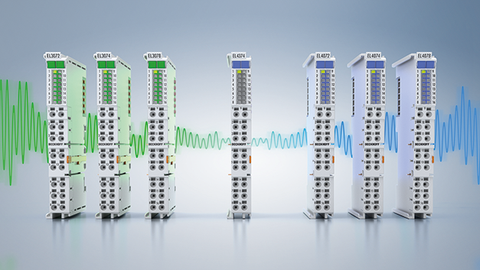
The new generation of EtherCAT analog terminals in HD (High Density) housing comprises seven terminals and covers a wide range of applications with up to eight channels and 16-bit resolutions. The new generation of analog terminals includes the EL4374, the first combined Beckhoff analog input/output terminal (10 V / 20 mA or -20/0/+4 to +20 mA) compatible with a conversion rate of 2 ksps per channel. The two inputs and outputs can be individually parameterized for current or voltage operation via TwinCAT (via CoE). With a technical measuring range of ±107% of the nominal range, this terminal also supports commissioning with sensor values in the limit range and evaluation in accordance with NAMUR NE43. The outputs can provide up to 107% of the nominal value, and the high output power allows a load of up to 750 Ω at 20 mA.
The same features are offered by the EL3072 and EL3074 analog input terminals, which now have 16-bit resolution (previously 12-bit) as 10 V / 20 mA universal inputs. The EL3072 is equipped with two individually parameterizable inputs, while the EL3074 has four. Another new feature is the EL3078 version, which facilitates the use of eight channels in the same compact HD housing. The higher resolution and expansion to eight channels have also been implemented for the analog output terminals, namely with the EL4072, EL4074, and EL4078.
Also suitable for DC

The MX-System is a uniform modular automation system that can be used to completely replace traditional control cabinets with function modules in many applications. This waterproof and dustproof system, which can be mounted directly on the machine, comprises a robust aluminum baseplate with integrated module slots, featuring EtherCAT for data communication and integrated distribution for different voltages. Its extensive portfolio of function modules includes the mains connection, drives, power supplies, industrial PCs, and I/Os. Boasting all of these features and more, the MX system easily covers the full range of functions of conventional control cabinets.
The function modules can be easily attached to the baseplate and simply screwed into place. This eliminates the need for any mechanical assembly of the control cabinet and its mounting plate, not to mention time-consuming manual wiring. All of this is directly reflected in the time required to set up the MX-System: including the necessary tests and checks, an MX-System can be set up in just one hour, in contrast to at least 24 hours for a comparable control cabinet. In this way, the MX-System also counters the shortage of skilled workers, as individual employees are less tied to a single task and can move on to the next project in no time. A further advantage is the straightforward pluggability of the function modules, which means they do not need to be connected by specialized electricians - a real bonus for companies lacking the necessary expertise in this area.
A notable application scenario involves the use of a higher-level DC power supply. The DC supply for complete production halls is based on the strategy of providing electricity from renewable energies (e.g., photovoltaics) in combination with storage technologies for machines and systems as a mains voltage of 600 V DC. The MX-System is already designed to be DC-ready in that it can distribute DC voltages and also be used directly for protective extra-low voltage power supply lines or modules for controlling synchronous and asynchronous motors. By facilitating the continuous use of DC voltage, it offers the major advantage of buffering the braking energy of the motors in the storage units of the DC networks rather than losing it through braking resistors. This possible use of the MX-System is already being implemented in a trial project.


You might also be interested in
The e-paper of issue 07/2024
Read in the current issue of Computer&Automation how ChatGPT can provide support in the conception phase, how LLMs are used in code analysis and whether TSN can be considered as a backbone for virtualized control systems.
 read more...
Consistent multicore and multitask support
Beckhoff relies on consistent multicore and multitask support in its current 'TwinCAT MC3' Motion Control generation. Thanks to its modular architecture, axes implemented with 'TwinCAT NC2' can also be seamlessly integrated.
read more...Consistent Multi-Core and Multitask Support
Beckhoff relies on consistent multicore and multitask support in its current 'TwinCAT MC3' Motion Control generation. Thanks to its modular architecture, axes implemented with 'TwinCAT NC2' can also be seamlessly integrated.
read more...Beckhoff simplifies AI training
An evolutionary development every year, a revolutionary leap every five to seven years - this is how Beckhoff aims to secure its technological leadership. At the press conference, the company from Verl also presented some technological highlights.
read more...HANNOVER MESSE DAILY Day 4
The top news from the fourth issue: Robert Habeck at the trade fair tour +++ Technological AI highlights from Beckhoff +++ Radar sensor technology in focus at Pepperl+Fuchs +++ ASi-5 counter module as an active distributor from Bihl+Wiedemann +++...
read more...These are your winners!
We put 96 products in twelve categories to your vote in December, and now the winners have been chosen! The trophies were presented at a 'Winner's Dinner' at the Seehaus in Munich. These are your "Products of the Year 2024"!
read more...Embedded Computing & IPC - The winners
A 'classic', a 'scene product' and a 'pragmatic approach' convinced the readers of Computer&Automation in the 'Embedded Computing & IPC' category.
read more...Drive technology - The winners
In the 'Drive Technology' category, a product with a very top target group came out on top.
read more...A prototype in four days
The 'Smart Green Island Week' brought together 1,000 technology enthusiasts on Gran Canaria to promote sustainable digitalization and encourage young STEM talent. For one week, the capital Las Palmas was transformed into a laboratory for...
read more...