

VDMA
Warning against the compartmentalization of global supply chains
Germany's prosperity is crucially dependent on the international division of labor. The VDMA warns that isolating global supply chains in the wake of the coronavirus crisis will harm everyone.
The IMPULS Foundation of the VDMA has commissioned an expert report from the Kiel Institute for the World Economy (IfW Kiel), which runs through a scenario in which the EU is sealing itself off more strongly through the use of so-called non-tariff trade barriers, i.e. through regulations or production standards that make market access more difficult for foreign suppliers, in order to achieve a relocation of foreign value-added steps. The result: If Germany makes cooperation with foreign suppliers more difficult in response to the coronavirus crisis, for example to make supply chains supposedly more resilient by bringing back value-added steps from abroad, this has massive disadvantages for everyone involved.
"The coronavirus crisis has shown the vulnerability of international supply chains. Drawing the conclusion that bringing production back to the home countries is extremely expensive and therefore the wrong approach," says IfW President Gabriel Felbermayr. "It would be more expedient to improve the resilience of the economy, for example through greater diversification with regard to suppliers, increased warehousing or the expanded use of recycling. A very restrictive due diligence law would be rather counterproductive. "
The effects of a lockdown in detail
The report's calculations are based on the assumption that Germany or the EU doubles these hurdles. According to the calculations, such a lockdown would lead to an annual decline in real income of 3.3% in Germany. Measured against German gross domestic product in 2019, income would therefore be €114 billion lower.
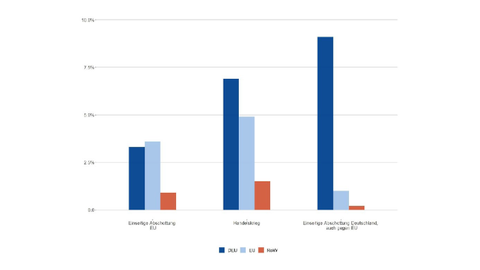
The chart shows the real income losses in Germany, the EU and the rest of the world as a percentage. (Note: Average of all affected countries, weighted by GDP. EU without Germany. RoW stands for Rest of the World. Source: IfW-Kiel's own calculations).
© IfW graphicIf there is a trade war and foreign countries react as expected with retaliatory measures, income will fall by as much as 6.9%. If Germany even seals itself off from other EU countries, gross domestic product is permanently 9.1% below the level without additional trade barriers year after year.
Income also falls in the rest of the EU and worldwide in all three cases. This is particularly clear in the case of retaliatory measures. Real income in the EU (excluding Germany) then falls by an average of 4.9 % and worldwide by 1.5 %.
German mechanical engineering would suffer disproportionately
The mechanical engineering sector in Germany sources almost 43% of its primary products either directly or indirectly from abroad. Due to this strong international interdependence, it would suffer disproportionately from a lockdown, around three times more than the German economy on average. Its production would fall by 14.3% annually if the EU were to impose a lockdown and by 19.5% if foreign countries were to respond with retaliatory measures. This would correspond to a loss of turnover of around 50 billion euros. If Germany also unilaterally seals itself off from the EU, production in the mechanical engineering sector will fall by 25%, which corresponds to a good 60 billion euros less turnover.
"The German economy will lose out if we try to turn back the clock on globalization," says Henrik Schunk, Chairman of the Board of Trustees of the IMPULS Foundation and Vice President of the VDMA. "Germany's business model in general and the mechanical engineering industry in particular is based on open borders, exchange and networking. These are the guarantees of success that we must preserve for our technological leadership and global market success."
High legal risks
According to the IfW, a due diligence law that would expose companies to high legal risks when selecting suppliers would counteract efforts to improve supply security. "This would make it more difficult for companies to diversify their supplier network. This would make it less crisis-proof and more expensive. The law should therefore be designed in such a way that security and prosperity are not jeopardized," says Felbermayr.
"Companies should only be held responsible for their own misconduct in their obligations and not for the responsibilities of states and a confusing chain of suppliers across several levels. In any case, civil liability in Germany for the misconduct of independent third parties abroad must be prevented. Increased bureaucracy and national solo efforts must be avoided," says Schunk. "With this in mind, the VDMA is happy to participate in the industry dialog with the German government."
Everyone involved loses out due to supply chain compartmentalization
Study author Alexander Sandkamp emphasizes: "Without an international division of labour, all trading partners end up poorer and the cake we can distribute becomes smaller. Weaker growth also affects people who receive social benefits or state transfers such as pensions, unemployment benefit or child benefit. Savings would probably also have to be made in the healthcare system."
It is true that a lockdown in Germany and the EU could slightly mitigate the consequences of a production shock in supplier countries, such as that caused by the coronavirus crisis, and the economy would possibly slump somewhat less severely. Albeit from a much lower level. As a result, even after a shock, an isolated German economy would be in a much worse position than with free trade.
Diversification through free trade reduces economic risk
In addition, there are fewer opportunities for adjustment in a regional economy, meaning that conceivable domestic shocks to the domestic economy have greater negative effects on welfare than in the case of international diversification through free trade. Furthermore, not every good can be produced locally in a regional economy. Dependencies on individual primary products and raw materials therefore also remain in a world of limited trade.


You might also be interested in
Companies are held accountable
From 2023, companies are to be held liable for violations of human rights and environmental standards by suppliers if due diligence obligations are neglected. It is about exploitation and child labor in global supply chains.
 read more...
Restriction of air traffic harms the economy
Germany's mechanical engineering companies have warned of far-reaching restrictions on air traffic and stricter border controls.
read more...More predictable trade policy expected
The Senate elections in Georgia have been lost in the chaotic scenes from the US Capitol. However, they are an important success for President-elect Joe Biden. The VDMA now expects a more predictable trade policy.
read more...Members expect sales growth in China
Mechanical engineering companies have different assessments of the BRIC countries' economic recovery from the coronavirus pandemic. However, many in China are expecting sales growth in 2020.
read more...Industrial AI and Manufacturing
Siemens and IFS Bridge the Gap Between Planning and Operations
Siemens and IFS are collaborating to use industrial AI to enable a closed-loop digital twin across the entire plant lifecycle. The goal is to more closely link design data with real-world operational information and optimize industrial processes.
read more...Collaboration on Open Energy Standards
Weidmüller Joins the EEBus Initiative
Weidmüller has joined the EEBus Initiative. Together, they aim to further promote the international EEBus communication standard for smart grids and intelligent energy management.
read more...ebm-papst is growing again thanks to AI and data centers
ebm-papst returned to a growth trajectory in fiscal year 2025/26. Air Technology, data center applications, and artificial intelligence are driving revenue and investments.
read more...Keysight Acquires VPIphotonics
With the acquisition of VPIphotonics, Keysight Technologies is expanding its software portfolio for photonics development. Going forward, these solutions will cover the entire design process, from component physics to the simulation of complete...
read more...Qualcomm Acquires AI Specialist Modular
Qualcomm is acquiring the AI software company Modular. The goal is to expand an open software platform for generative and agent-based AI in edge, cloud, and data center environments.
read more...