

WSS research prize for RWTH Aachen University
100 million Swiss francs for sustainability research
A team from RWTH Aachen University came out on top in the Werner Siemens Foundation's ideas competition and won 100 million Swiss francs for research into technologies for the sustainable use of resources.
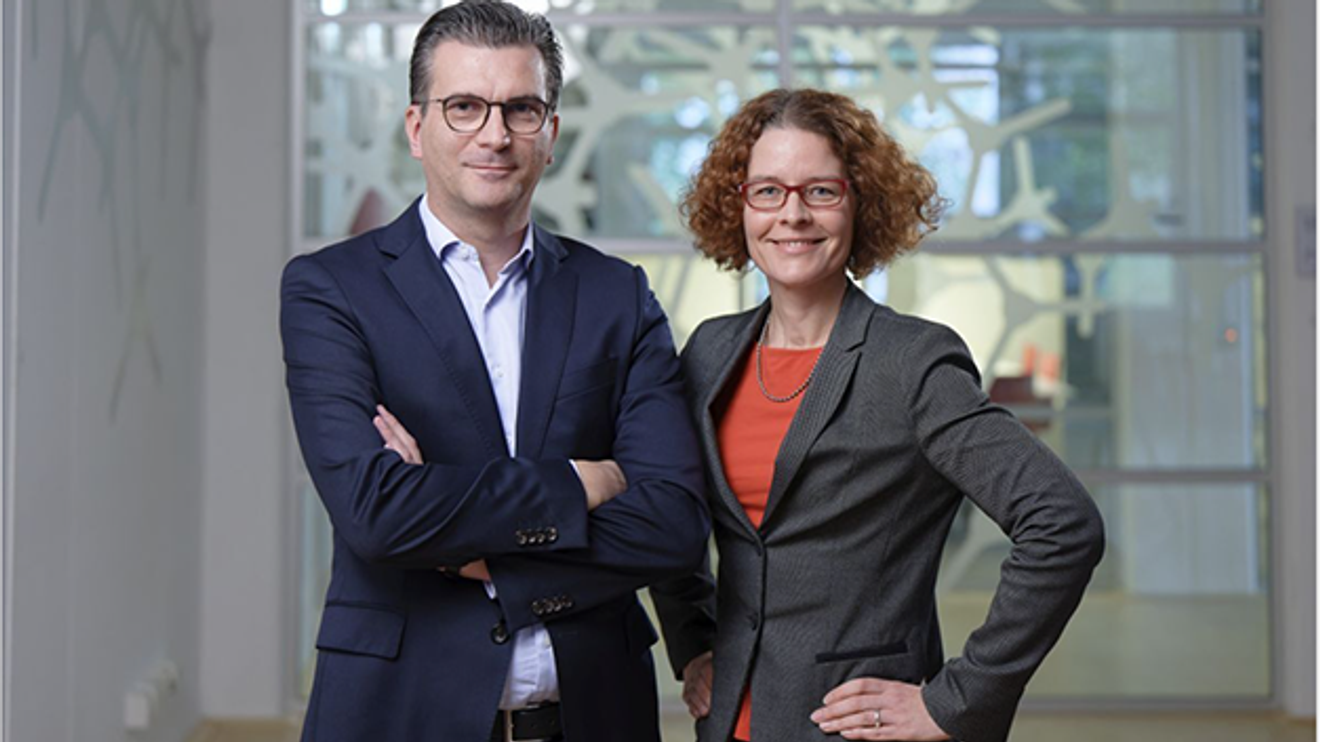
The Werner Siemens Foundation, WSS for short, based in Zug, Switzerland, organized an ideas competition to mark its 100th anniversary. A team from RWTH Aachen University won the competition. The team led by Professor Jürgen Klankermayer from the Chair of Translational Molecular Catalysis and Professor Regina Palkovits from the Chair of Heterogeneous Catalysis and Technical Chemistry came out on top against 122 other ideas from Germany, Austria and Switzerland with their project "catalaix: Catalysis for a circular economy". In future, they will develop catalysis-driven recycling processes in a WSS research center that will enable a multidimensional circular economy. The WSS is providing the center with a total of 100 million Swiss francs for a funding period of ten years.
With the equivalent of around 93 million euros, the researchers at RWTH Aachen University and Forschungszentrum Jülich will use the funding from the Werner Siemens Foundation to establish a research center that will pave the way for a circular chemical industry. The research work will focus on catalysis - the technology that increases the speed of chemical reactions or makes them possible in the first place. Catalysts help to create the starting materials for a variety of products that are essential to our daily lives. However, the majority of these products still end up as waste at the end of their life. The team led by Klankermayer and Palkovits wants to change this by using newly developed catalysts and processes to break down such products into recyclable molecular building blocks. "Until now, chemists have mostly been looking for new catalysts that form bonds," explained Klankermayer. "But we also need catalysts that break bonds, and we have to think about recycling at the same time when manufacturing future products."
First focus on plastics
The focus of "catalaix" is initially on the plastics sector. Every year, 400 million tons of plastic are produced worldwide, and this could rise to 16 gigatons by 2050 - that's how much all humans, animals and fungi on earth weigh together. Currently, only nine percent of all plastics are recycled, such as PET bottles, which are shredded and molded into new PET bottles. However, such one-dimensional cycles are not suitable for a holistic approach, says Regina Palkovits. "Different plastics are produced in different quantities, and their lifespan varies: packaging has to be reintegrated into the cycle after perhaps half a year, while building insulation only after 30 years." The Aachen team will convert plastics into reusable raw materials by combining chemical, electrochemical and microbial catalysis processes. They have already demonstrated that this can work for various classes of plastics.
However, their idea goes beyond individual and isolated material cycles. They plan to further develop the circular economy according to the 'open-loop principle'. This means that the molecular building blocks created through recycling can be used in a variety of ways and can be fed into other value chains and material cycles as required. This creates the basis for a flexible, multidimensional circular economy.
Jürgen Klankermayer and Regina Palkovits are supported by the core team consisting of Professor Lars Blank (Chair of Applied Microbiology), Professor Alexander Mitsos (Chair of Systems Process Engineering) and Professor Grit Walther (Chair of Operations Management). The "catalaix" team consists of twelve other professors from RWTH Aachen University and the FZJ in order to cover the complexity of the problem from catalysis to the process to the system view.
The Werner Siemens Foundation supports long-term and well-funded scientific projects and is financing its largest research project to date with "catalaix". "We would like to launch a special project to mark our anniversary and make a contribution to the sustainable use of our planet's resources," said Dr. Hubert Keiber, Chairman of the Board of Trustees. "We are convinced that we will succeed with the support of the 'catalaix' project."


You might also be interested in
ERP system as an enabler
In large parts of the economy, new regulations trigger a Pavlovian reflex of rejection. This also applies to measures aimed at climate protection. The manufacturing industry in particular has an enormous task ahead of it in this respect.
 read more...
Motivation boost through research allowance
The research allowance is a success story in mechanical and plant engineering. This was the conclusion of a VDMA study. The Growth Opportunities Act could even increase the effect.
read more...Clamp with plastic made from recycled waste materials
The '221 Series' connection terminal block from Wago is now also available with green levers - this variant is partly made from biocircular and recycled plastics.
read more...Raw materials lying dormant in the drawer
According to Bitkom, around 210 million old cell phones were stored in German households last year. This means that 87% of people had at least one discarded cell phone. This figure has more than doubled since 2015.
read more...Recycling initiative expanded
Igus is expanding the 'Chainge' recycling initiative launched in 2019. In future, users will not only be able to have energy chains recycled, but also other technical plastic components. It will also be possible to purchase recycled material.
read more...Chemical recycling plant planned in Germany
Mura Technology, a partner of the Cologne-based company Igus, is planning the first chemical recycling plant in Germany: up to 120,000 tons of plastic waste per year are to be recycled back into crude oil in Böhlen, Saxony.
read more...More recycled plastics in electronics products
The Strategy for Plastics was adopted in 2018 as part of the EU Circular Economy Action Plan: Its aim is to increase the proportion of recycled plastics in new products. The Increace project has set about implementing it.
read more...Check with Michael Blass, Igus
The plastic recycler
Igus launched the 'green chainge recycling program' at the end of 2019. Michael Blass reveals how this recycling program for plastic energy chains and drag chains has proven its worth.
read more...The e-paper of issue 1/2-2024
Distributors can help to master the three megatrends of electrification, automation and digitalization. The service providers explain how in this issue. Our new article series "ChatGPT in the industry" also starts in issue 1/2-2024.
read more...