

Servo drive technology
Dynamic handling efficiently realized
The automation of transport and handling tasks is an essential prerequisite for further increasing the efficiency of modern production systems. Dynamic, precise and compact systems can be realized based on servo drive technology.

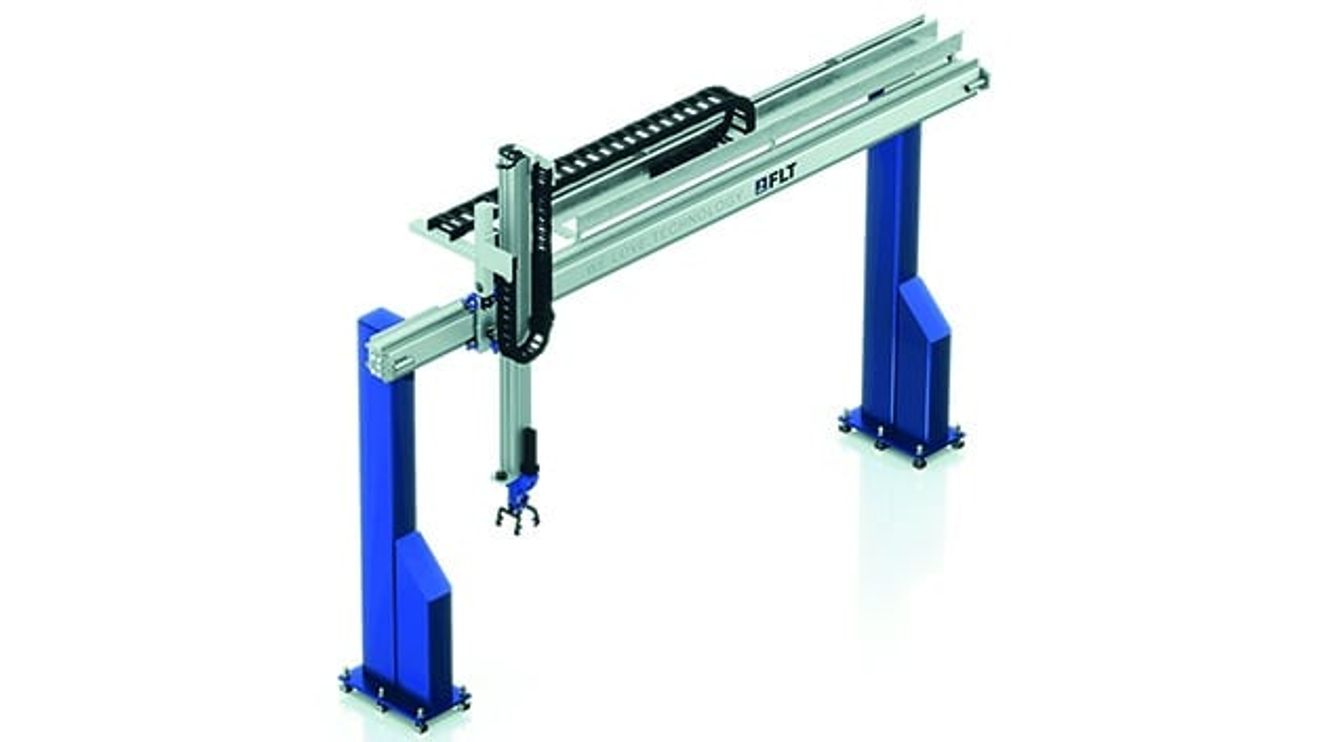
Fibro Läpple Technology (FLT), based in Haßmersheim north of Heilbronn, specializes in the intelligent interlinking of systems and robot-supported processing cells, which are used not only in the automotive industry but also in sectors such as aviation and general industry. For transport and handling tasks such as machine or press loading, the company has developed a modular system that can be used to implement various sizes of highly dynamic gantry robots and axes.
In the course of development, FLT was confronted with various challenges: The axis and gantry system was to cover a wide range of industrial applications or form the basis for applications in the loading and unloading of machines, machining centers and parts transfer as well as the transport of devices, tools or machining systems within production and logistics. The various planned sizes should cover payloads of up to 3000 kg, horizontal travel distances of over 100 m and vertical strokes of up to 3 m. And all this at a horizontal speed of up to 4.5 m/s and accelerations of up to 6 m/s², or up to 2 m/s vertically with an acceleration of up to 4 m/s². Finally, stand-alone solutions should be just as possible as inline integration. As a result, a high level of standardization, reliability and precision was required.

View of the vertical axis drive of the linear gantry robot LGR from FLT, which was assembled from the new modular system. The system can transport loads of up to 1500 kg and has a stroke of up to 40 m per carriage.
© SEW-EurodriveUltimately, FLT implemented the modular gantry system based on drive technology from SEW-Eurodrive: In addition to the Movi-C modular automation system from the Bruchsal-based company, its CM3C servomotors and PxG planetary gearboxes are also used. FLT requires several motor sizes for the portal, each with adapted torques. For example, CM3C100L motors with a continuous standstill torque of 39.6 Nm are used for the travel axis and a space-optimized CM3C80L with a continuous standstill torque of 22.8 Nm for the lifting axis.
With the CM3C servomotor series, SEW has supplemented the existing CMP series with higher inertia motors. The CMP is the 'sprinter', so to speak, which was developed for extremely dynamic applications with low mass inertias and an overload capacity of up to three times the nominal torque. The CM3C, on the other hand, has an almost doubled mass moment of inertia due to the increased rotor diameter and therefore offers control-related advantages in applications that are themselves characterized by high moments of inertia or large moving masses. This motor series is available in sizes 63S to 100L and continuous standstill torques from 2.7 Nm to 40 Nm.

FLT design manager Boris Bind checks the control cabinet with the drive and control components from the Movi-C modular automation system.
© SEW-EurodriveAnother feature of the CM3C motor design is the significant increase in the corner speed. Depending on the motor size, it can reach up to around 5000 rpm, allowing maximum acceleration to be maintained up to this speed range. Boris Bind, Head of Design at FLT, confirms this: "The dynamic reserves of the CM3C motors allow us to further reduce the cycle times in our portals." In addition, when designing the motors, care was taken to ensure that the drive remains quiet even when used on 4 kHz axes, so that no unacceptable noise levels are generated even when operating many motors on one system. This was achieved thanks to the special electromagnetic design with a pole-to-groove ratio that reduces harmonics.
The motors can be adapted to the respective application via various options. For example, in addition to the servo-type 24 V holding brake, a spring-applied brake with increased working capacity is available as an option. Compared to the standard servo holding brake, its working capacity is several times greater. This offers more safety reserve, especially for hoist applications, so that an emergency failure can be safely controlled without having to replace the brake. In addition to the standard resolvers and Hiperface encoders, the new Movilink DDI single-cable system is used as the motor encoder. This not only halves the amount of cabling required. In contrast to conventional systems on the market, it also offers a range of additional functionalities. For example, the digital protocol used is not only used to transmit encoder information and motor temperature. It can also be used in future to digitally control the brake and implement condition monitoring of the drive via status information.
In addition to its own encoder systems, SEW has also introduced other encoder systems with the CM3C. As an alternative, the motors can also be equipped with Hiperface DSL, Endat2.2 and DriveCliq encoders. This allows the user to use the motors with standard industrial controllers, which are also used at FLT.
The advantages of single-cable technology
The Movilink DDI single-cable technology allows easy commissioning of the servomotors. Previously, manual configuration had to be carried out using a laptop and software tools, or at least the electronic nameplate had to be read in. Today, the motor automatically logs on to the frequency inverter after connection via the aforementioned interface and the system takes care of all the necessary configuration steps. Existing controller settings are retained. This means that the drive can be restarted quickly, particularly when servicing is required, as in principle only the mechanical installation and electrical connection need to be carried out.
Last but not least, the CM3C servomotor series is perfectly matched to SEW's standard gear units. This provides the user with various output and transmission variants - spur, parallel shaft, bevel, worm or spiroplane gear units. For the lifting axis, FLT relies specifically on bevel gear servo geared motors. Thanks to their compactness and flexibility, they can be optimally integrated into the system. In addition, the CM3C motor is suitable for combination with the new PxG servo planetary gearboxes. FLT therefore uses this 'duo' in the travel axes of the gantries, for example.
The smart drive

Michael Gutman, SEW-Eurodrive: "The aim must be to offer the same simple and flexible integration of digital products on one platform, analogous to today's multiple integration and adaptability of physical drive systems."
© SEW-EurodriveThe Industrial Internet of Things (IIoT) requires smart components that can be digitally networked and record, process and communicate statuses. Michael Gutmann, Head of the Product Solution Center - DriveRadar department at SEW-Eurodrive, explains how drive technology fits in here.
Mr. Gutmann, where does drive technology stand today when it comes to IIoT?
Michael Gutmann: Today's drive and automation systems have mostly been optimized for their core functions and associated communication integration. Mechanical and electromechanical products are often not yet equipped with sensors and cannot be networked. Although vibration or temperature sensors, for example, can be retrofitted here, external sensors often lack any product or system-specific information that would make data interpretation - for example from a digital twin - simple and easy.
How can this shortcoming be remedied?
Michael Gutmann: As far as SEW-Eurodrive is concerned, under the umbrella brand 'DriveRadar' we offer value-added smart products that provide additional benefits in the area of condition monitoring and predictive maintenance. To this end, we are first equipping the electromechanical products completely with the Movilink DDI digital interface - right down to the servo geared motor. Movilink DDI is a fully digital (PtP) interface between motor and inverter. It is mechanically and electrically robust as fully integrated coaxial technology and allows connections of up to 200 meters. Information is transmitted between all participants - i.e. brakes, nameplate, encoders, sensors, etc. - using SEW's own 'Datastream' transmission protocol.
The digital interface connects the frequency inverter and motor to form a smart system. This system is available for all our motors and is aimed at all applications - with just one cable and one connector system. This significantly simplifies integration into IT systems because the type plate data and the digital interface are used for plug-and-play auto-commissioning when connecting, i.e. without user intervention.
What does further development look like?
Michael Gutmann: In a further expansion stage, the optional DriveRadar sensor board turns the geared motor into a sensor unit on the application. Sound, magnetic field, vibration, temperature, humidity and so on are then available digitally with a CPU pre-processing unit in the geared motor using the board's services. This enables, for example, the direct calculation or detection of the spatial position of the motor in relation to the project planning, the detection of bearing damage or the monitoring of mechanical overload values. In a final stage, transmission sensors can be connected to this unit, for example for the oil temperature or oil condition. This makes it possible to calculate oil ageing directly in the geared motor.
The first customer pilots are planned for the first half of 2020 in order to better coordinate the requirements and technical implementation. This will be followed by an initial product release - whereby the focus here is only on the hardware to a limited extent, but rather on making the functions available and integrating them into the user's systems.


You might also be interested in
Portfolio expansion for DC motors
Faulhaber has several new additions to its range of DC micromotors: the GXR 1437 family of motors with copper-graphite commutation and the SXR 1424 and SXR 1437 motors with precious metal commutation.
 read more...
Danijel Sesar takes over the management of Stöber Switzerland
Since August 1, Danijel Sesar, as Managing Director of the local subsidiary, has been tasked with establishing the drive specialist Stöber as a strategic partner in the Swiss mechanical engineering sector.
read more...Dual leadership in Shanghai
Stefan Becker has been appointed Managing Director of Eckelmann Automation Technology in Shanghai and will manage the subsidiary together with Zhongwei Huang.
read more...Efficiency of 99.13 % achieved
ABB says it has set a new benchmark in the energy efficiency of large synchronous electric motors. A motor developed for a steelworks in India achieved an efficiency of 99.13% in tests, surpassing the previous ABB record of 99.05%.
read more...Clemens Maier takes over industry sector management
Clemens Maier is taking over the management of the industrial sector at Bachmann electronic. The 41-year-old automation expert is following in the footsteps of Leopold Matouschek, who will focus entirely on the management of the subsidiary Bachmann...
read more...ABB achieves expected IE6 hyper-efficiency
ABB claims to be the first company to achieve the expected efficiency class IE6 with its magnet-free synchronous reluctance motor design. According to ABB's definition, this has 20 percent less energy losses than comparable IE5 motors.
read more...Integrated measurement technology for condition monitoring
There are new variants of the high-precision motor feedback system 'EDS/EDM35' from Sick. Variants with additional sensors for monitoring vibration behavior and humidity supplement the standard variants.
read more...Hollow shaft rotary table for high torques
Hollow shaft rotary tables from Oriental Motor's 'DGII' series are now also available in combination with the servomotors from the 'AZX' series for high torques in the upper speed range.
read more...For predictive maintenance
According to the manufacturer, the new incremental encoder from Oriental Motor is particularly suitable for use in predictive maintenance thanks to its precision in measuring speed, position and direction of rotation.
read more...