

Functional safety
Locking with need for clarification - help with risk assessment
DIN EN ISO 1419 has already been available for five years. However, there are always uncertainties regarding the actual safety functions of a guard locking device, which the machine manufacturer must evaluate based on his risk assessment. Here is some help.

The danger zone of machines and systems is often protected by guards that prevent access and, in some cases, protect people and machine operators from hazards such as flying parts or coolants. The necessary access to this area is usually provided by movable guards or safety doors. Opening such a safety gate must lead to a safe state of the machine so that people can safely enter the danger zone or reach into it.
The position of the safety gate must therefore be monitored. This position monitoring using a position switch initiates an immediate stop of hazardous movements, for example, via the machine control system as soon as the safety gate is opened. In addition to this safety function 'immediate shutdown' when a safety gate is opened, such position monitoring systems also have the safety function 'protection against unexpected start of the machine in the event of an open safety gate'. A machine may therefore only be started when the safety gate is closed again. Position switches used for position monitoring are referred to as interlocking devices in the DIN EN ISO 14119 standard.
Machines and systems where it is not possible to switch off a hazardous movement immediately - for example machines with overtravel movement - must be equipped with interlocking devices with a locking function on the safety door. DIN EN ISO 14119 describes this device as 'interlocking devices with guard locking function'. However, the term 'interlocking' is often confused with 'guard locking'. What is meant here, however, is the interlock in the electrical part of the machine's control system. The 'guard locking' element holds the door in the closed position by means of a locking device or electromagnetic forces.
But what about the actual safety functions that the machine manufacturer must evaluate based on his risk assessment?
The safety functions
First of all, the designer of a machine must consider whether guard locking is necessary on a safety guard. The standard provides sufficient information on this - in the following wording: "If the stopping time of the entire system is greater than or equal to the access time required by a person to reach the danger zone, an interlocking device with guard locking must be used. The access time must be taken into account from the distance between the danger zone and the guard together with the approach speed. The approach speeds of the person as well as the reaction times of the control system must be taken into account.

The 'AZM300' solenoid interlock from Schmersal offers a guard locking system in the form of a turnstile. This means that the guard locking can be approached from three sides, which ensures universal applicability.
© Schmersal GroupGuard locking is often used for process protection. In this case, guard locking is only used to protect against interruptions to the work process; the control of guard locking only plays a subordinate role. Therefore, in this application, only the interlocking part of the guard locking is considered in terms of safety and integrated into the safety circuit.
In principle, an interlocking device with guard locking consists of two 'parts', which must be considered individually and integrated into the safety circuits of the control system in accordance with the risk assessment. Here there is in
DIN EN ISO 14119 refers to 'Control systems according to ISO 1389-1 or IEC 62061'.
Electromechanical safety switching devices - even if they are part of a guard locking device - can achieve a maximum Performance Level (PL) d individually (including fault exclusion) (in accordance with DIN EN ISO 13849-2; Table D.8). For PL e, a second switch must be fitted to the safety guard for reasons of redundancy. For non-contact interlocking devices (DIN EN 60947-5-3, PDDB-Requirements for proximity devices with defined behavior under fault condition), use up to PL e is possible. The manufacturer's specifications must be observed.
An entire chapter in the DIN EN ISO 14119 standard is dedicated to the topic of guard locking control.
Chapter 5.7 of the standard describes the use, design, monitoring, additional unlocking functions and other requirements for guard locking devices. Particular attention must be paid to the topic of 'unlocking the guard locking' with regard to the performance of the guard locking. This is a safety function that is considered as part of the risk assessment and must fulfill the required PLr or SIL as part of the safety-related control system (SRP/CS). This PLr or SIL depends on the application-specific risk assessment and may well be lower than for the interlocking device. All parts of the device for unlocking/locking the guard locking (control signal) are considered safety-related parts of the control system, including the mechanical parts. The question often arises as to whether two guard locking devices must be used for PLe or SIL 3. An answer to this can be found in DIN EN ISO 14119 in chapter 8.4; note 2: "The probability of failure of the guard locking function and the simultaneous access of a person is very low. For the guard locking function, fault exclusions for the mechanical parts are also possible in the case of PLr e (see ISO 13849-2:2012, Annex A); ISO 13849-2:2012, Table D.8, does not apply here to guard locking devices, as D.8 only applies to the interlocking devices part".
This means that in order to be able to justify this fault exclusion for the mechanical part, the guard locking devices must be tested according to the criteria specified in the standard and withstand them. Manufacturers of interlocking devices with guard locking specify the locking forces in the data sheet and on the product rating plate. The machine manufacturer must specify which guard locking device with which locking force is actually required for the safety gate.
Other important points that repeatedly lead to confusion are the control (unlocking) and position monitoring of the guard locking solenoid (locking device). It goes without saying that a machine equipped with an interlocking device with guard locking can only be started when the safety guard is closed and locked. It is therefore necessary to check the position of the interlocking device as well as that of the locking means of the guard locking. Commercially available guard locking devices are equipped with fail-locking protection. Fail-safe means that by connecting the locking means to a contact, it is possible to monitor both the position of the locking device and the guard locking with a single device. Only when the actuator is inserted into a guard locking device do the locking means and the locking device take effect. A start release can take place.

With two-channel control, a fault exclusion for the locking device of the guard locking can be assumed due to safe external energy isolation. This means that only the external safe energy cut-off determines the safety level of the unlocking function.
© Schmersal GroupUnlocking the guard locking is part of the risk assessment. This is intended to prevent guard locking from unlocking in the event of a fault and thus allowing access to the hazardous movement. As unlocking is usually initiated from the control section of the machine in commercially available guard locking devices, this section is a safety function if required by the risk assessment. The safety chain must be designed accordingly. This includes the detection of the standstill in the control section (standstill monitoring, time delay, position monitoring, etc.), the processing of the logic signals and the control of the guard locking (single or dual-channel).
The performance of a guard locking device therefore does not depend on the guard locking alone. Rather, both the control section and the cable routing are decisive. In the case of two-channel control, it can be assumed that the locking device of the guard locking is fault-free due to safe external energy isolation. In this case, the locking device of the guard locking does not contribute to the probability of failure of the unlocking function. The safety level of the unlocking function is therefore determined exclusively by the external safe energy cut-off.
If guard locking is controlled via a single channel, a maximum of PL d/ SIL 2 can be achieved for this safety function.
The devil in the detail
In principle, the functionality and use of an interlocking device with guard locking for monitoring the position of a safety gate are quite easy to understand. However, the devil is often in the detail here too. It is therefore generally recommended to study the main standards and their requirements when using interlocking devices or interlocking devices with guard locking. It is also possible to call in external support: For example, the experts at tec.nicum, Schmersal's service division, offer manufacturer-neutral advice on this.
Author:
Frank Schmidt is Head of Standards, Committees and Association Work at Schmersal in Wuppertal.
The DIN EN ISO 14119
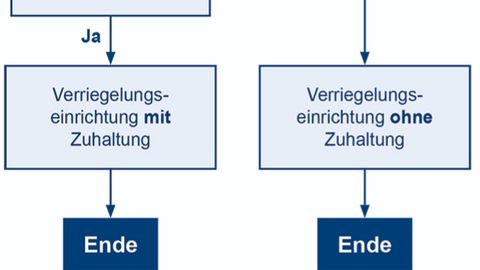
In accordance with DIN EN ISO 14119, interlocking devices with a guard locking function must be used on machines and systems where it is impossible to switch off a dangerous movement immediately - e.g. machines with overrunning motion.
© Schmersal GroupDIN EN ISO 14119, published in 2014 as a type B2 standard in accordance with ISO 12100, is primarily aimed at the manufacturer or integrator of machinery, as the subtitle of the standard "Guidelines for design and selection" makes clear. At the same time, however, it also addresses the manufacturer of safety switching devices, as it was necessary to formulate requirements for these safety components as part of the standardization process, insofar as there are no product standards for guard locking devices, for example. In addition, there are machine manufacturers who design interlocking devices for their safety doors themselves or purchase interlocking devices and expand and use them with their own guard locking components. This standard is therefore just as important for the manufacturer of safety switching devices, such as Schmersal, as it is for the machine manufacturer.
Until 2014, the standard DIN EN 1088 "Safety of machinery - Interlocking devices associated with guards", which defined the requirements for the design of the safety gate and position switch system, applied to machines equipped with safety gates. Some changes have been made to it in DIN EN ISO 14119 - for example, an improvement in the structure and readability, a clear classification and naming of the types of interlocking devices, the description of their technologies with their advantages and disadvantages or the definition and consideration of 'defeating in a reasonably foreseeable manner (manipulation) and the naming of the measures required to minimize possible defeating as a result of the risk assessment'.
The standard also deals intensively with the topic of interlocking devices with guard locking and their safety functions, as well as with the safety assessment integrated into the control system.


You might also be interested in
Safety first
The development of cobots into a commodity product is closely linked to the issue of safety in robotics - a challenge that needs to be mastered efficiently.
 read more...
Safe operation via radio - (how) does it work?
Many machine builders want to use tablets in addition to the existing machine operation. Demanded features such as WLAN, camera, multi-touch and much more are available here - but if safety functions are required, these devices reach their limits.
read more...Heavy-duty HRC requires new safety approaches
The topic of HRC is not just for 'lightweights'. In the field of heavy-duty robotics, solutions will also be in demand in the future that allow humans and robots to work together directly without the need for a safety fence. However, this requires...
read more...Secure hold in the slip ring
Transmitting safety-relevant data via slip rings is no trivial matter. Motion control experts from Kollmorgen have developed a TÜV-certified safety solution, including UL approval, together with slip ring manufacturer Stemmann-Technik.
read more...Validation neglected
EN ISO 13849 is decisive for the integration of safety-related control functions in machines. However, the part of the standard relating to validation is often neglected in practice - a major shortcoming.
read more...Dangerous movements well secured
How can dangerous movements be safeguarded? A challenge for the user, as there are a wide variety of functional and normative requirements. An overview.
read more...The intelligent safety switch
Safety modules and safety switches that communicate at I4.0 level simplify troubleshooting. However, the communication capability also has interesting potential for predictive maintenance and tamper protection.
read more...The vampire effect of quantification
There are always controversial discussions regarding the determination of risks for products and systems. But which approaches actually make sense in the context of safety and security? What approach does the new framework for safety and security -...
read more...Warnings - less is often more!
Many operating instructions contain warnings 'to death'. This may be reassuring for the manufacturer, but for the reader it means that relevant information is barely noticed - possibly with fatal consequences for people, the environment and the...
read more...