

Reichelt Electronics
Quantum leap through qubits
Quantum computing is still at the beginning of its development potential. However, current transformation examples and trends already show that quantum computers are becoming increasingly powerful. A look at the status quo.
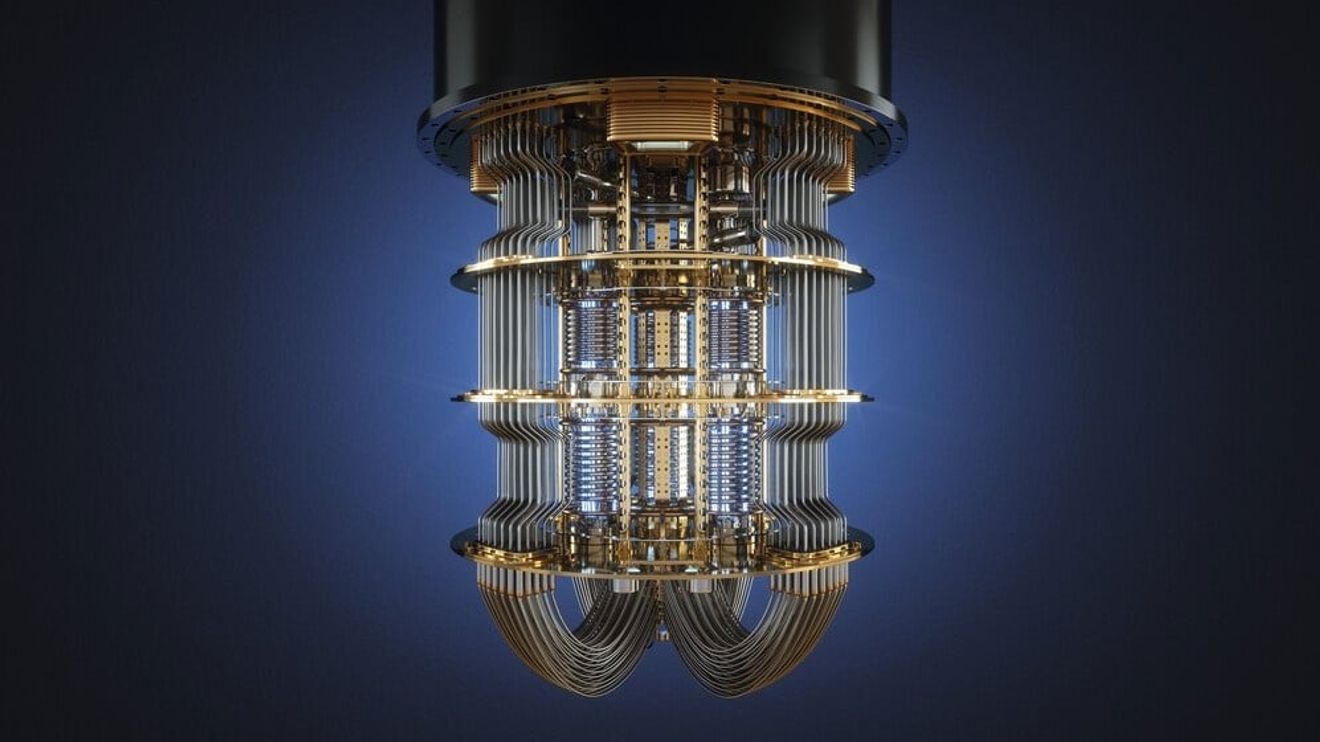
Quantum computers promise to be able to solve previously unsolvable problems efficiently. But how is this supposed to work? This question can be explained by looking at the differences between quantum processors and conventional computers: Quantum computers use the laws of quantum mechanics and work with qubits, whereas conventional computers work with bits. The advantage of qubits is that they can not only assume the values 0 or 1, but also allow any combination of both due to the superposition of quantum states. This makes quantum computers considerably more powerful and enables them to solve tasks in real time that are not even possible with today's supercomputers.
Advances in hardware
Quantum computing is a very interesting field due to its many potential applications, which already has a long scientific tradition in quantum physics in Germany. Germany has been an international leader in basic research in this field for many years. Major institutes and research facilities such as the Fraunhofer Institute for Applied Optics and Precision Engineering IOF are dedicated to the development of various quantum technologies. For example, new architectures and technologies such as superconducting qubits are being researched. In this technology, quantum bits are to be realized by resistance-free flowing currents in superconducting circuits. The advantage of these currents is that they are relatively robust against external interference and can therefore retain their quantum properties over a longer period of time.
The application development
Despite all the expectations and research, quantum computers have not yet arrived in everyday use. However, there are already a growing number of applications that are suitable for use on quantum computers in industry, particularly in the field of materials science and optimization. Quantum algorithms are used here to help solve complex optimization tasks. Some companies use them, for example, to develop applications for use in the energy sector and in logistics - especially in adaptive supply chains.
| Reading tip: European industry is facing the challenge of translating innovations in the field of quantum technology into scalable processes and products. The 'Qu-Pilot' project aims to help here by using the existing pilot manufacturing infrastructure. Read more here |
To make such applications a reality, special algorithms are used to calculate systematic quality assurance. Because of the way the qubits react to these algorithms, many more variables can be evaluated simultaneously than by a supercomputer. For this reason, the development of algorithms specifically optimized for use on quantum computers is an important area of quantum computing research. These algorithms can be significantly faster and more efficient than classical algorithms for certain applications.
In addition to the development of algorithms, the quantum computing community is also working on the development of standards for programming, the exchange of algorithms and the benchmarking of quantum computers in order to improve interoperability and comparability.
Transformation potential for the industry
As quantum computers are able to calculate a large number of solutions in parallel, they have the potential to perform data analysis many times faster. This potential of quantum technology will come into play particularly in the field of machine learning or artificial intelligence and will profoundly change the application possibilities in practice. Despite the advanced computing power of conventional computer systems, many artificial intelligence tasks still take a considerable amount of time, whereas quantum computers can recognize patterns and correlations very quickly and efficiently. Image analysis and image interpretation with quantum neural networks are particularly interesting and have already been well tested. Industry in particular can use this technology to improve quality assurance and optimization in production, for example, or to increase efficiency in logistics and the supply chain. This would also make it possible to optimally calculate the use of resources.
Quantum sensor technology

Quantum computing has the potential to revolutionize companies and strengthen their competitive position.
© Adobe Stock/Reichelt ElektronikHowever, quantum technology is not only pushing the boundaries of what is possible in the field of data analysis and processing, but also in the field of sensor applications. Quantum sensors can generally measure all physical quantities such as time, pressure, temperature, electrical currents and acceleration with an accuracy that cannot be achieved with current technology sensors.
There are already groundbreaking new developments from Germany, for example from quantum sensor pioneer Quantum Technologies. "Until now, highly sensitive measurements of magnetic fields required large setups and had high power consumption. There were also repeated problems with the measurements: microwave radiation was required to measure the fields and components heated themselves as a result," explains Dr. Robert Staacke from Quantum Technologies. "We were able to solve these problems with our new compact, purely optical and cooling-free quantum magnetometer, which is just as suitable for industrial use in mechanical and plant engineering as it is in medical technology or high-voltage engineering."
| Reading tip: European industry is facing the challenge of transferring innovations in the field of quantum technology into scalable processes and products. The 'Qu-Pilot' project aims to help here by using the existing pilot manufacturing infrastructure. Read more here |
The more companies that can benefit from quantum sensor technology through innovative technology like this, the faster quantum technology will be able to establish itself. Applications currently being researched in the electronics sector, for example, include the visualization of individual bits in electronic storage media. In medical diagnostics, for example, the aim is to use quantum sensor technology to gain an insight into the tiny magnetic fields of the heart and brain. In the automotive sector, major manufacturers have been working for some time on producing quantum sensors for controlling autonomous vehicles or building powerful batteries for electric cars.
Optimization of traffic flows

The author: Christian Reinwald is Head of Product Management and Marketing at Reichelt Elektronik in Sande.
© Reichelt ElectronicsQuantum computing is also particularly suitable for optimizing traffic flows in road traffic. A quantum computer can perform complex calculations and thus calculate routes for vehicles and aircraft faster and more efficiently in real time. Industry can use this technology to optimize supply chains or reduce traffic congestion in cities, for example. Parcel deliverers could use it to plan their routes optimally. When traffic flows are optimized, not only industry but also every individual benefits from greater reliability in road and rail traffic in real time.
Simulation of chemical reactions
Another trend in quantum computing is the simulation of chemical reactions. A quantum computer can simulate the interactions of atoms and molecules and thus accelerate the development of new materials and medicines. Industry can use this quantum chemistry or materials research to optimize the development of materials for the automotive or aviation industries, for example. In future, quantum computing may be able to simulate new molecules, materials and their properties, such as new solvents for recovering carbon dioxide.
Hand in hand
These examples show that current trends in quantum computing offer many potential applications in industry - and that the technology has the potential to transform the way companies work and differentiate themselves from their competitors. But does that make them the saviors of the future?
The long-term goal of developing a universal quantum computer that calculates difficult computational problems exponentially faster than a classical computer is definitely still in the future. However, a suitable architecture for calculating practical challenges can be realized by fundamentally improving both the hardware and the software. It is also realistic to assume that quantum computers will not replace conventional computers for the time being, but rather supplement them in applications to help out where the need goes beyond current technology. Germany is playing a pioneering role here with many research approaches and work.


You might also be interested in
DLR QCI awards two contracts
The German Aerospace Center (DLR) has commissioned the development of a special mini quantum computer for training courses. The aim: a quantum computer that future users, students and companies can touch and try out.
 read more...
25 years of Computer&Automation - The e-paper
For 25 years, Computer&Automation has accompanied the growing influence of IT in automation technology. Ultimately, IT and automation can no longer be clearly separated. In this anniversary issue, you can read about the importance that...
read more...Extra-fast quantum computer for Stuttgart
The race for the future of quantum computing is in full swing internationally. Research is also being carried out in Baden-Württemberg. A project at the University of Stuttgart is currently testing a new idea.
read more...Uniform standard for real-time data communication
Automation and networking are basic requirements for Industry 4.0. Reliable data communication at high transmission rates is essential. TSN helps to merge IT and OT into a uniform network without compatibility problems.
read more...The knowledge hub of the embedded community
The embedded systems industry will meet from March 11 to 13. In seven exhibition halls, exhibitors in Nuremberg will provide information on hardware, software, services and tools. Two accompanying conferences, expert panels and exhibitor forums will...
read more...Customized Single Board Computer
Helbling has developed a flexible embedded vision platform based on an ARM processor that can be used as a reference design for the development of customized single board computers (SBC).
read more...Secure embedded PC for industrial applications
According to the manufacturer, the 'ReliaCOR 54-13' embedded PC from Inonet is one of the first embedded computers made in Germany to be certified for AI applications in accordance with IEC 62443-4-2. It therefore meets the requirements of...
read more...Operation via touch, glove, pen or digitizer
Getac launches the next generation of 'F110' and 'K120' tablets: The new F110 is suitable for use in a variety of harsh outdoor and indoor scenarios.
read more...IPC for IIoT gateway
The compact and energy-efficient industrial PC 'DA-1200' from Cincoze is suitable for IIoT gateways in modern industrial applications.
read more...