
Supply Chain Report 2026
German Companies suffer most from Delivery Problems
Supply bottlenecks are hitting German industrial companies harder than their European competitors. According to a survey of more than 1,500 companies, a third of companies in Germany are reporting a significant impact on their business. The supply of semiconductors remains particularly critical.

German industrial companies continue to suffer particularly badly from supply chain disruptions compared to other European countries. This is shown by the latest supply chain report from reichelt elektronik. The survey institute OnePoll interviewed more than 1500 industrial companies in Germany, France, Italy, the Netherlands and Spain for the fourth edition of the study.
Germany leads the way in production losses
32% of German companies reported that supply bottlenecks had a strong impact on their business - more than in any other country surveyed. This is particularly evident when it comes to production stoppages: in Germany and the Netherlands, companies had to interrupt their production for an average of 26.3 and 26.8 days respectively. In Spain, the average was 16.7 days.
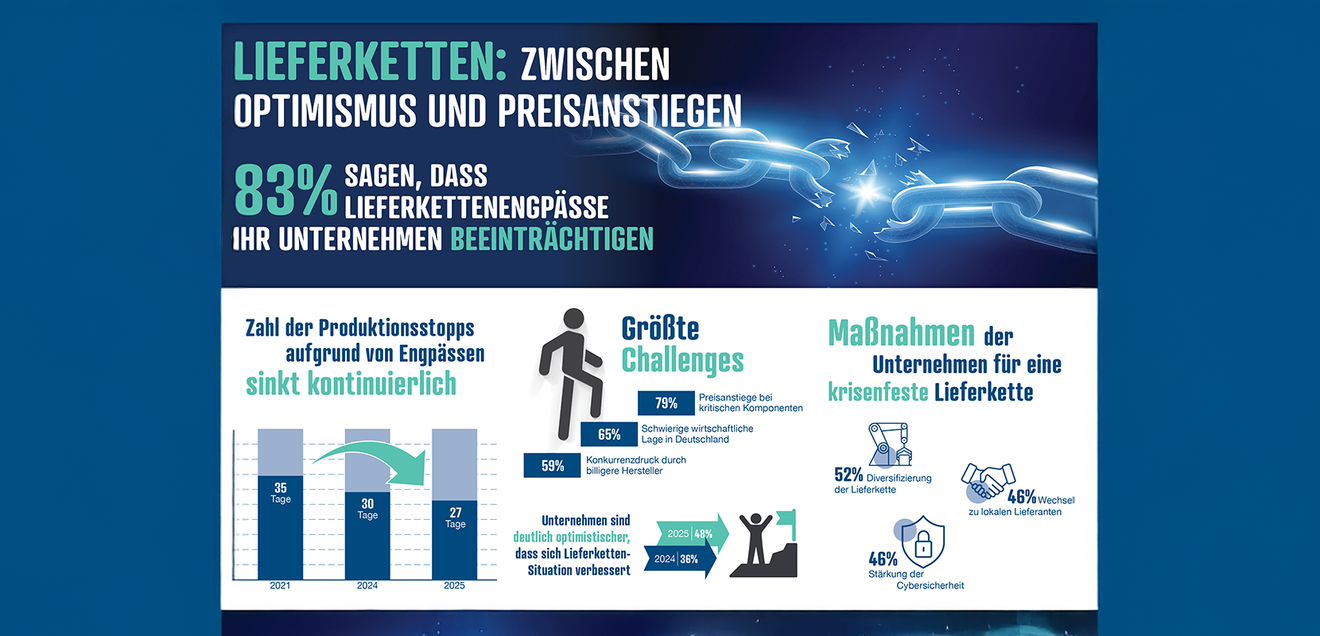
The reactions of companies also differ. 52% of German companies have expanded their supplier base. Spanish companies rely primarily on local suppliers (50%), while companies in the Netherlands are increasingly turning to automation (46%).
Semiconductors in particularly short supply
There are also clear differences in access to important components. In the Netherlands, 45% of companies rate the procurement of critical components as easy. In Germany, the figure is only 35%.
Semiconductors in particular remain in short supply: 44% of German companies report problems with procurement. This is well above the European average of 35% and 21 percentage points above the Netherlands at 23%. Sensors are also in short supply more frequently: 37% of German companies report shortages, compared to 20% in Spain.
German companies fare better with other components. Battery bottlenecks affect around 24% of German companies, compared to 37% in the Netherlands. French and Italian companies report more problems with developer boards (31%), while Germany has the lowest figure here at 19%.
Calls for less bureaucracy
German companies also see a greater need for political action. 55% call for a greater reduction in bureaucracy within the European Union - more than in any other country surveyed. In the Netherlands, only 39% cite administrative hurdles in the single market as a problem.
German companies also report more difficulties with digitalization: 50% see challenges here. In France, this figure is 31%.
Different expectations for the future
Across Europe, 52% of the companies surveyed expect the supply situation to ease. Companies in Spain (66%) and Italy (62%) are particularly optimistic. In Germany and the Netherlands, 48% share this view, in France 40%.
German companies are also more critical of political risks: 68% see political decisions as a threat to their business, compared to 48% in France. 66% of German companies also rate the global economic situation as difficult. In Spain, this figure is even higher at 76%.

"The study clearly shows that German companies were particularly hard hit by the challenges in global trade," says Christian Reinwald, Head of Product Management & Marketing at reichelt elektronik. "In addition to ongoing supply chain problems, there are new export tariffs and political uncertainties. This is not only reflected in the growth figures of recent years, but also in the mood. While other European countries are reacting more flexibly to crises and are sometimes more optimistic about the future, Germany is groaning under the strain. Nevertheless, it would be too early to throw in the towel. German companies still have unique expertise and great innovative potential. These strengths can help to overcome the current difficult situation and remain competitive in the long term."


You might also be interested in
Maryannick Dauba appointed Head of Avnet Silica
Avnet Silica has appointed Maryannick Dauba as president. The long-time executive will take over leadership of the company in the EMEA region effective July 1, 2026.
 read more...
More than 364 Providers included
DigiKey expands Portfolio by 108,000 Products in 2025
DigiKey has added more than 108,000 products and 364 new suppliers to its ex-stock portfolio in 2025. The company thus provides engineers and manufacturers with immediately available components and new technologies.
read more...Klaus Conrad turns 90 - Entrepreneur and Supporter
Klaus Conrad turns 90: The former head of Conrad Electronic shaped the company, expanded the mail order business and was involved in social projects in Hirschau and internationally.
read more...DMASS reports Growth in Q4/2025
Europe's electronics distribution grew by almost 10% in the fourth quarter of 2025. However, according to industry association DMASS, the recovery remains unevenly distributed and geopolitical risks are weighing on the outlook for 2026.
read more...Conrad continues Growth Course with new Management
Conrad Electronic is continuing its transformation from a traditional retailer to a B2B platform. The new managers Dr. Daniel Saga and Guy Dann strengthen the strategic focus on different customer segments.
read more...Industrial AI at SPS | DigiKey
Europe as the Engine of the Industrial AI Revolution
Connor Doherty from DigiKey explains why Europe will be a pioneer of the AI revolution, how digital twins, edge AI, and AI-powered sensors are transforming manufacturing, and why integration, data quality, and cybersecurity remain the biggest...
read more...DigiKey appeals to the Innovators of tomorrow
DigiKey invites students to take part in its annual back-to-school competition to win products and giveaways. The aim: to encourage curiosity and creativity and reward bold ideas.
read more...DigiKey and TraceParts enter into Partnership
DigiKey has announced a partnership with TraceParts, a provider of CAD content for engineering, industrial equipment and mechanical engineering.
read more...Significant Portfolio Expansion
Digikey expanded significantly last year, both in terms of providers and new products (NPI). 455 new providers and more than 1.1 million products in the core business have been added to the distributor's portfolio.
read more...