

China Manufacturing 2025
Industry 4.0 in China
At the beginning of April 2017, around 1,000 international experts met in Shenzhen, China, for the second China manufacturing 2025 Summit, which focused on the topic of 'Global transformation to intelligent manufacturing'. Rahman Jamal was there and shares his impressions.
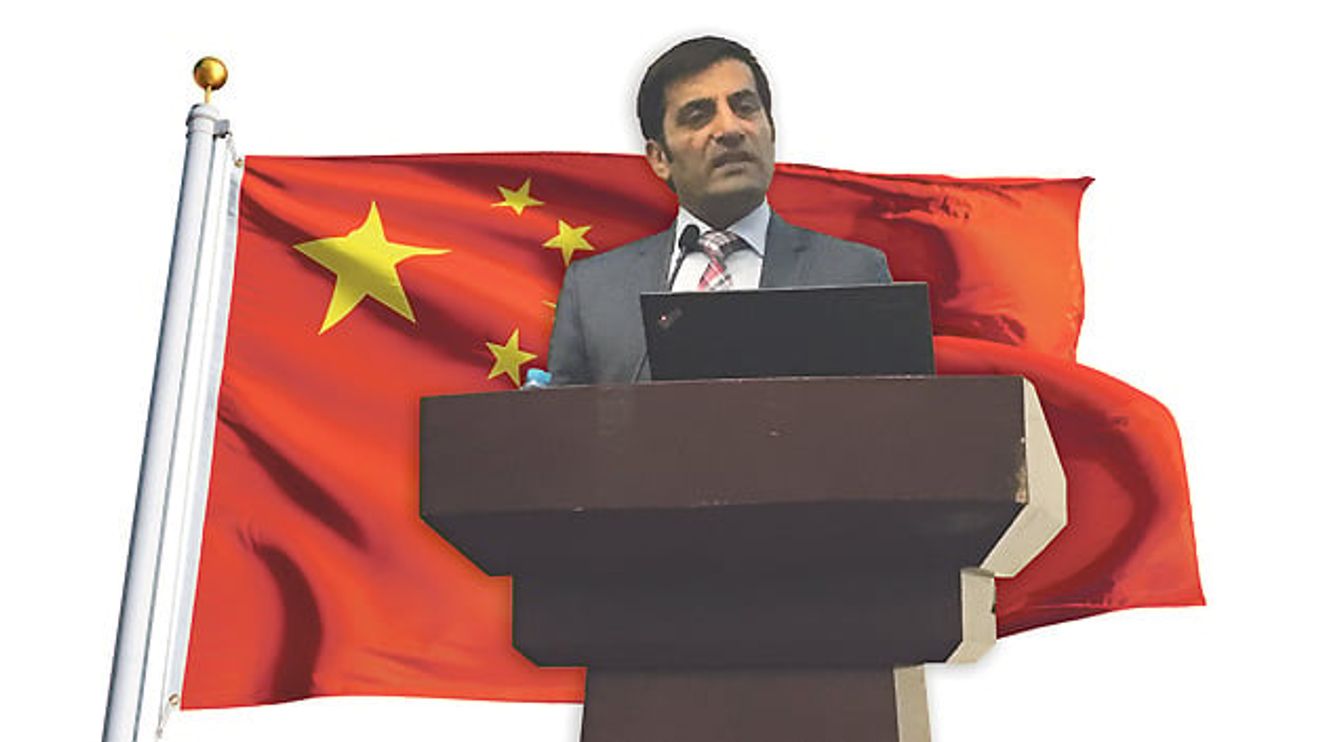
Mr. Jamal, 1000 international experts on the topic of Industry 4.0 in China - is such an event in China comparable to congresses in this country?
Jamal: Yes, absolutely. The participants included experts as well as university lecturers and company representatives. Prominent multinational companies such as Intel and Accenture were also represented. I was certainly surprised that there were so many participants at the 'Made in China 2025' event, as the initiative there is called in line with our 'Industry 4.0'.
For me personally, the closed-door meeting, which took place the day before the official event, was particularly interesting. As the only internationally invited participant from industry, I was able to experience the quality of the discussions among the hand-picked experts. The fact that the topic also has a high political profile was demonstrated by the fact that the Minister of Science and Technology of the People's Republic of China, Wan Gang, chaired this closed-door session and also opened the summit.
Why were you the only internationally invited participant from the industry?
Jamal: I was invited to present the global perspective on IIoT and Industry 4.0 from my point of view. The experts wanted to hear recommendations on how they can achieve the 'Made in China 2025' goal. And the fact that the Chinese are serious about Industry 4.0 can also be deduced from the fact that the representative of the Chinese Ministry of Industry and Information Technology (MIIT), Dr. Xiaopeng An, was present and also wanted to discuss technology trends in the USA and Germany with me personally.
How do you assess the cooperation and knowledge exchange between China and foreign countries?
Jamal: In my opinion, China is still in the information-gathering phase. Things like IIoT labs or Industry 4.0 labs are currently springing up like mushrooms. One example of this is the 'Industry 4.0 Smart Factory Lab' at Tongji University, which opened in 2014 and with which National Instruments is collaborating. The different levels of the two countries in the IIoT sector are also reflected in the general status of research and development in both countries: Germany already invests 3% of its gross domestic product in this area, compared to 2.1% in China. The target for 2020 is 2.5%.
Three years ago, the German and Chinese governments signed a strategic partnership to work together more closely in research and innovation. The first pilot projects are due to start this year - including on the topics of Industry 4.0, electromobility and energy.
Is the lab at Tongji University comparable to facilities in the USA and Germany?
Jamal: Yes, absolutely! You can see a complete production line with robots, digitally controlled machine tools as well as hardware and software such as robot slide rails, intelligent cameras, servers, control software and utilities. The lab aims to create a flexible production model with digitalization and personalization and become a demonstration project for a smart factory in the Chinese manufacturing industry.
How do you rate the innovative strength of the Chinese? In terms of Industry 4.0, at what level do you see China by 2025?
Jamal : With 'Made in China 2025', Chinese policymakers want to ensure that the country remains an attractive location for manufacturing even if it is no longer considered a low-wage country. If the Chinese market succeeds in implementing this plan, industrialized nations such as Germany will have to dress warmly!
So is it better to isolate yourself or cooperate?
Jamal : Germany has opted for cooperation, which I very much welcome: the Federal Ministry of Education and Research spends around 20 million euros a year on its China strategy. Our Chancellor has explicitly spoken out in favor of setting up a joint research fund to ensure a reliable framework for strategic cooperation with the Asian country. This fund is to be launched next year and will be filled with up to 4 million euros annually by each of the two countries from 2020. And there are a whole series of other examples of cooperation: The "German-Chinese Government Consultations" have been taking place since 2011 and have already been held three times. It should be noted that China is one of the few nations with which Germany has held such consultations. Ten 'Joint Declarations of Intent' have now been adopted in these consultations. These include the 'Joint Declaration on the Establishment of a Sino-German Innovation Platform'. The focus of this platform, signed by the BMBF and MoST (Ministry of Science and Technology), is on innovation research and policy.
Another example of cooperation between Germany and China is the promotion of joint higher education institutions. This includes the aforementioned Sino-German University of Applied Sciences at Tongji University. In the 2016/2017 winter semester, 85 German and Swiss students studied there, 66 of whom were studying for a double Bachelor's degree. - This number of students is set to increase.
Mr Jamal, you were also awarded the title of visiting professor by the Chinese-German University of Applied Sciences during the trip. What impressions did you take away from the university?
Jamal : The CDHAW at Tongji University is the official Chinese-German faculty. I found it interesting that the students there all speak our language and that the lectures are also held in German. This also applied to my inaugural lecture as a visiting professor, which was attended by 200 interested Chinese students and in which I spoke on the topic of 'Platforms for IIoT'. All CDHAW students will also spend their fourth year of study in Germany. They will spend a semester at one of the 27 German or Swiss partner universities as well as a practical phase in a local company or write their Bachelor's thesis there.
Incidentally, I am the fourth German guest professor alongside representatives from SAP, VW and Phoenix Contact. This line-up alone clearly shows how seriously the Chinese take the topic of 'Industry 4.0', as they surround themselves with experts and skills from a wide range of industries.


You might also be interested in
Berlin wants EU protective wall against China's company takeovers
For some time now, China has been buying up high-tech companies in Europe and Germany in order to strengthen its own industry in the Far East. The German government is now calling on the EU Commission to wake up to this issue.
 read more...
ZVEI invites IT industry to collaborate
With the establishment of the new 'IT in Automation' working group, the ZVEI aims to promote the networking of machines with office processes and expressly invites IT companies to participate.
read more...China as a lead market?
Can China develop into a leading Industry 4.0 market? Despite some misguided incentives due to government intervention, investment bubbles and overcapacity, China's innovative strength should not be underestimated: There are pioneers to learn from...
read more...New law in China affects European companies
The new cybersecurity law issued by the Chinese government came into force on June 1. Many German and European companies are very uncertain about the extent to which they are affected by the change in the law.
read more...How does China use the Internet?
Which are the most popular apps on China's consumer Internet and how do they compare with Internet usage worldwide? The Shanghai team of Stieler Technology and Marketing Consultants analyzed eight apps.
read more...China could lose the most jobs
How many jobs are threatened by automation? The data portal Statista has processed figures from McKinsey in an infographic.
read more...The first steps towards digitization
Real-time transparency in the material flow: this was the goal set by Miba when it set out to digitalize its internal logistics processes. But how successful was the close link between ERP and MES in the end? - A field report.
read more...How will the IoT change companies in 2020?
How will network technology in companies change in 2020? Axel Simon, Chief Technologist at HPE Aruba, takes a look into the crystal ball
read more...Digital twin revolutionizes maintenance
As virtual representatives of real machines, digital twins open up new possibilities for maintaining and servicing complex industrial plants and systems. A project report.
read more...