

HMS Industrial Networks
Industrial Ethernet continues to gain ground
The market share of Industrial Ethernet in terms of newly installed nodes in factory automation has risen to currently 64%. Fieldbuses, on the other hand, fell from 35% to 30%, while the market share of wireless technologies remained stable at 6%.
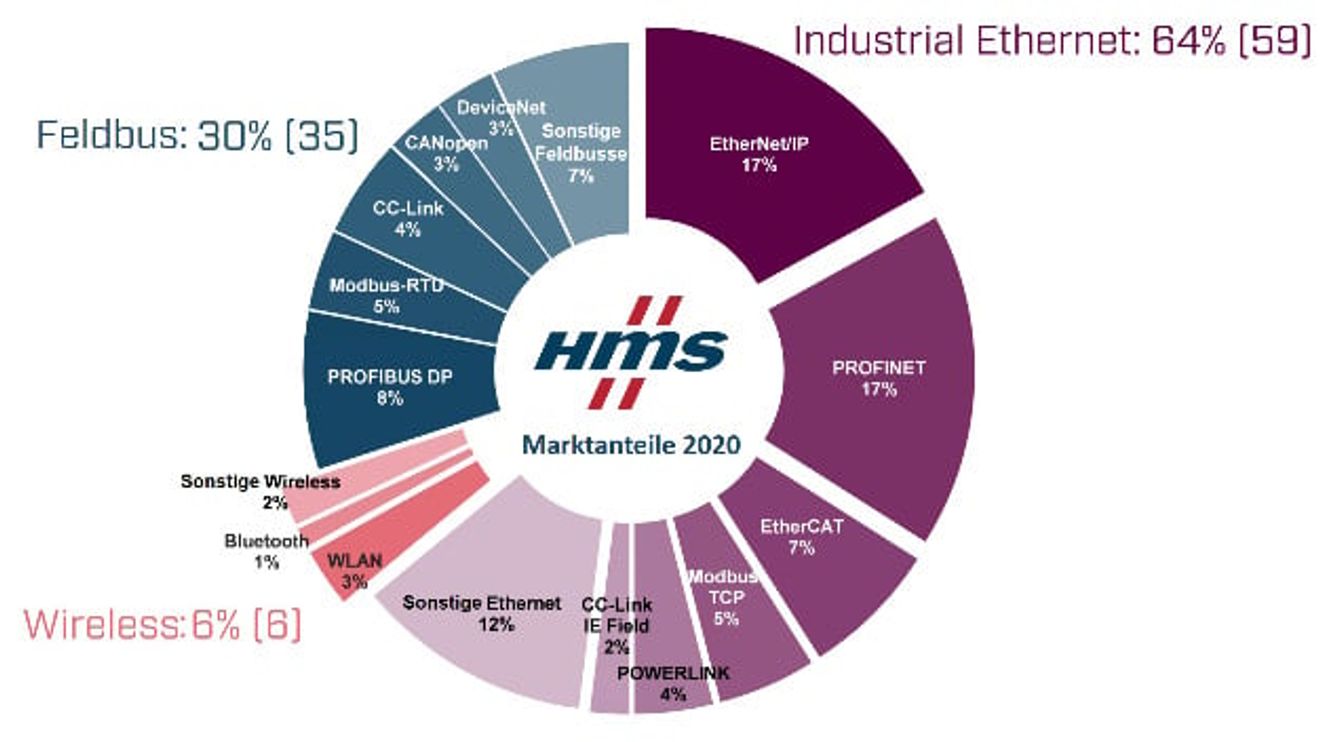
Market shares of industrial networks 2020 from the perspective of HMS - fieldbuses, Industrial Ethernet and wireless. The figures in brackets are the figures from the previous year.
© HMSThese are the results of HMS's annual study on the market share of industrial networks. As an independent provider of solutions for industrial communication and the Industrial Internet of Things (IIoT), HMS relies on an in-depth insight into the industrial networking market. The study reflects HMS' assessment of the market shares of fieldbuses, industrial Ethernet and wireless networks. The general market situation worldwide is more than exceptional due to the coronavirus, so HMS has refrained from specifying growth rates this time.
Industrial Ethernet on the rise
HMS concludes that Industrial Ethernet continues to gain market share from fieldbuses and has now achieved a global market share of 64% of newly installed nodes in factory automation (59% in the previous year). EtherNet/IP and Profinet share first place with 17 percent of the total market each. EtherCAT is also widely used worldwide with 7 percent. With a market share of 5 percent, Modbus TCP has overtaken Ethernet Powerlink, which has a market share of 4 percent.
Fieldbuses continue to decline
HMS expects fieldbuses to decline to 30 percent of newly installed nodes (previous year: 35 percent). Profibus is still the number one fieldbus with a market share of 8 percent, but has fallen below the 10 percent mark of the overall market for industrial networks for the first time. It is followed by Modbus-RTU with 5 percent and CC-Link with 4 percent market share.
Estimates of the market shares of Industrial Ethernet and fieldbuses

Thilo Döring, HMS: "We expect demand for wirelessly networkable devices and machines to increase."
© HMS"We expect steady growth in the industrial networks market in the coming years. However, due to the coronavirus situation, which is having a massive impact on business conditions worldwide, we are unable to make any statements about growth rates this year. Our analysis this year therefore only includes market shares," explains Thilo Döring, Managing Director of HMS Industrial Networks GmbH in Karlsruhe. "If we only look at the market shares, we can see that it is the Industrial Ethernet networks that are continuing to drive networking within factories. The leaders are EtherNet/IP and Profinet, followed by EtherCAT. Profibus is still the most widespread fieldbus, but has lost market share because fieldbuses are declining overall. It is also interesting to note that Modbus continues to have a high market share - both for fieldbuses with Modbus RTU and for Ethernet-based Modbus TCP. This shows us that well-known technologies are still being used for new installations in factories if they have proven themselves."
Stable wireless networks with good future prospects
Wireless technologies have maintained their market share of 6 percent. WLAN is still the most widespread, followed by Bluetooth. "Wireless networks have maintained their market share in an overall growing market, which is not a bad thing. However, we assume that the share of wireless technologies will continue to grow in the long term," says Thilo Döring. "Activities around wireless technologies are underway worldwide - keyword private LTE/5G networks. They make smart manufacturing possible in the first place. We therefore expect demand for wirelessly networkable devices and machines to increase. After all, they are a central component of flexible automation architectures of the future."
Regional differences
In Europe and the Middle East, networks are distributed more or less equally. The leaders in these regions are EtherNet/IP and Profinet. They are followed by Profibus and EtherCAT. Modbus (RTU/TCP) and Ethernet Powerlink are also popular in Europe and the Middle East. The situation is quite different in the US market, which is dominated by EtherNet/IP. Only EtherCAT has made up some ground on the American market. The picture is completely different in the Asian market. None of the industrial networks has really established itself there, and the network landscape is very heterogeneous. However, the two networks Profinet and EtherNet/IP are also the most widespread in Asia. However, Profibus, EtherCAT, Modbus (RTU/TCP) and CC-Link/CC-Link IE Field are also quite common in Asia.


You might also be interested in
View data from globally distributed machines
HMS Networks introduces Ewon DataMailbox, a secure, free cloud-based solution that enables machine builders and plant operators to access data from their globally distributed machines.
 read more...
Supports CC-Link IE TSN
The Anybus product family from HMS Industrial Networks enables data exchange between field devices, machines and systems via common fieldbus and industrial Ethernet networks. The company has expanded the modular embedded family 'Anybus CompactCom'...
read more...HMS Networks makes a purchase
HMS Industrial Networks, a wholly owned subsidiary of HMS Networks, has acquired 70% of all shares in the Dutch company Procentec, based in Rotterdam.
read more...The top articles in June
There was a lot of news in the past month that we included in our reporting. One thing became clear: despite the crisis, the industry is not standing still, even sees opportunities and is continuing to develop. The most-read articles for you in June.
read more...More than just storage and sales
Today's customers expect much more from distributors than just distribution. Dieter Schink, Managing Director of May Elektro-Bauelemente in Berlin, explains the extent to which the understanding of their role is changing.
read more...Prototyping and testing of TSN
Very high demands are placed on TSN in terms of interoperability. What contribution do cross-manufacturer testbeds make here? How can the implementations of TSN standards and interoperability be tested?
read more...The configuration
Time-Sensitive Networking must offer a standardized communication platform for machine builders and automation engineers alike - the TSN configuration must support both worlds without conflict. How and with which approach can this be achieved?
read more...First specification within reach
At SPS 2018, the Field Level Communication initiative was established under the umbrella of the OPC Foundation. How far has the initiative's work progressed now?
read more...Industry 4.0 in mechanical engineering
Since 2008, Michaela Rothhöft has been conducting the "Industrial Communication / Industry 4.0" market study every three to five years with the support of the VDMA. The results of the 2020 update.
read more...