

Isra Vision
Guided by the point cloud
In assembly processes, 3D point cloud technology plays a special role in the guidance of industrial robots. Quad-camera sensor solutions that enable multi-stereo recordings are a new approach here.
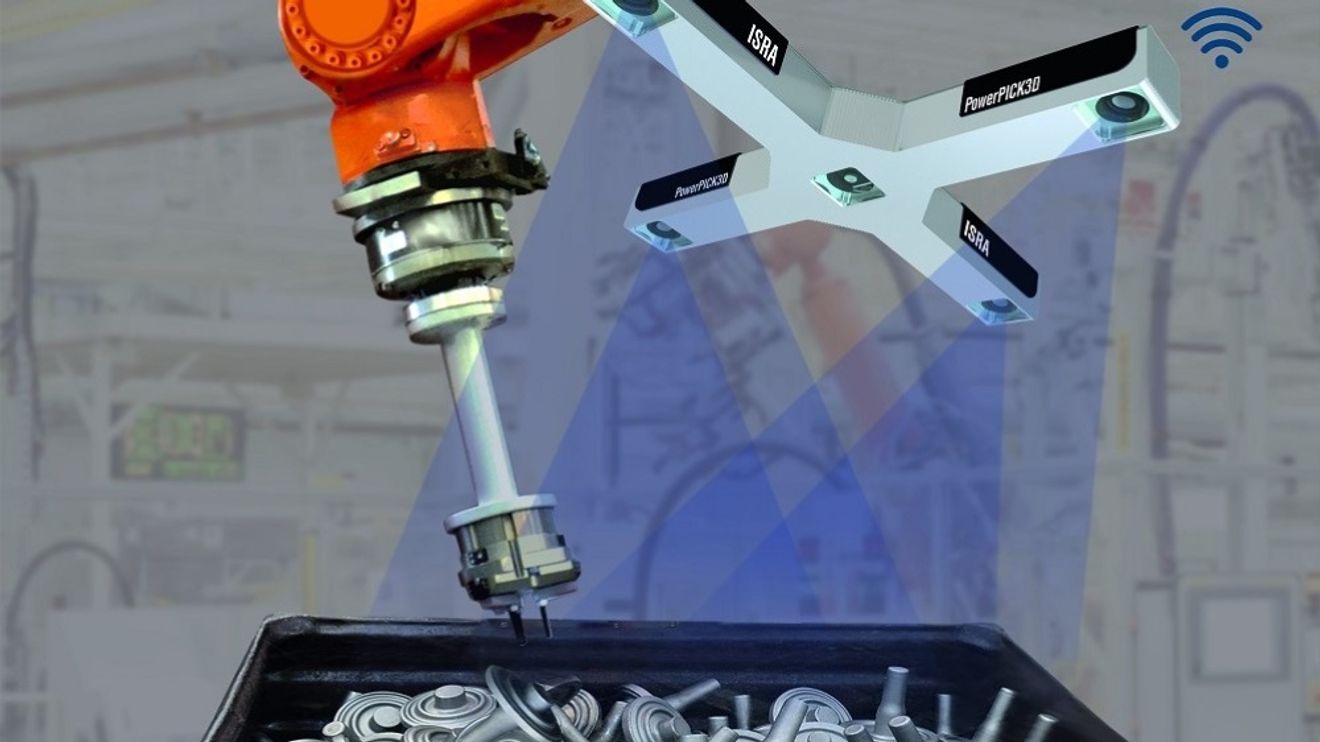
The high cost pressure in production requires labor-intensive processes to be automated as seamlessly as possible. Until now, special mechanical devices have usually been used to separate components.
However, these are expensive, inflexible and take up a lot of space. They also often lead to noise pollution. Relieving employees of tasks such as the removal of heavy and unwieldy parts is another common reason for advancing automation for these applications.
Industrial robots are therefore increasingly in demand for various assembly processes, and 3D point cloud technology is particularly important for guiding them. When generating such point clouds, the entire scanned surface of an object must be captured quickly and precisely and converted into a dense data set of individual points, each of which is represented by its spatial coordinates.
The three-dimensional coordinate set of the individual points enables reliable 3D detection of objects. Object detection and gripping point determination are based on this. The path planning of the robot and gripper systems is realized collision-free. Powerful camera technology is required for these applications.
Quad camera technology
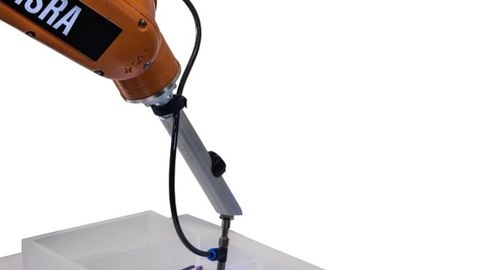
Camera technology has developed enormously since the early days of robot guidance. Initially, there was no universally applicable solution in sight. Corresponding solutions initially used 2D laser scanners to obtain the 3D data and positions of the parts. However, linear triangulation points did not provide satisfactory results for many applications.
It became more effective with a moving laser line, which can be used to determine the position and orientation of unsorted, randomly distributed objects in depth, for example. Intelligent collision avoidance enables interference-free robot guidance. However, this method also has a decisive disadvantage:
For example, not all corners are reliably detected during the so-called 'reach into the box'. This means that parts lying on the edge, for example, can remain in the crate at the end.
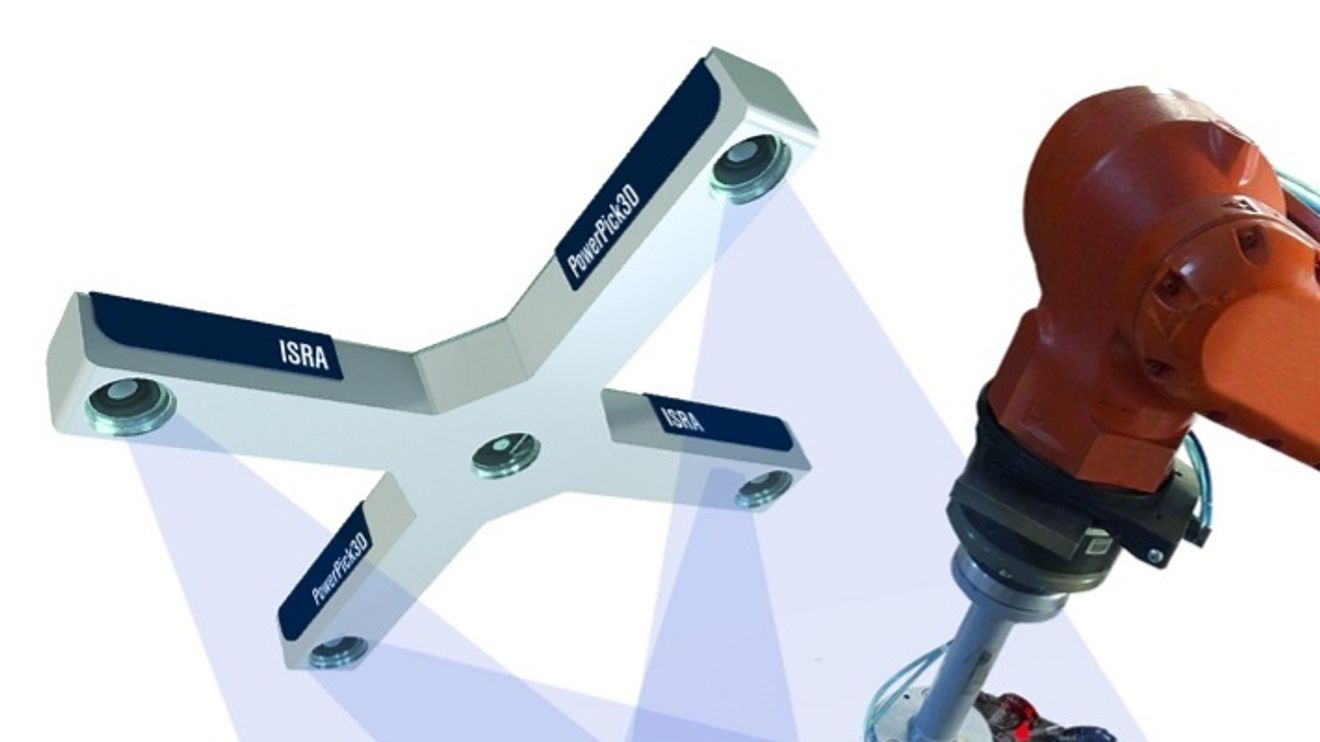
To overcome this problem, Isra Vision has developed a multi-stereo process in which four integrated cameras capture the components to be gripped. This solution significantly increases the number of views of the parts. The exact height of the parts to be gripped is now also detected.
The quad camera technology enables 6x stereo recordings with very high data redundancy. The six camera pairs lead to much better scanning results, even with reflective or shiny surfaces. The accuracy and speed of cycle and scan times are improved accordingly. In addition, the multi-stereo quad camera technology ensures that bins are completely emptied during bin picking.
Emptying containers
Isra Vision's 'Powerpick3D' offers a solution for assembly processes such as the fully automatic emptying of containers with unsorted components: the sensor system is used to automate demanding, robot-based applications, especially for the separation of bulk materials with the shortest cycle times.
Powerpick3D' automatically creates an optimized gripping sequence and calculates the corresponding gripping poses. Thanks to the multi-stereo quad camera equipment, the multi-view images of the sensor remain reliable even if there are shadows in the sensor's field of view or light reflections on the component surfaces.
The system also determines the position of randomly distributed objects at different heights and orientations. The illumination technology is based on an LED projector, which has the task of projecting specific patterns onto the parts for scanning. Thanks to this principle, fewer images are required. The high-resolution 3D point cloud is generated from the camera images, which can also be used to precisely determine the height position thanks to the multi-stereo camera technology.
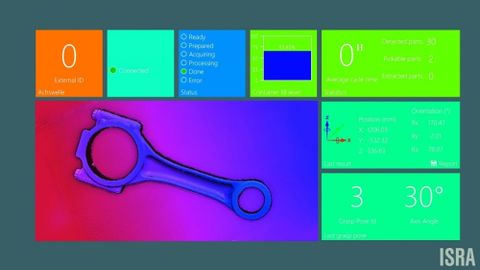
The bin-picking sensors learn new part geometries quickly and efficiently using a CAD data set. This means that the number of detectable components is virtually unlimited.
© Isra VisionThe path planning of the robot and gripper systems is realized completely collision-free by checking the model of the gripper on the robot path with the 3D point cloud and surrounding detected workpieces for collisions. The determination of the gripping point as the basis for the calculation of the robot path enables the targeted removal of the component and a defined placement. In contrast to conventional separation methods, the robot system can therefore react quickly and flexibly to production or component changes. A computer integrated in the sensor is responsible for object detection and determining the gripping point. This embedded PC also reduces the scanning and cycle times during operation due to the lack of long communication paths.
'Powerpick3D' is available in various sizes to ensure the maximum detection level for different applications. The measuring fields can be between 600 mm x 400 mm and 1200 mm x 1000 mm, and the depth of the measuring volumes ranges from 400 mm to 1000 mm.
Compatible with all common robot types, 'Powerpick3D' is already proving its worth in applications such as bin picking of anchor nails, brake calipers, angle joint housings and many other objects.
Grip the smallest unsorted components

Small or thin-walled components pose a challenge not only because of their small size: Robot systems can move them very quickly due to their low weight, and usually only over short transport distances. Fast scanning times and precise object recognition are therefore essential in order to achieve an optimum cycle time.
'Minipick3D' is optimized for the fast and reliable gripping of complex, unsorted small components with an edge length of just a few millimetres. The multi-stereo quad camera equipment ensures a complete overview as well as the necessary precision and speed. The measuring field here is 300 mm x 200 mm. The solution therefore meets the requirements for applications in the precision mechanics, electronics, toy and similar industries, for example: Connectors, terminals, small injection molded elements, filigree parts or components are reliably detected and can be gripped automatically. The accuracy is in the sub-millimeter range.
An embedded PC is also integrated into this very compact solution, which enables the highest data transmission speeds to be achieved. The sensor can also be mounted directly on the robot so that, for example, several crates can be emptied with just one sensor.
Learn new part geometries quickly
With the help of point cloud technology, the various sensors extract the components to be gripped from the - initially unstructured - information using a CAD template. As the systems quickly learn new part geometries using a CAD teach-in, the number of detectable components is virtually unlimited. The sensor solutions can be installed quickly in any environment thanks to their flexible mounting system.
Equipped with an intuitive touch user interface, the systems can be set up for operation in no time at all.
As part of Isra Vision 's 'Touch & Automate' portfolio, 'Powerpick3D' and 'Minipick3D' can also be operated without expert knowledge. This makes it easier to set up new part shapes. New parts can be taught in with just a few commands on the touch panel.


You might also be interested in
Precisely align the protective housing
The positioning system is a compact solution for the precise alignment of protective camera housings. The core of the modular system consists of fine positioning axes with 150 mm stroke, which ensure high adjustment accuracy with their hand-cranked...
 read more...
900 nm to 1700 nm wavelength range
The NIT WiDy SenS SWIR cameras with dual-mode InGaAs sensor (linear and logarithmic) offer a compromise between high sensitivity (linear response) and high dynamic range at 120 dB (logarithmic response).
read more...Mobile or for use in confined spaces
The robustly built high-speed camera Phantom VEO 1310 from High Speed Vision is suitable for research, development and production automation.
read more...Use in research and development
The Flir A8580 series thermal imaging camera is a cooled entry-level model with 1.3 megapixels that is suitable for industrial, military, scientific and product research and development applications.
read more...autoVimation supports ETH Zurich project
The aim of the 'Rowesys' - Robotic Weeding System - project at ETH Zurich is to develop a sustainable alternative to the use of herbicides in agriculture based on mechanical weeding. autoVimation is supporting the project as a sponsor.
read more...Vision 2020 does not take place
Vision, the world's leading trade fair for machine vision, will not take place this year, as Messe Stuttgart, the organizer, has announced. The trade fair was originally scheduled for November 10 to 12.
read more...Robot programs itself
Robot welding processes have been unprofitable in steel construction to date. This has changed with a solution in which the robot programs itself and then welds each component immediately.
read more...IDS Imaging Development Systems
3D data directly from the camera
Shifting computationally intensive processes away from the industrial PC and into the camera improves both the speed and accuracy of data processing. But what are the benefits of integrated data processing in detail?
read more...Space for microscopy and analysis
In quality control, space is often limited, so there is little room for microscope equipment. With the Doku-Kit3, Optometron offers a handy camera-monitor unit that enables self-sufficient microscopy and analysis without a PC.
read more...