

iT Engineering Software Innovations
Predictive maintenance in drive technology
Industry 4.0 is driving the trend towards small batch sizes with high product variance. This puts different loads on drives in machines and systems and makes it more difficult to predict the right time for maintenance. IIoT Building Blocks help with predictive maintenance.

Drives are a core element of machines and systems: they provide continuous movement and transportation, in short, they ensure production operations. In their use, they are subjected to different levels of stress depending on the use, production application and load as well as the operating time or operating time of the machine. In addition, environmental conditions such as temperature, humidity or dust influence the frequency of maintenance and servicing. Drive maintenance is therefore a key factor that supports the company's value creation process. In most cases, only narrow time windows are available for this.
Predictive maintenance can help to optimize the economic efficiency of production operations [1]. By comparing historical and real-time data, predictions are made about the increasing wear and damage progression of individual parts or components of machines. Pattern and anomaly detection is used to derive suitable times for maintenance and servicing from this database. In this way, maintenance can be tailored to the actual use of the machine and unplanned downtimes can be prevented [2].
For drive technology, the production of different product variants and small batches poses additional challenges simply due to the fact that the underlying database can vary greatly depending on the part produced. This trend is being reinforced by Industry 4.0 and the increasing production of small batch sizes and custom-made products. The methods used for pattern and anomaly detection must be correspondingly variable and universally valid without generating false positive results. Interoperability, scalability and performance are corresponding basic requirements for a suitable solution approach.
With IIoT building blocks for predictive maintenance
The basis for predictive maintenance is a good database. On the one hand, this requires fast and uncomplicated data collection; on the other hand, the collected data must be evaluated and analyzed in order to transform it into valuable information. With the IIoT Building Blocks, iT Engineering Software Innovations offers a combination of software components and open source technologies that enable machine learning methods in an industrial environment. Divided into three building blocks - Collect, Explore, Improve - individual components support the process - from data collection to evaluation - to suit individual use cases. In addition, data from different production machines can be clearly combined.
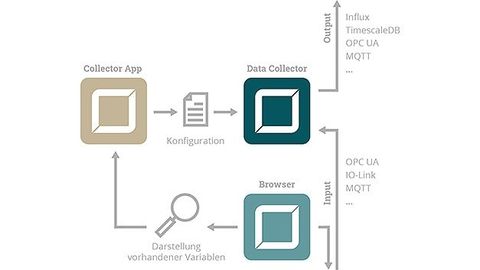
The 'Collect' module is dedicated to data collection with three self-developed software components(Fig. 1):
- The 'Data Collector' collects large, high-frequency data volumes on the store floor.
- The 'Collector App' makes it easy to set up the system, such as configuring data inputs and outputs and selecting and assigning the data to be collected.
- The browser supports the visualization and selection of existing machine control variables.
In the 'Explore' module, relevant data is visually processed and evaluated in a structured manner, while the actual use of the data is created in the 'Improve' module. The collected data is statistically evaluated, correlations are identified and suitable machine learning models are trained. Open source solutions are used to visualize and apply methods in terms of artificial intelligence (AI) and machine learning (ML). Based on the information and forecasts obtained, processes can be optimized, maintenance cycles adapted or production quality improved.
EN-AI-BLER research project
The aim of the EN-AI-BLER research project - 'Intelligent provision of production data to increase added value through AI applications' - is to enable a consistent data pipeline even in heterogeneous production landscapes consisting of a large number of machines and systems. One focus is on standardization and automatic data structuring in the brownfield. The project is working on an AI-based identification algorithm to connect non-standardized machines and systems to platforms [3]. The aim is to create a retrofittable data pipeline that can also be used to enable existing production facilities across industry boundaries to use AI models. The AI models based on this data can be used to improve the availability of production in a wide range of industries. This project is being carried out in cooperation with the wbk Institute for Production Engineering at the Karlsruhe Institute of Technology (KIT), Braun Sondermaschinenbau (manufacturer of production and assembly systems) and iT Engineering Software Innovations and is funded by the Baden-Württemberg Ministry of Economic Affairs, Labor and Tourism as part of the Baden-Württemberg AI Innovation Competition.
Automated identification of parameters

Existing software components already enable the connection of heterogeneous data sources in the production environment, for example using OPC UA or MQTT. At the same time, the machine controller itself is an essential and central data source. Extensive connection and configuration options mean that different sources can already be merged and variables can be collected at the user's discretion. However, time-consuming and manual identification of the data remains in order to assign machines and control parameters. Automated parameter identification with a three-stage process provides a remedy. In the first step, ML methods are used to classify the collected time series data. This results in an assignment to classes, for example position, motor current or speed data. A second stage enables granular differentiation between the parameters. This allows, for example, a target position signal to be distinguished from an actual position signal. In a third step, a correlation-based assignment to axes and a rule-based differentiation between different types of axes is carried out [4].
This parameter identification enables the use of intelligent data processing through simple and fast data access and parameter assignment and also forms the basis for numerous applications in the field of drive technology, including predictive maintenance. A sensor can be used to collect data from the drive which, together with existing variables from the control system, is available for classification and identification(Fig. 2). The data collected from the drive is merged and processed in an edge device. It is important to synchronize the different data over time to ensure comparability and identify dependencies. When selecting suitable software solutions and system configurations, it is also important that the performance of the machine and the processes of the entire system are not impaired. To ensure this, outsourcing data storage in real time to an edge cloud is a good option.

Dashboards can be created based on the collected data. These not only provide added value through the visual compression and illustration of the data itself, but also enable optimization approaches to be found and transparency to be created across the entire production process. The visualization supports a quick understanding and interpretation of the data. Examples of dashboards created on the basis of drive data are shown in Figure 3 .

Unexpected deviations, such as increased vibrations, noise or changes in current consumption, which indicate high wear and future failure, are detected at a very early stage and allow predictions to be made about the availability, status and condition of the system across process boundaries. This opens up further opportunities for the drive technology sector to identify potential and carry out optimizations as well as implement new business models as part of predictive maintenance. The iterative cycle for these optimizations is shown in Figure 4.
Creating flexibility
In the production environment, the communication between different systems and control systems, the exchange of data and predicted values and the heterogeneity of data and systems pose particular challenges. For this reason, the existing software modules of the IIoT Building Blocks will be adapted in future with regard to the adaptability of different machine control systems and the number of available input interfaces will be expanded. In addition, solutions need to be found for other challenges, such as making data from the production machines available even if their addresses and the structure of the data blocks and variables are not known.
At the same time, this simplifies and therefore broadens the application options for AI/ML solutions, making predictive maintenance available for a wide range of machines and drive technology, for example. Flexible out-of-the-box solutions can be used to meet the growing trend and demand for individual solutions.
Literature
[1] Nagel, M., Klein, A. (eds.): "Predicitive Maintenance: Zukunftsweisender Ansatz für mehr Effektivität und Effizienz in der Instandhaltung" in Modernes Produktionscontrolling für die Industrie 4.0. Freiburg. Haufe, 2018.
[4] Netzer, M., Gönnheimer P., Schäfer, W., Grosser, K., Fleischer, J.: Datenenabling zur breiten Anwendung von KI in der Produktion. WT Workshop Technology BD. 07/08-2021.
The authors

Judith Armbruster is Product Manager IIoT Building Blocks at iT Engineering Software Innovations.
Philipp Gönnheimer, M.Sc., is Group Leader for Machine Tools and Mechatronics at the wbk Institute of Production Engineering at KIT.
Markus Netzer, M.Eng., is a research assistant at the wbk Institute of Production Engineering at KIT in the Machine Tools and Mechatronics department.


You might also be interested in
AI-controlled predictive maintenance
Unplanned network outages are poison for business processes. Cisco is now tackling this problem with an AI-based technology for predicting and potentially resolving network problems.
 read more...
Mobile instead of stationary
In addition to the technical steps of inspection, maintenance, repair and improvement, administrative aspects such as planning, evaluation and feedback are also important in maintenance management. This works efficiently with a mobile solution for...
read more...Communicative energy management
As active links between drive electronics and electrical storage units, Pxt devices optimize the energy balance of electrical drive systems. Although special communication is not absolutely necessary for this, it provides significant additional...
read more...The digital twin as a basis
Wolfram Schäfer, Managing Director of iT Engineering Software Innovations, explains in an interview how software is changing automation systems, what opportunities this is creating and what role the digital twin plays in this.
read more...iT Engineering Software Innovations
Digitization of production
The IIoT Building Blocks from iT Engineering Software Innovations support the entire process of industrial data processing - from the collection of data to its evaluation.
read more...Car tuning for industrial drives
Machines only function optimally if the drives used are adapted to the drive train during commissioning: This requires the parameters of the software in the inverter to be set specifically for the machine. Integrated auto-tuning shortens this...
read more...Increase integration level
How are digitalization, sustainability and AI influencing the development of precision drive technology? Sebastian Markert, Head of Research and Development, and Mathias Blaskovic, Product Manager Precision Gearboxes, from Sumitomo Drive...
read more...RWTH Aachen offers guidelines for action
The WZL at RWTH Aachen University has developed a generic guideline for the successful application of predictive maintenance. It is now available for download.
read more...Optimizing predictive maintenance with AI
Predictive maintenance is not based on static models, but must constantly adapt to the circumstances. Machine learning algorithms can help with this.
read more...