

Micro-Epsilon
Real 3D from a single source
3D sensors alone are no guarantee for highly accurate 3D measurements - a coordinated interaction of hardware and software is essential.
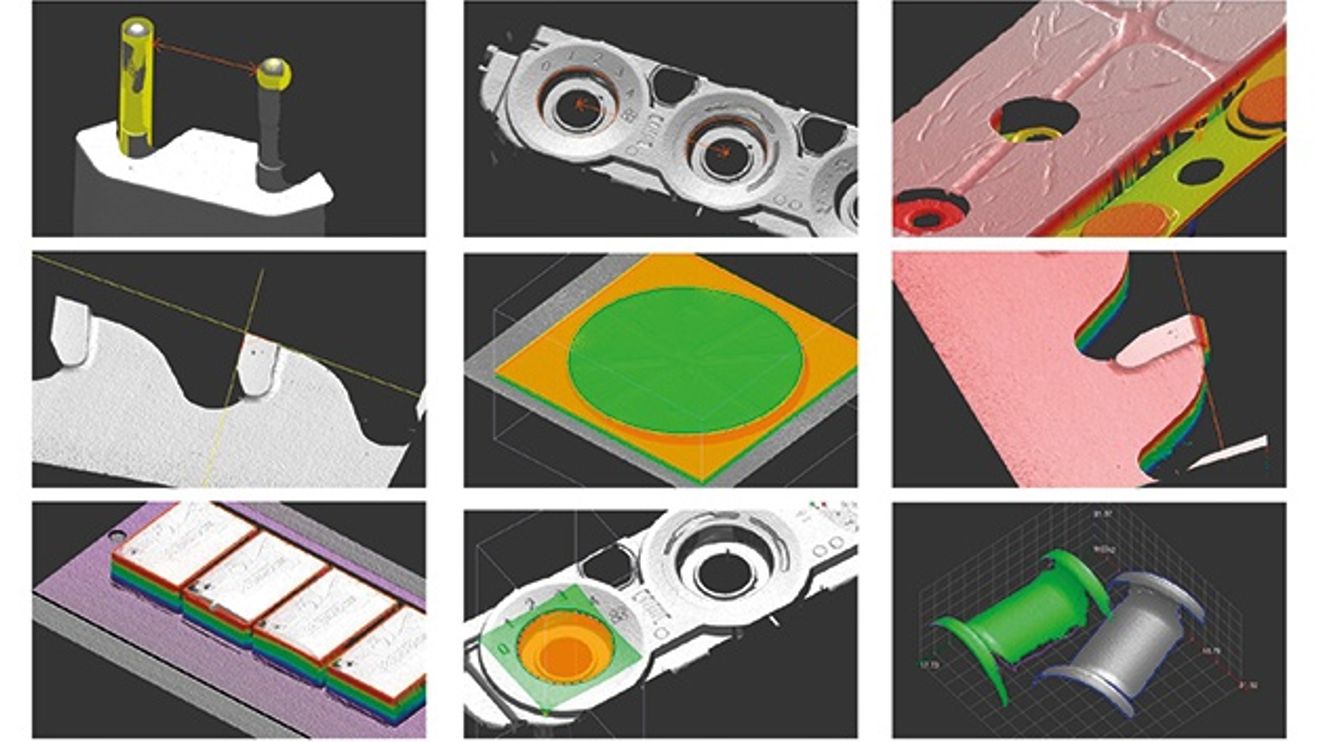
3D measurements can be carried out with many different sensors. It is therefore advantageous if one software can communicate with all sensors from one manufacturer. The '3DInspect' software fulfills this requirement. It is compatible with sensors for geometry, shape and surface inspection of matt objects, as well as those for measuring and inspecting reflective surfaces and 3D laser scanners for precise inline 3D measurement from Micro-Epsilon. Several z-coordinates are available in the software for each x-y coordinate.
The software can be controlled intuitively and enables the sensors to be parameterized and the measurement data to be recorded. Its range of tools extends from the alignment of the point clouds and the selection of relevant objects to filters for smoothing and optimizing the point cloud. Calculation programs for distance, height, angle and radius are also integrated. The calculated data can be output to the PLC, but can also be further processed as required. In addition to the standard version, the 'Automation' function extension is available for automated production processes. If users use an alternative image processing solution, an SDK is available that is based on the GigE Vision and GenICam industry standards, including numerous function blocks. A C/ C++/ C# library with sample programs and documentation supports software development.
The software functions
The software's measurement programs can be divided into three groups:
- Programs for the selection, filtering, transformation and alignment of point clouds are assigned to 'Data processing'. Corrections of the installation position, point selection, alignment using cuboids, planes, lines or points are possible. This includes mean, median, low-pass, high-pass and erosion filters.
- The 'Objects' group contains programs for fitting geometric objects. Here, centers of gravity or extreme points in the 3D point cloud can be calculated. It is also possible to fit objects such as spheres into the point cloud.
- The measurement results can be mathematically combined and calculated in the 'Measurement value output', and options for signal output are also available. Output takes place via UDP, TCP or Modbus, with the software functioning as the respective server.
3D measurement of diffusely reflecting surfaces

Unassembled PCB substrates are used as basic elements for printed circuit boards. Due to the high quality requirements that apply to substrate production, 100% inspection by high-precision measuring sensors is necessary.
© Micro-EpsilonThe 3D software package is compatible with the sensors in the 'SurfaceControl' series, among others. These are used for fast 3D measurement and inspection of diffusely reflective surfaces such as metal, plastic or ceramic. The sensor uses fringe light projection and calculates a highly accurate 3D point cloud from the recorded data. This point cloud can be used to identify geometries and the smallest defects. Even minimal structures on components and shape deviations become visible.
Applications can be found, for example, in the 100% inspection of unpopulated PCB substrates, which serve as basic elements for PCBs such as those used in sensors, smartphones or computers. If the flatness of the substrate does not meet the specifications, assemblies cannot be placed precisely during assembly. For high-end ceramic substrates, for example, measurement accuracy requirements of up to 2 µm apply. The Surfacecontrol 3D 3500' 3D snapshot sensor, which measures the matt surface of the substrates directly in the production line, can take on this task. The measured values are calculated in the sensor and output to an external PC via the integrated Gigabit Ethernet interface. Further processing, evaluation and logging of the 3D data is possible with the 3DInspect software. If defects are detected on the substrates, the control unit sorts out the bad parts fully automatically. A measurement with subsequent calculation and evaluation takes place within just 1.5 seconds.
3D measurement of reflective surfaces
The 'Reflectcontrol' sensor is used for 3D measurements on reflective and shiny surfaces. It can be used for micrometer-precise measurements for stationary monitoring of the production line or for inline inspection, for example on robots. A stripe pattern is generated on the sensor display, which is reflected across the surface of the object to be measured into the sensor's cameras. Deviations cause distortions in the stripe pattern, which are evaluated by the software.
The sensor is primarily used in the semiconductor industry, for example for 3D shape detection of wafers. The sensor checks the flatness or planarity of wafers with just one image. It provides a precise 3D representation of the reflective surface, which can be used to determine the topology with micrometer precision.
Inline quality inspection

The author: Viktor Kirchgessner is Group Manager Consulting & Sales 2D/3D at Micro-Epsilon in Ortenburg.
© Micro-EpsilonIn order to generate 3D scans, a movement must take place. To do this, the laser scanners in the 'Scancontrol' series are either moved over a measurement object using a robot or traversing system, or the measurement objects are guided past the scanner using conveyor belts, for example. The laser scanners are available with numerous measuring ranges, red and blue laser technologies and accessories. They can be integrated into image processing software packages via the Ethernet/GigE Vision interface. Laser scanners from Micro-Epsilon are ideal for geometry monitoring as they are easy to parameterize and can be integrated into the line without any programming knowledge.
The evaluation of the 3D scans is visualized in the software and the results can be documented and further processed.


You might also be interested in
Laser sensors for the battery industry
The optoNCDT 1900-6 and 1900-6LL laser sensors expand the Micro-Epsilon laser triangulation sensor portfolio.
 read more...
Competence center for micromechatronics opened
Micro-Epsilon Messtechnik recently opened a production center for micromechatronics at its headquarters in Ortenburg. Miniaturized mechatronic systems for semiconductor machine construction and aerospace applications are manufactured on an area...
read more...Confocal chromatic precision sensor
The confocal chromatic sensor 'IFS2407-1.5' expands Micro-Epsilon's 'confocalDT' sensor portfolio and is used for high-precision displacement and thickness measurement. The sensor has a measuring range of 1.5 mm with a base distance of 17 mm.
read more...Confocal sensors for series integration
The 'confocalDT IFD2410' and 'confocalDT IFD2415' confocal compact sensors represent a new generation of sensors from Micro-Epsilon.
read more...The e-paper special: looking for products of the year 2024
They've earned it: all 96 nominated products from 12 categories in their own e-paper. Browse through the individual areas and make your personal selection. You can also find out more about the companies and their solutions in the accompanying video...
read more...Geometry inspection of long products in the metal industry
The 'DimensionControl Metal Profile Gauge (MPG)' from Micro-Epsilon is used for automatic profile measurements of long products made of steel, aluminum and non-ferrous metal and can be easily integrated into the production line thanks to its...
read more...The e-paper for the special issue
Sensor & Vision 2023
Intelligent sensor technology always requires smooth interaction with software and surrounding systems. The examples in this e-paper demonstrate what this can look like in individual cases. This shows that team play counts - in sensor technology as...
read more...Complete 3D solution with standardized software
Micro-Epsilon's '3DInspect' software enables the parameterization and acquisition of measurement data from the new generations of the 3D product portfolio for precise geometry, form and surface inspection - Surfacecontrol, Reflectcontrol and...
read more...Measurement technology - The winners
Whether it's heat, pressure or flow, measurement technology allows the system operator to keep an eye on everything. The winning products in the 'Measurement technology' category show which measuring principles can help with this.
read more...