

Functional safety
Secure hold in the slip ring
Transmitting safety-relevant data via slip rings is no trivial matter. Motion control experts from Kollmorgen have developed a TÜV-certified safety solution, including UL approval, together with slip ring manufacturer Stemmann-Technik.
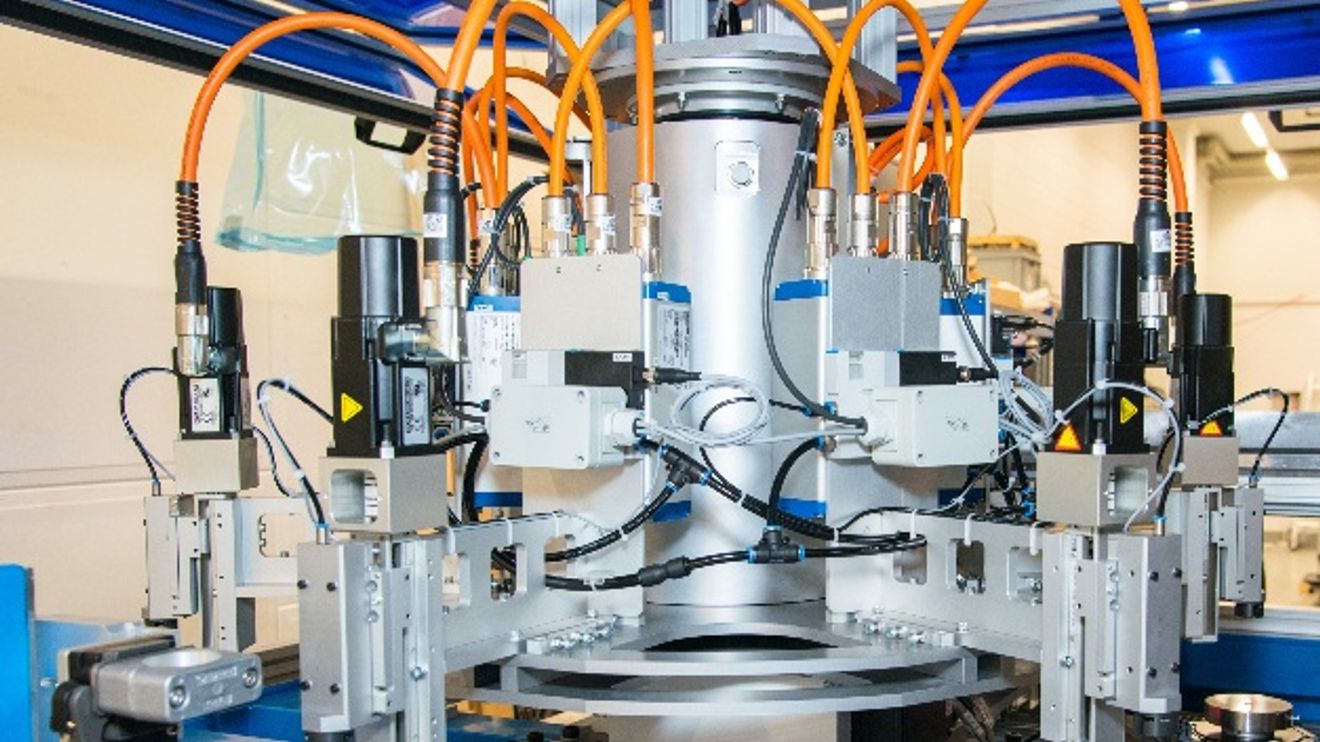
Slip rings came along with electric motors and generators. The functional principle with sliding contacts on rotating circular conductors is basically simple. It is the detailed questions that today form challenging work packages for development - for example with regard to the growing role of safety technology in mechanical engineering. It is not quite so simple to transfer data, energy, air or liquids from a static location to an endlessly rotating component - as the example of rotary indexing tables shows.
In rotary indexing tables, which are widely used in assembly and test bench technology, for example, different processing stations are placed along an outer radius. Each time they are indexed, they take the component in the workpiece carrier one production step further. If the workpieces on the rotating table also need to be positioned rotationally or linearly, the drives must move with them. Slip ring systems are used to transmit the necessary power and control data. This technology is well established and works reliably over a long service life. However, the topic becomes exciting when safety-relevant data also needs to be transmitted via such a slip ring. Kollmorgen was faced with this task as part of a project for a manufacturer of measuring inspection machines, which used it to examine the behavior of crystalline components.
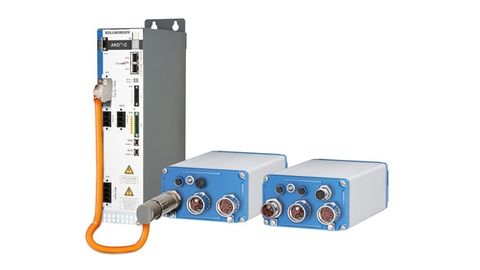
The combination of Safe Torque Off and single-cable connection technology enables a lean installation with decentralized servo controllers.
© KollmorgenThe engineering project envisaged installing not only the actuators but also the control system decentrally on the rotary indexing table to save space. Kollmorgen solved this task with the decentralized AKD-N servo controllers and compact AKM synchronous servo motors. The main advantages of the decentralized design and the connection technology between controller and motor with just one cable: small control cabinets and less space required for installation. In addition, the single-cable connection technology with the loop-through option from controller to controller improved the inertia behavior of the rotary indexing table. The requirement for safety technology still had to be met. This is integrated in the test station in the central AKD-C power supply module. Consequently, the connection to the servo axes is required.
The safe torque off (STO) was necessary because, with a diameter of the rotary indexing table of 120 cm, masses are moved that represent a potential hazard for humans. However, the test procedure does provide for the operator to intervene in the system, which ultimately results in Safe Torque Off in the safety assessment.
The central AKD-C power feed module has STO on board as standard - but in conjunction with clearly defined and certified cables. However, the use of a slip ring as a link between the central power supply module and the controllers used would inevitably interrupt the cable and invalidate the certification. The same applies at this point to any existing UL approval. It would also no longer be effective.
As part of the engineering project, Kollmorgen joined forces with the test bench manufacturer to search for a suitable slip ring manufacturer, who in turn was willing and able to develop a safety slip ring with TÜV approval together with the servo drive technology specialists.
One of the challenges in the project was how the naturally occurring wear of the contacts could be safely controlled through the lens of safety technology. According to the manufacturer, the slip rings from Stemmann-Technik's Bako LP series that were ultimately used promised a reliable service life of 35 million revolutions at maximum speeds of up to 80 rpm.
Another challenging task was to reliably transmit the safety signals without interference. It should be noted here that the shielding integrated in cables is no longer present in the slip ring. Consequently, ways are required to prevent signal errors caused by the coupling of interference signals.
Interference-resistant signal communication
Kollmorgen and Stemmann-Technik achieve this resistance to the well-known problems associated with EMC through two measures: Firstly, two shielded connection cassettes in the safety slip ring separate the power from the Ethercat communication, via which the superimposed safety signal is also transmitted. This ensures that the magnetic influences of harmonics in the power conductors in particular do not cause any signal interference.
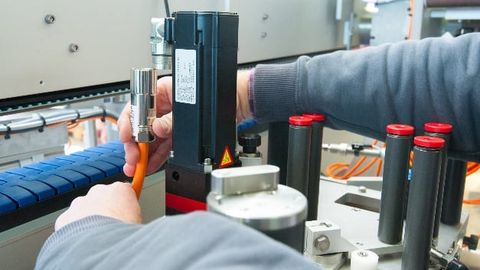
The servomotors can also be installed quickly and space-savingly thanks to the single-cable connection technology.
© KollmorgenThe second aspect for high interference immunity within the slip ring lies in the structure of the safety signals. In contrast to the usual practice of implementing STO with 5 V (DC) or 24 V (DC) signals, Kollmorgen uses alternating current signals with fixed frequency patterns between the AKD-C as the central module and the decentralized AKD-N servo controllers.
In practice, this detail ensures that possible interference signals are completely ignored by the drive if they do not have exactly the same frequency. As a result, this method is significantly more robust against interference - which, in combination with the two separate connection cassettes for power and signals, ultimately led to certification by TÜV Süd. Equipped with this, the machine manufacturer has the advantage of being able to safely switch off the rotary indexing table without losing access to the traveling positioning drives for the workpiece carriers. Full access to all controllers is maintained even in the event of an emergency stop - which ultimately saves time-consuming referencing as a result of undefined states.
In a nutshell: the safety slip ring solution described creates the basis for not having to forego the advantages of drive-based safety technology, even in applications with a slip ring connection. The certification of STO in the slip ring paves the way for implementing the safely switched-off torque in rotating applications with the innovative single-cable connection technology and decentralized servo controllers.
Author:
Felix Haunschild works in the Safety Development department at Kollmorgen Europe, Ratingen.


You might also be interested in
Safety first
The development of cobots into a commodity product is closely linked to the issue of safety in robotics - a challenge that needs to be mastered efficiently.
 read more...
Locking with need for clarification - help with risk assessment
DIN EN ISO 1419 has already been available for five years. However, there are always uncertainties regarding the actual safety functions of a guard locking device, which the machine manufacturer must evaluate based on his risk assessment. Here is...
read more...Safe operation via radio - (how) does it work?
Many machine builders want to use tablets in addition to the existing machine operation. Demanded features such as WLAN, camera, multi-touch and much more are available here - but if safety functions are required, these devices reach their limits.
read more...Heavy-duty HRC requires new safety approaches
The topic of HRC is not just for 'lightweights'. In the field of heavy-duty robotics, solutions will also be in demand in the future that allow humans and robots to work together directly without the need for a safety fence. However, this requires...
read more...Validation neglected
EN ISO 13849 is decisive for the integration of safety-related control functions in machines. However, the part of the standard relating to validation is often neglected in practice - a major shortcoming.
read more...Dangerous movements well secured
How can dangerous movements be safeguarded? A challenge for the user, as there are a wide variety of functional and normative requirements. An overview.
read more...The intelligent safety switch
Safety modules and safety switches that communicate at I4.0 level simplify troubleshooting. However, the communication capability also has interesting potential for predictive maintenance and tamper protection.
read more...The vampire effect of quantification
There are always controversial discussions regarding the determination of risks for products and systems. But which approaches actually make sense in the context of safety and security? What approach does the new framework for safety and security -...
read more...Warnings - less is often more!
Many operating instructions contain warnings 'to death'. This may be reassuring for the manufacturer, but for the reader it means that relevant information is barely noticed - possibly with fatal consequences for people, the environment and the...
read more...