

Festo
Mobile robot system for assembly and intralogistics
With the 'BionicMobileAssistant', Festo has developed the prototype of a robot system that moves autonomously in space and can recognize objects, grip them adaptively and work on them together with humans.
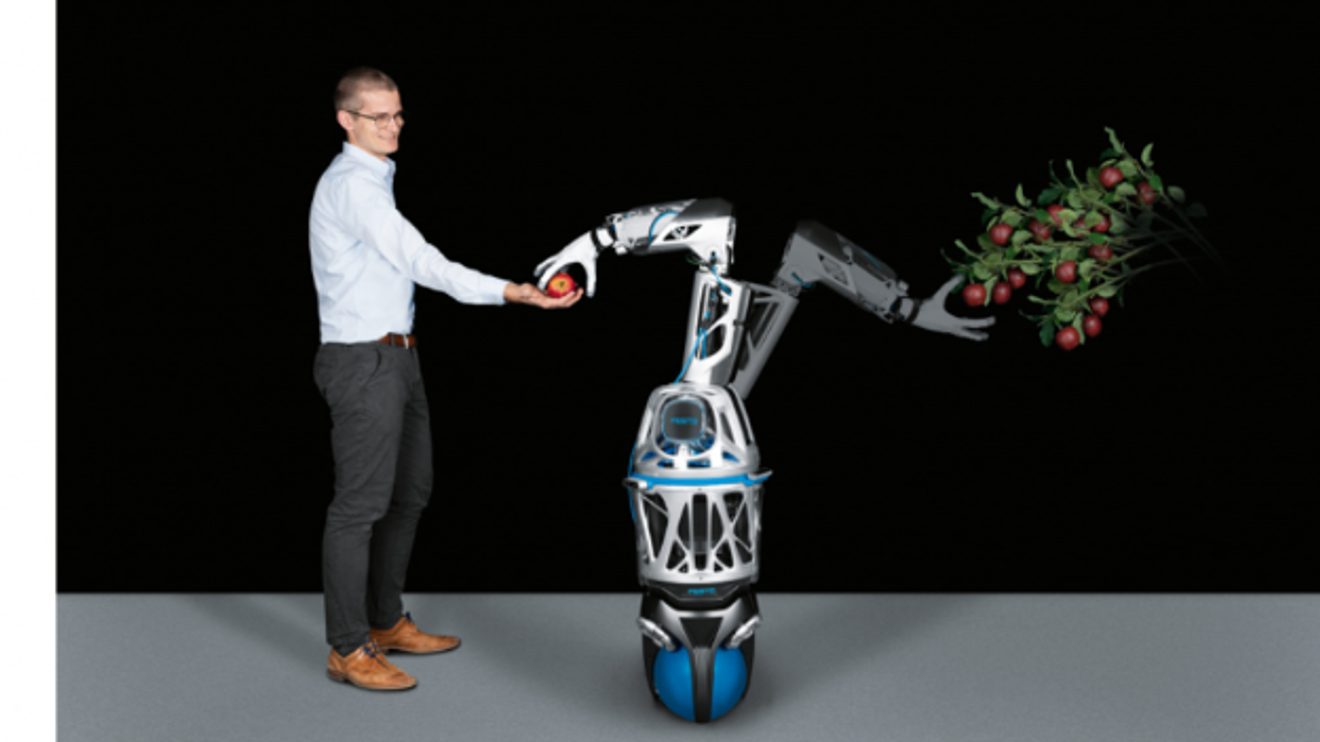
The entire system, which was developed in cooperation with ETH Zurich, has a modular structure and consists of three subsystems: a mobile robot, an electric robot arm and the 'BionicSoftHand 2.0'. This pneumatic gripper is inspired by the human hand - Festo presented an initial version in 2019.
To enable the 'BionicSoftHand 2.0' to perform the movements of the human hand in a natural way, small valve technology, sensors, electronics and mechanical components are integrated in a very small space. The fingers and opposable thumb consist of flexible bellows structures with air chambers, encased in a firm yet flexible knitted textile. This makes the hand light, adaptable and sensitive, but still capable of exerting strong forces. The pneumatic fingers are controlled via a compact valve terminal with piezo valves, which is attached directly to the hand.
In order to increase the range of movement of the thumb and index finger compared to the first version of the 'BionicSoftHand', the developers have significantly increased the lateral swivel range of both fingers. As a result, they can now work together optimally and grip very precisely. Thanks to a 3D-printed wrist with two degrees of freedom, the hand can also move forwards and backwards as well as to the left and right. This also enables gripping with a tight radius.
For more stability in the fingers, there are now two structural elements in each of the air chambers that act as bones. A bending sensor with two segments per finger determines the position of the fingertips. The hand also wears a glove with tactile force sensors on the fingertips, the palm and the outer sides of the robotic hand. This enables it to feel the properties of the gripped object and adapt its gripping force to the respective object - just like us humans.
In addition to tactile sensors, the hand has a depth camera on the inside of the wrist for visual object detection. With its help, the robotic hand can recognize and grasp various objects, even if they are partially covered. After appropriate training, the hand can also use the recorded data to assess the objects and distinguish good from bad, for example. The information is processed by a neural network that has been trained in advance with the help of data augmentation.
The 'BionicSoftHand 2.0' is combined with a mobile ballbot and a lightweight, electric robotic arm - the 'DynaArm'. It enables fast and dynamic movements. This is thanks to its lightweight design with highly integrated drive modules weighing just one kilogram.
The developers rely on an ingenious drive concept for the Ballbot: the robot balances on a ball. This allows the 'BionicMobileAssistant' to maneuver in any direction. The system has its entire energy supply on board: the battery for the arm and robot is located in the body; the compressed air cartridge for the pneumatic hand is installed in the upper arm. This means that the robot is not only mobile, it can also work autonomously. The algorithms stored on the host computer also control the autonomous movements of the system. With the help of two cameras, the robot orients itself independently in space.
The system would be predestined for use as a direct assistant to humans, for example as a service robot, as a helping hand in assembly or to support workers in ergonomically stressful or monotonous tasks. They could also be used in environments where humans cannot work, for example due to hazards or limited accessibility. Maintenance or repair work, the measurement of data or visual inspections are particularly conceivable. It is also conceivable that mobile robots could take on the simplest tasks in areas where there is an increased risk of infection or a lack of personnel due to infection. For example, a possible future scenario could be that they bring drinks and food to tables in restaurants or deliver medication to hospital patients or people in need of care in retirement homes.
Thanks to its modular concept, the 'BionicSoftHand 2.0' can also be quickly mounted on other robot arms and easily put into operation.


You might also be interested in
No more machine downtime!
Festo presented the 'Festo Automation Experience' label - 'Festo AX' for short - at SPS Connect. Dr. Dominic Kraus, Product Manager Digital Business at Festo, explains what's behind it.
 read more...
30 % shorter cycle times
According to the manufacturer Festo, the most important features of the cantilever axis with toothed belt ELCC-TB include its compact design, 30 % shorter cycle times and 50 % less vibration.
read more...SPS Connect 11/25 - 11:05 - 11:45 a.m.
Big data analytics at the edge for mechanical engineering
The topic of data analysis has been part of mechanical engineering for a very long time. But why is big data analytics coming to the fore in mechanical engineering right now?
read more...SPS Connect 11/25 - 11:20 - 11:40 a.m.
End-to-end connectivity combined with complete...
Process transparency: The next big step into the digital age. Get to know Festo Automation Experience - the software for condition monitoring, preventive maintenance of components as well as machines and systems.
read more...SPS Connect 24.11. - 15:10 -15:30
News from the administration shell
The interoperable digital twin Industry 4.0 in the implementation perspective. This presentation presents the latest developments of the Industrie 4.0 platform and ZVEI with regard to the administration shell.
read more...Precise and non-contact temperature monitoring
The Flir A400/A700 fixed thermal imaging cameras are available from Flir Systems as a smart sensor and image streaming solution. They can be used to monitor plants, production lines and critical infrastructures and check people for an elevated body...
read more...The self-sufficient fault detective
How can operators of existing interlinked machines and systems create a holistic data picture of the technical behavior and environmental variables of their production lines? One approach is a mobile sensor system developed by Fraunhofer IOSB-INA.
read more...Productive and safe
Independent Cart Technology (ICT) is a new generation of drive systems for production. As intelligent conveyor systems, they are an efficient alternative to conventional conveyor and positioning systems. But are they also safe?
read more...Programming even by non-professionals
The TracePen from Wandelbots makes it possible to assign tasks to robots easily and without programming knowledge. According to the provider, even non-experts can use it to train robots for a task.
read more...