

Fraunhofer IWU - with video
Market-ready gesture control for robots
The Fraunhofer IWU reports: Industrial gesture control for robots is now ready for the market. It complies with the applicable guidelines on machine safety and data protection.
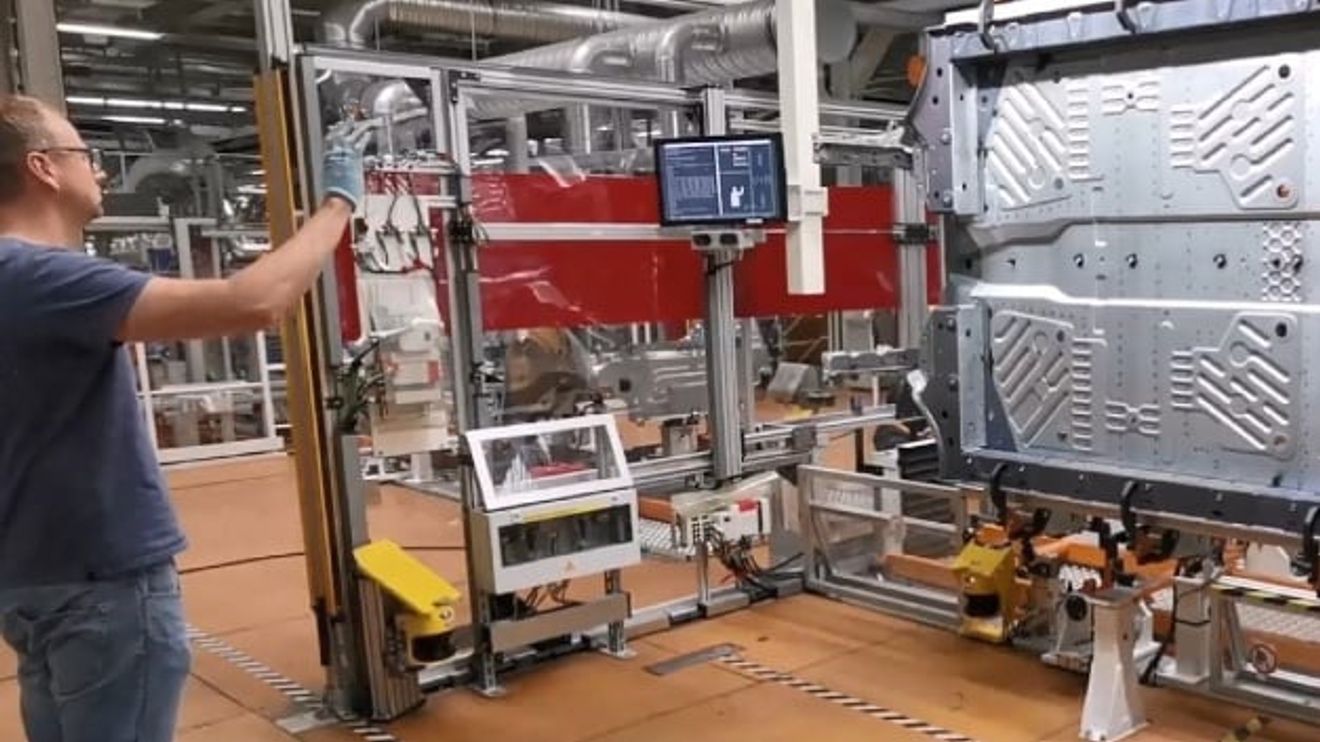
Automotive production at Volkswagen in Zwickau: Contact-free gesture control of heavy-duty robots in application testing.
© Fraunhofer IWUGesture control is not a new development; it is already being used in some areas. For industrial applications, a few things still needed to be clarified. The Fraunhofer Institute for Machine Tools and Forming Technology IWU has now announced: Industrial gesture control is now ready for the market. The researchers are certain that gesture control of robots by humans will make their collaboration in production more intuitive, efficient and ergonomic. What's more, applicable guidelines on machine safety and data protection are complied with.
Controlling colleagues' robots with gestures
In the future, people will be able to control their colleagues' robots contactlessly with their arms and hands using gestures. "During development, this always reminded us of conducting a choir or orchestra. In our gesture control system, the members of the 'ensemble', namely the robots, also pay very close attention to arm and hand movements," explains Paul Eichler, project manager in the Department of Robotics at Fraunhofer IWU. "Conventional operating elements such as buttons and switches become superfluous. Employees can move naturally to interact with the robots - as if they were signaling a 'stop' or a direction to another person in the factory."
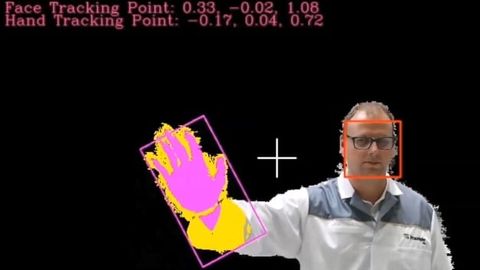
This is how the robot sees a human: A Fraunhofer IWU researcher demonstrates industrial gesture control from the perspective of a robot.
© Fraunhofer IWUFor touch-free robot control, the researchers use specially developed path planning algorithms, smart optical sensors, fast and stable image processing methods and freely placeable user interfaces - all coordinated with each other. "Our technology brings gesture control to the industrial sector. Many people are familiar with it from home, where it has so far mainly been used in computer games, such as consoles for home use. The player's movements are detected and immediately translated into game maneuvers on the screen. However, we are not controlling game characters here, but machines and systems," says Dr. Mohamad Bdiwi, Head of the Robotics Department at Fraunhofer IWU, explaining the principle. "Programming skills are no longer necessary for direct control. The employees control the robots intuitively."
Proven market maturity in e-car manufacturing
The gesture control of industrial robots is technically mature and reliable. It complies with the applicable safety requirements for certification in accordance with the EU Machinery Directive. Anonymization procedures are also integrated. As data is not stored in a cloud but processed on site in the factory, data protection is also ensured in accordance with the GDPR.
The fact that gesture control works reliably and safely and can also be introduced into industrial production has been proven in the body shop of electric vehicles at Volkswagen Saxony. The company sees clear advantages in the production of the ultra-modern modular electric drive matrix (MEB). IWU project manager Paul Eichler: "The motivation for our partner was to improve the ergonomics for the employees in the testing and work station at the end of the welding line in the body shop. We have shown that our system of gesture-controlled heavy-duty robots has many advantages in production. Gesture control enables employees to adjust the position and orientation of the robot individually and in fine increments. This makes production more efficient and flexible."
Gesture control also fundamentally facilitates collaboration between humans and robots. Although they now often work side by side without a safety fence, direct interaction was previously not possible. In close proximity to humans, industrial robots switch off for safety reasons. Now the two can work together directly and safely.
Focus on 'Cyber-Physical-Human Systems' at the Chemnitz site
Intuitively controlling production robots with gestures is one example of the innovative strength of the Chemnitz site in the field of cyber-physical-human systems (CPHS). The Fraunhofer IWU works closely with the Chair of General Psychology and Human Factors at Chemnitz University of Technology across the boundaries of scientific disciplines. There, research is being conducted into the cognition-based support of psychological processes and their implementation in technical systems using artificial intelligence algorithms.
Dr. habil. Franziska Bocklisch, head of the professorship, explains the joint research objectives with Fraunhofer IWU: "The close interaction between humans and technology in Industry 4.0 shows how important it is to combine technology and human sciences. In the future, many more complex tasks will only be able to be mastered by humans and technology working together. This poses completely new challenges for human-centered technology development, for example in the targeted support of human information processing in the operation and maintenance of production systems. In Chemnitz, we have pooled the necessary transdisciplinary expertise to ensure that humans and robots can work together harmoniously in the production process."


You might also be interested in
*****ENG*****Mobile assistance robots in assembly line production
Robotics experts from the Fraunhofer IFF have collaborated with partners from industry and research to develop new technologies that enable mobile assistant robots to perform assembly tasks even on moving objects such as in flow manufacturing.
 read more...
Mobile assistance robots in flow production
Together with partners from industry and research, robotics experts at the Fraunhofer IFF have developed new technologies that enable mobile assistance robots to perform assembly tasks even on moving objects such as in flow production.
read more...Portfolio of collaborative robots expanded
ABB is expanding its portfolio of collaborative robots (cobots) with the 'GoFa' and 'Swifti' cobot families, which offer higher payloads and speeds.
read more...Robotics for schools and training companies
In many professions, knowledge of robotics will be a prerequisite for a successful application in the future. This is why schools and training companies are now integrating robotics into their curricula - including in the form of special robot...
read more...These 5 trends will shape robotics in 2021
Robot density is increasing rapidly in all industries worldwide. With new application possibilities, robots are also learning new tricks and helping to reduce the CO2 footprint. The 5 top trends in robotics.
read more...New president at robotics provider
Teradyne has appointed Kim Povlsen as the new President of Universal Robots. Povlsen will assume the role on March 1, 2021.
read more...Angle measurement in the smallest space
Thanks to their housing depth of just 6 mm and a housing diameter of 16.4 mm, the hollow-shaft conductive plastic potentiometers in the 'MHP16' series from Megatron are particularly suitable as position indicators in motor valves and actuators.
read more...Psychosocial aspects of human-robot collaboration
How can robots be used outside of production? Kuka is researching this in collaboration with the BMBF, the German Sport University and RWTH Aachen University. The RoboGym shows what it can look like in reality.
read more...Cyber security for industrial robots
Kaspersky and Alias Robotics have entered into a partnership to jointly improve the cyber security of robots used in OT networks.
read more...