

Machine tools / robotics
Planetary and cycloidal gears in comparison
If precision gearboxes are to be used in robotics or automation, designers are faced with a choice between two different types of gearbox: planetary and cycloidal gearboxes. The advantages and disadvantages of both solutions.
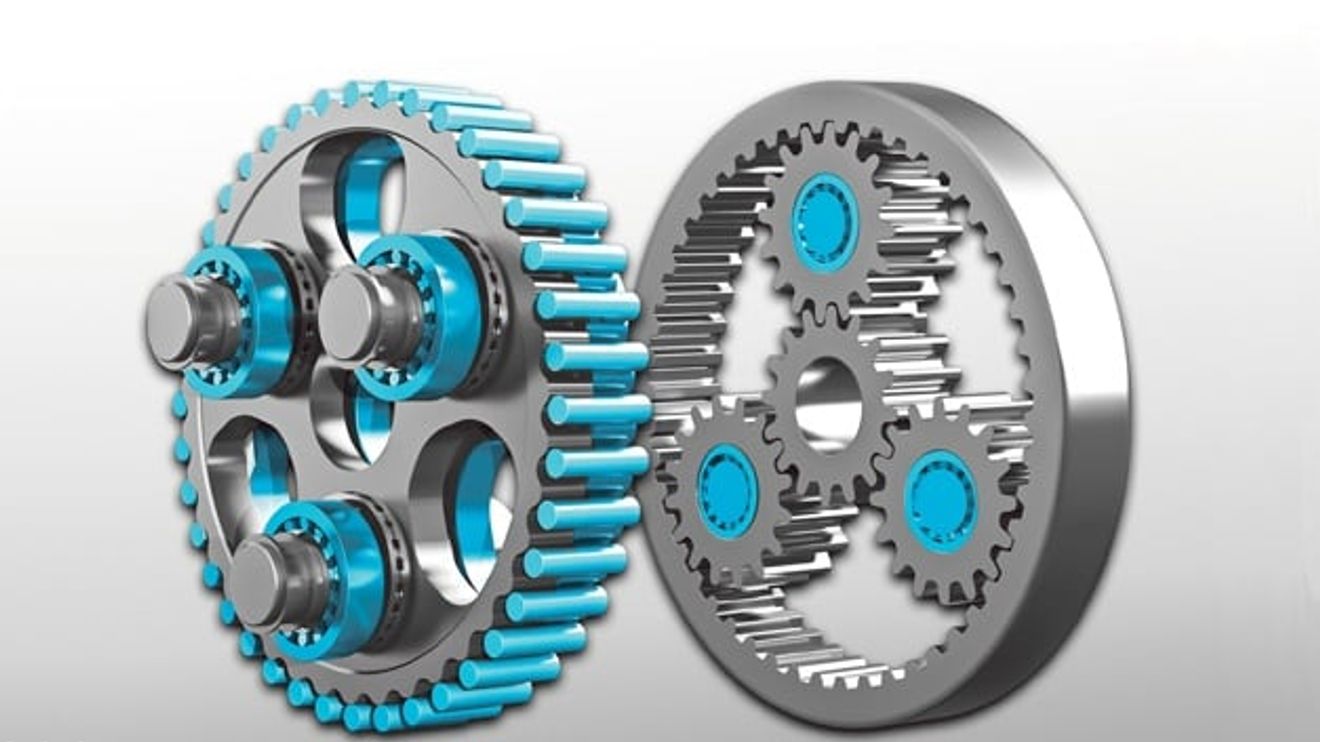
Applications in robotics or machine tool construction generally require a high level of precision. Robust precision gears with a long service life are required to guarantee this in the long term. With planetary and cycloidal gears, two different designs have become established here. Design engineers should therefore be aware of the respective advantages and disadvantages of these gearbox types and weigh them up in order to find the optimum reduction solution.
Planetary gearboxes distribute the load
Planetary gearboxes essentially consist of three basic elements: a central sun gear, three or more satellite or planetary gears and a ring gear. In a typical planetary gearbox, the sun gear transmits the movement to the satellites. These then roll in the static ring gear. The planetary gears are mounted on the planet carrier, which transmits the speed to the output shaft. "With planetary gearboxes, gear ratios from 3:1 to 100:1 are generally possible with one or two gear stages," explains Marcus Löw, Sales Manager at Nabtesco Precision Europe. By adding one or more preliminary stages, the overall reduction ratio can be further increased.
In contrast to simple reduction solutions, such as worm gears, planetary gears exert less force on the gears, as the torque is always distributed over several gears. This distribution also ensures low-noise operation without interrupting the power flow.

Cycloidal gearbox with two-stage reduction ratio
Cycloidal gears, on the other hand, rely on two-stage drive components. They mainly consist of four components: a drive shaft, two to three eccentric shafts, two cam disks and an output shaft that runs slowly according to the reduction ratio. In the first stage, the rotary movement of the servomotor is transmitted to the spur gears via the input shaft. The speed is reduced according to the reduction ratio of the input shaft to the spur gears. The spur gears are mounted on eccentric shafts, each of which has three eccentrics offset by 120°. The two cams are driven via a bearing on the eccentrics. The three eccentric shafts on the output and input side are each mounted on bearings.
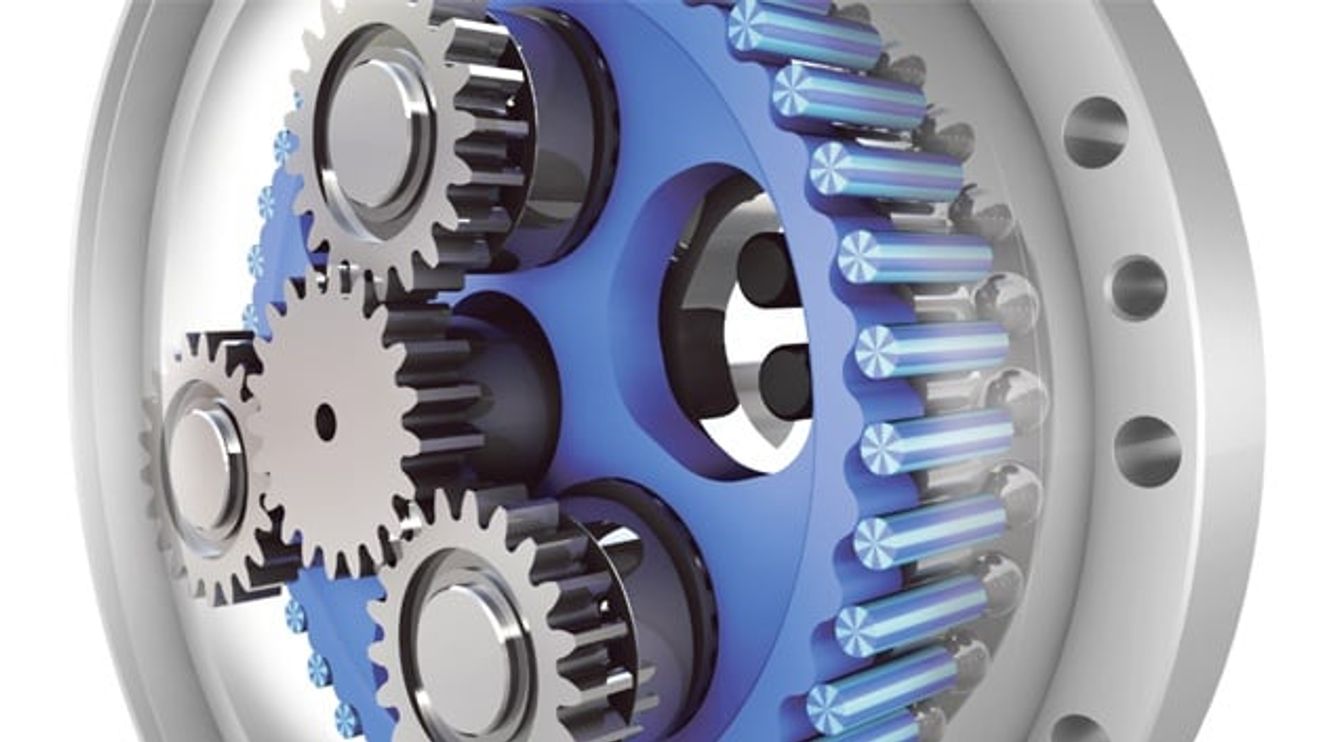
The almost 100% contact within the cycloidal pin design and the even force distribution within the gearbox allow a high load with low backlash.
© NabtescoA cam profile corresponding to the cam disks is incorporated on the inside of the housing. This forms the second reduction stage. The cam profile in the housing has one more recess than the cams. Pins arranged between the cams and the cam profile in the housing transmit the rotary movement to the output shaft in a rolling motion. When the eccentric shafts complete a full rotation, the cams rotate off-center by one pitch. All cams of the cam disk touch the pins and roll on them.
So-called tooth engagement is ensured over the entire circumference of the cam profile, as the two cam disks on the eccentrics are shifted by 180° in relation to each other. This means that torques of up to 5 times the nominal torque can be transmitted with a precision of less than one angular minute with extremely smooth running and high reduction ratios can be achieved thanks to the two reduction stages. Specifically, cycloidal gears allow reduction ratios from 30:1 to over 300:1 - without additional preliminary stages, which are otherwise necessary with standard planetary gears.

The gearboxes in the RV-C series from Nabtesco have a hollow shaft that allows supply and data cables, wires or lasers to be routed through the gearbox.
© Nabtesco"The power transmission via pins and rollers, which is typical of cycloidal gears, ensures high efficiency, a long service life and extremely low backlash in the gearbox," says Marcus Löw, highlighting the main advantages over planetary gears. "In addition, the rolling friction of all elements involved in the power transmission guarantees a very low breakaway torque - 0.1 Nm to around 5.9 Nm, depending on the size and transmission ratio."
The two-stage reduction principle reduces vibrations and mass inertia and allows larger reduction ratios. The almost complete contact within the cycloidal pin design and the even force distribution within the gearbox also allow a high load with low backlash.
Thanks to this special design, the gearboxes achieve high repeatability and path accuracy. In the zero crossing of the hysteresis, for example, the opening of the RV gearboxes from Nabtesco is significantly less than one angular minute. The symmetrical design and the roller bearing support of all shafts also ensure constant operating behavior over the entire service life. They also allow high load peaks of up to five times the nominal torque, as can occur in emergency stop situations, for example.
The decision criteria
When it comes to deciding between cycloidal and planetary gearboxes in the design phase, the first thing to consider is the precision required in the application: "If play and positioning accuracy are essential, cycloidal gearboxes consistently offer the better performance data," says Marcus Löw. In other words: "Cycloidal gears have a more robust design than planetary gears and therefore have a longer service life. Even over a long period of time, the backlash increase in cycloidal gears is extremely low." Due to their design, they are significantly stiffer, more compact (around 50 % shorter) and lighter than multi-stage planetary gearboxes. They also offer 500 % higher overload safety. Another important criterion is the required reduction ratio. With reduction ratios of 3:1 to 100:1, planetary gearboxes offer a high torque density. "Even if it is possible in principle, the design of cycloidal gears makes it difficult to achieve reduction ratios below 30:1 without an additional preliminary stage," says Marcus Löw. "However, if the required reduction ratios are above 30:1, cycloidal gears have an advantage, as they do not require any additional preliminary stages compared to planetary gears."
When comparing the dimensions of the two gearbox types, it is noticeable that the overall length of planetary gearboxes increases noticeably with increasing reduction ratios. For example, multi-stage planetary gearboxes are around 30 to 40 % longer than cycloidal gearboxes with identical reduction ratios. Cycloidal gears, on the other hand, have a diameter that is around 10 % larger with a shorter overall length.
According to Löw, in order to find the optimum gearbox in each case, it is necessary to consider all the requirement parameters of the individual work cycles with regard to service life and emergency stop situations. Special attention must therefore be paid to the specifications of the individual gearboxes: "The design of an application should always be based on the gearbox in order to achieve the best possible economic performance," advises the expert. This makes it easier to design the entire application.
Cycloidal gearboxes such as those from Nabtesco are primarily used in applications that require fast and precise positioning movements with high loads without resonance. Optional gearboxes allow motors to be mounted at right angles and also enable larger reduction ratios than those already offered by the factory of up to i = 300. With other gearboxes, these can only be realized via several planetary stages.
The RV-E series combines the RV gearboxes with large integrated angular contact ball bearings. They are used to absorb external forces and torques; an additional external bearing is unnecessary. This results in precision gearboxes in a compact design with extreme rigidity and long, constant operating behavior.
Author:
Axel Hahne is a technical editor from Buchholz.


You might also be interested in
New approaches in drive technology
Nabtesco develops physical AI solutions
Nabtesco is working on intelligent drive systems for industrial applications. The focus here is on the use of physical AI, the combination of artificial intelligence with real physical systems.
 read more...
Sumitomo Drive Technologies at the SPS 2024
Precision gearbox expands portfolio
Sumitomo Drive Technologies is expanding its DA series precision gearbox portfolio to include size 10, the smallest single-stage gearbox in the series with an outer diameter of just 110 mm.
read more...Easy to implement
Leantechnik rack and pinion gearboxes can be used to design all types of lifting and positioning systems. Integration into the application is easy thanks to the 3D product configurator from Cadenas.
read more...Relieving the load on large gearboxes with a new control strategy
The IMA at the University of Stuttgart has developed a new monitoring and control system that detects damage to large gearboxes and provides relief without affecting the overall performance of the system. Unscheduled maintenance is reduced.
read more...Precision gearboxes for the food industry
The gearboxes in the 'Neco' and 'RD-C' series from Nabtesco have a hygienic design with smooth surfaces and optimized seals, making them easy to clean
read more...The gearbox makes the robot
How precise, strong and fast a robot is depends on the performance of the gearboxes used. In the white paper, you can find out what is important in the design and how your robot can also benefit from the properties of Nabtesco gearboxes.
read more...Rigid shaft coupling with overload protection
KBK combines a rigid shaft coupling with a safety coupling in its second "Hero" coupling combination 'THH'.
read more...New president at Farnell
Avnet has appointed Rebeca Obregon as the new President of Farnell, an Avnet company, effective July 1, 2024. Farnell is a high-service distributor of electronic components.
read more...Stepper motors with Neugart gearbox
The stepper motors of the AZ series from Oriental Motor are now available with PLE planetary gearboxes from Neugart.
read more...