

ISW Stuttgart
Continuity - the new paradigm
Flexible, adaptable, dynamic and digital - tomorrow's production technology should be all of these things. The software-defined manufacturing research project aims to turn this vision into reality for the vehicle and supplier industry.
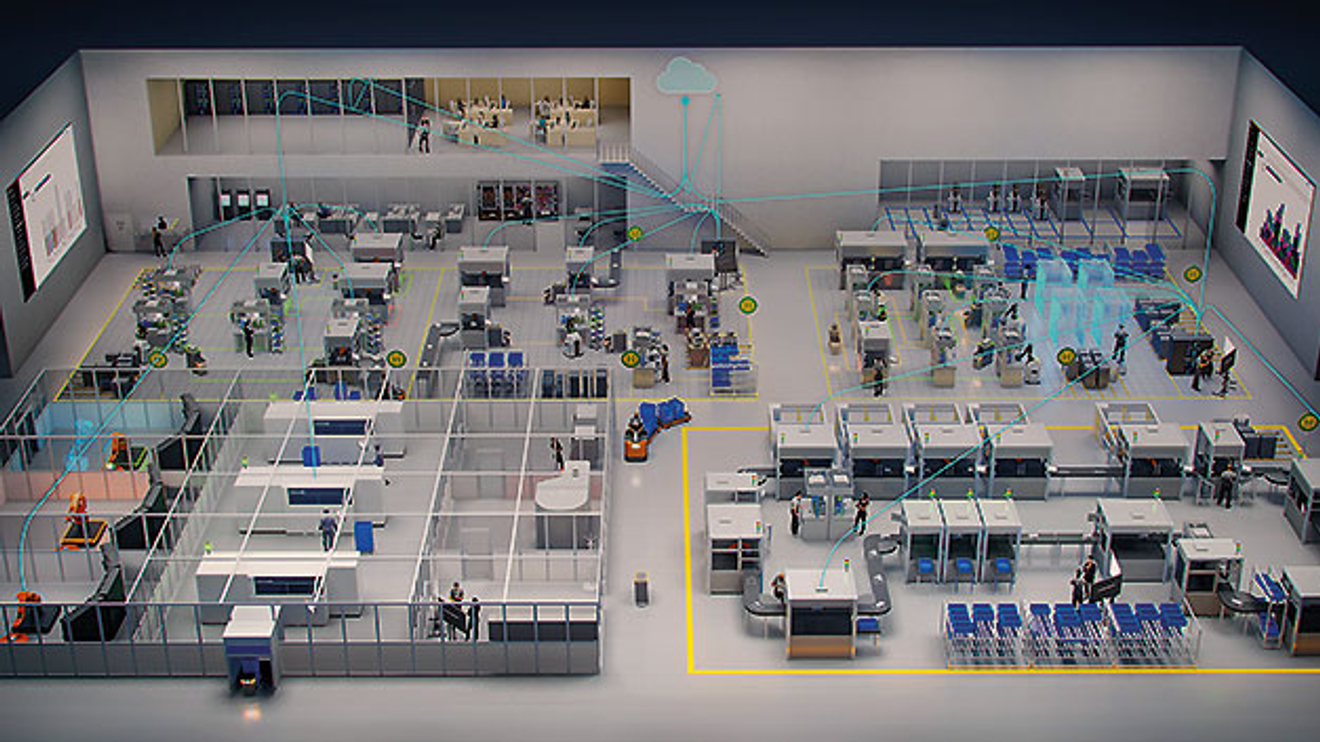
In times of highly volatile markets and great uncertainty in supply chains, flexibility and adaptability are key success factors for the manufacturing industry. For decades, these parameters have been optimized and solutions for fully automatic adaptation have been developed. Nevertheless, the production systems used are still relatively rigid. Machines and systems are tailored specifically to the product to be manufactured. Hardware and software are permanently linked to each other, usually cannot be adapted and are sold as a proprietary overall system. The IT world, with its high level of innovation and dynamism, which is characterized by adaptability, fast innovation cycles and a flexible response to customer requirements, is seen as a successful alternative.
| The Software-defined Manufacturing research project |
|---|
| As part of the research project Software-defined Manufacturing for the automotive and supplier industry (SDM4FZI), a total of 28 companies along the entire value chain and two universities will be developing the foundations required for SDM over the next three years. The Federal Ministry for Economic Affairs and Climate Protection (BMWK) is funding the project with around 35 million euros(http://www.sdm4fzi.de). The project is led by a cross-partner core team, which is also committed to the dissemination and community concept of the idea and has contributed to the publication of this article. These include Michael Neubauer, Carsten Ellwein, Florian Frick from ISW Uni Stuttgart, Dr. Johannes Fisel, Dr. David Kampert, Dr. Urs Leberle from Bosch, Marvin Carl May, Sebastian Behrendt from wbk KIT, Ernst Esslinger from Homag, Dennis Pfeifer from ISG Industrielle Steuerungstechnik and Dr. Peter Zahn from Nagel Maschinen- und Werkzeugfabrik. |
However, a quantum leap in terms of flexibility and adaptability in the production environment can only be achieved through a paradigm shift that focuses not only on technologies, but also on methods, processes, business models and, in particular, the mindset: software-defined manufacturing (SDM) is needed.
The paradigm of continuity
In the IT environment, the term continuity is omnipresent, particularly in the forms of continuous integration, continuous delivery and continuous deployment - i.e. the constant integration of new software fragments into the product stack, the continuous provision of an up-to-date compilation and the automated installation of the latest compilation on a defined target system. The previously prevailing principle of the large, regular publication of new product versions - so-called releases - is thus replaced by a paradigm of evolutionary software products in which the product continuously develops together with the needs of its consumers. Continuity in the form of the Continuous-X approach therefore makes a decisive contribution to agile methods and allows us to react to changing market needs at an early stage. This results, for example, in fast and cost-effective software adaptations thanks to modular systems, lean processes and routine implementation.
In the context of software-defined manufacturing (SDM), the paradigm of Continuous-X is therefore transferred to the manufacturing industry. The resulting process is shown in the form of the two superimposed loops in Figure 1.
The conventional management of plants and production systems typically takes place in connection with projects for conversions or expansions. The depiction of the blue (outer) loop describes that the management of plants and production systems in SDM logic is considered continuously and in conjunction with engineering.
The left, blue wing shows the software-supported planning and development of a product. The right, blue wing represents the real system and includes its realization, commissioning and operation. At the intersection of these two wings, the transition to realization takes place from left to right and the system adjustments from right to left. This familiar and commonly used flow through agile product development and production already shows in the way it is presented that continuity in the form of pure consistency and adaptability is ensured by the feedback of the system into the work on it.
However, in order to follow the model of software development in its entirety, the possibility of reacting agilely to changing conditions is missing. At this point, the methods from IT cannot be transferred directly to industrial production. The construction and operation of a factory is much more complex and extends across a large supplier network with a large number of participating companies. In order to be able to use IT methods despite the inertia of the system here, the SDM approach extends the real systems with virtual ones. This results in correspondingly modified processes. Their realization allows the process to be extended by the second, inner, grey loop. On the left, parallel to software-supported engineering on the blue path, new methods on the gray path no longer merely support engineering, but drive it independently and, based on findings from previous runs, independently derive new planning, model and software generations (for example for production control). On the right-hand side, the real system and a virtual image are supplemented by the gray second path. Initially created models, plans and software fragments, as well as subsequent generations of evolutionary development, therefore do not have to be tested in the real system, but can be simulatively tested on the digital twin in order to make targeted improvements and validate them appropriately.
The overlapping of the two loops, at whose intersections the run can be changed not only from right to left, but also from blue to grey and vice versa, results in many completely different possibilities for implementing a run. This flexibility and the resulting agility now make it possible to transfer the idea of Continuous X in its full breadth to the manufacturing industry; for example in the forms of Continuous Engineering, Continuous Simulation, Continuous Monitoring and Continuous Improvement.
New paradigm, new architecture
Current OT solutions are characterized by heterogeneous technologies, manufacturer-specific ecosystems and monolithic solutions from the cable to the cloud. The implementation of SDM therefore requires a rethink from the system architecture to the technical implementation. Following the example of IT and the divide-and-conquer approach that prevails there, the system is divided into cooperating subsystems that have clear tasks, are connected by open interfaces and are characterized by interoperability. Another decisive factor is consistent abstraction by means of a layer model, which abstracts and encapsulates complex technologies for applications.
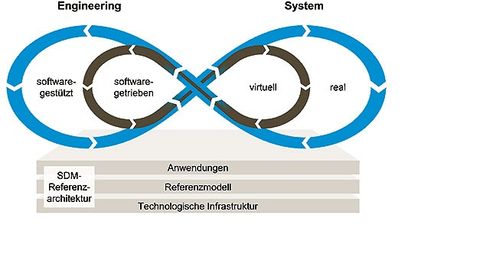
The SDM reference architecture(Figure 1) can be divided into three levels: The actual production and value creation takes place at the application level. This is based on an abstraction level, which guarantees interoperability between application modules and the infrastructure level through suitable reference models, administration shells and function interfaces. The technological infrastructure forms the basis of the architecture. This combines hardware and software components as well as communication.
The SDM infrastructure follows the as-a-service concept. Applications are not developed for a specific platform or communication technology, but require the infrastructure to provide certain computing and communication resources that must meet application-dependent requirements. The infrastructure itself is responsible for implementation.
Various current technologies are used for implementation. Various virtualization solutions in the form of virtual machines and lightweight container solutions are used to provide compute resources. The aspect of real-time capability in particular is of central importance for many SDM use cases. Communication between individual platforms and systems should also be seen as an integral part of the infrastructure. The focus here is on convergent real-time capable communication networks, which are to be used via a uniform layer. In terms of technology, the focus here is on TSN, DetNet, Wireless TSN and 5G on the lower communication layers, while OPC UA is a central component on the higher layers.
"Developing" the technological infrastructure centrally and top-down is not considered expedient due to its complexity. Instead, it should be viewed as a dynamic, continuous ecosystem that is to be shaped, explained and improved as part of SDM.
SDM in practice
SDM is not a theoretical approach, nor can it be developed on paper and then implemented. In addition to the technological drivers and the nine mindsets, it is primarily applications that drive development forward. Innovative solutions that can already be implemented today using SDM are shown below:
- Virtualization: Adapting production to new requirements is costly and time-consuming; planned change capability requires large initial investments. A new flexibility can be created by consistently separating the application from the underlying infrastructure. The separation of hardware and controls allows continuous changes, updates and a new level of flexibility and adaptability (continuous deployment, continuous integration). A concrete example of this is the use of virtual PLCs on an edge platform, which can be easily managed and adapted. Cross-PLC monitoring and data availability are also easy to implement.
- Commissioningon the digital twin: Commissioning using digital twins enables a more efficient process, less downtime and better product quality. The simultaneous use of virtualized control technology allows a continuous transition from the virtual to the real system. The use of digital twins during operation also allows future events to be predicted, which can be reacted to before they occur.
- Continuous data chains: The classic sequential separation of engineering and operation is replaced by a continuous change between operation and further development. The consistent use of the same models across life cycle phases enables a new, continuous consistency and efficiency (continuous engineering). One example of this is the adaptation of a production system to changing requirements, such as a new product variant. Or the transfer of data across the entire value chain, for example to determine the total CO2 footprint of a product.
- Monitoring and optimization: A uniform infrastructure and abstraction level enables simple monitoring of relevant process variables and the efficient development of value-added services to optimize the system (continuous monitoring, continuous improvement). For example, data can be used for monitoring machine statuses, predictive maintenance and new business models.
An open community
The transition to SDM has already begun. The participants in the research project Software-defined Manufacturing for the Automotive and Supplier Industry (SDM4FZI) want to contribute to this paradigm shift. The consortium sees itself as an open community.


You might also be interested in
Porsche tests 5G network at Leipzig production site
Sports car manufacturer Porsche is now testing a 5G network in production at its Leipzig site. This is the first research network with the latest mobile communications standard in a Porsche production environment, the Group announced on Friday...
 read more...
Working group for software-defined vehicles
The open source organization Eclipse is now actively addressing interested companies with a manufacturer-neutral working group for the development of next-generation vehicles based on open source.
read more...Virtualized control systems using TSN backbone
The major challenges in implementing virtualized control systems are scalability and connectivity to the field level. An implementation at the ISW shows that this can already be achieved today using a TSN network.
read more...TSN in combination with EtherCAT
TSN is an important building block for convergent communication in flexible production. Mastering and integrating existing fieldbus technologies such as EtherCAT is an important part of the transition. An inventory of what is already possible.
read more...TSN - backbone for virtualized control systems?
It is currently a major vision: the virtualization of control systems. This and the next article in this series will address this topic. The decisive prerequisite and content of this article is the connectivity of the control system right down to...
read more...The e-paper of issue 07/2024
Read in the current issue of Computer&Automation how ChatGPT can provide support in the conception phase, how LLMs are used in code analysis and whether TSN can be considered as a backbone for virtualized control systems.
read more...TSN application engineering
How can the decoupling of network configuration and application engineering work in TSN applications? What could future workflows look like and how will engineering tools be affected? A proof of concept based on open source solutions points the way.
read more...Enabler of SW-defined production?
Digitalization is often reduced to the addition of digital services to traditional systems. However, the real potential lies in a digital ecosystem that needs to be established as part of software-defined manufacturing - TSN plays an important role...
read more...On the way to Manufacturing-X
The Manufacturing-X initiative is driving forward the digitalization of supply chains in industry. But what does a factory that can handle this need to look like? The ISW at the University of Stuttgart provides answers to these questions.
read more...