

Processors
AMD conquers industrial computers
AMD's Ryzen Embedded V1000 processor family is currently conquering the embedded market. In combination with the eNuC box PC form factor, powerful solutions are being created for the industrial and edge computing sector.
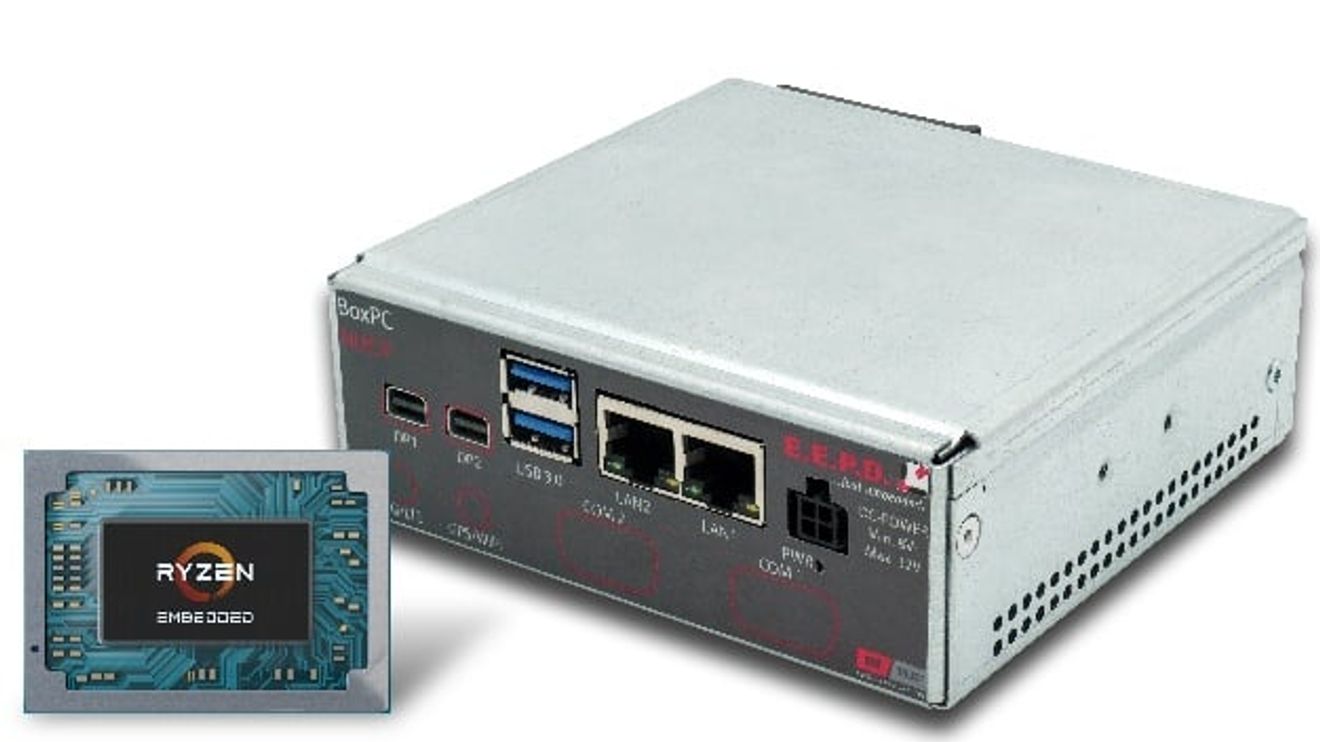
Why is AMD's new processor family interesting for the embedded market? It is particularly attractive because of the space- and energy-saving SoC design, which seamlessly integrates the x86 performance of the 'Zen' CPUs with the 'Vega' GPU architecture. It also sets new standards for next-generation box PCs in terms of computing power. Solutions for robotics, automation and mobile systems in particular often require the integration of new technologies such as AI, machine learning and deep learning. The new SoCs offer graphics performance and multimedia performance at the level of discrete GPUs with a computing power of up to 3.61 TFlops. Nevertheless, the power consumption (thermal design power, TDP) is only 12 to 54 W. With these performance values and the two to four cores, which support both hypervisor technologies and simultaneous multithreading (SMT) for up to eight parallel tasks, the current embedded processor generation is predestined for use in numerous automotive, industrial, medical and robotics applications as an IPC, control computer or HMI.
More intelligence at the Edge
However, the GPU not only offers powerful 3D graphics in UHD. It is also attractive for deep learning inference systems in artificial intelligence, which require massive parallel data processing. A comprehensive ecosystem for general-purpose GPU (GPGPU) use is available for this purpose. As the ecosystem is characterized by open source software, long-term availability and standardization are ensured.
Integrated security
For Industry 4.0-connected machines and systems, the Ryzen Embedded V1000 processor family offers numerous functions that significantly simplify connectivity tasks at the edge of the IIoT. However, the Internet connection results in significantly higher security requirements than with previous non-networked infrastructures. Processors that offer developers more off-the-shelf security features therefore make it easier to design in security efficiently, not only technically but also in terms of costs. For example, this new generation of processors offers numerous hardware-integrated additional functions. They make it possible to develop trustworthy IPC configurations with as little effort as possible. For example, the new AMD Ryzen Embedded V1000 SoCs offer integrated hardware-based protection against unauthorized memory access as well as Secure Encrypted Virtualization (SEV) to securely isolate hypervisors and virtual machines (VMs). They also offer a one-time programmable (OTP) function that allows customers to manage their own encryption keys.
Standardized features on only 10 cm x 10 cm
For particularly compact system solutions, AMD processors have now been made available for the first time in the compact eNUC Box PC form factor. This relatively new embedded form factor, which was standardized at board level by the SGET (Standardization Group for Embedded Technologies e.V.) in 2014, is the new star of embedded box PCs. This is particularly because it is extremely compact and can therefore be used anywhere as an application-ready system.
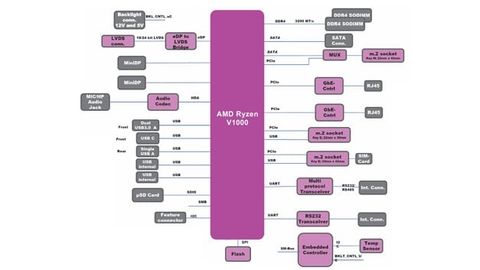
Despite its small form factor, the AMD Ryzen Embedded-based eNUC offers a whole range of interfaces.
© E.E.P.D.The footprint of the embedded boards is extremely compact at 101.6 mm x 101.6 mm (4 x 4 inches). Nevertheless, they offer sufficient space for numerous interfaces on their front and rear edges. Another advantage of these systems is the standardization via the SGET. This is unique in the field of box PCs - there is no comparable manufacturer-independent host for standardization, neither for 3.5-inch systems nor for Pico-ITX. Such standardization secures important success factors for the embedded market: On the one hand, it ensures - like all form factors - that footprint-identical system designs remain available for many years to come. It also ensures that uniform system configurations are available, even if they are purchased from different manufacturers, as a certain set of interfaces is an integral part of the specification. The specification also requires that the eNUC boards support at least the industrial temperature range between 0 °C and +60 °C or even the extended temperature range between -40 and +85 °C. In addition, manufacturers should guarantee long-term availability of at least five years. All of this is unique in the box PC market thanks to the SGET specification.
Due to these many advantages, there are already numerous eNUC board and system manufacturers on the market today. This gives customers the freedom to always choose the best solution.
Broad ecosystem
A wide range of accessories - from standard cooling solutions and cable assemblies to enclosures - also makes it easy to purchase third-party components. As a derivative of a commercial standard, the eNUC form factor can also offer low component costs for embedded applications, as there is often an option that is commercially mass produced, so NRE costs can be kept to a minimum. The fact that a large developer community works with this form factor also ensures the continuous improvement of the standard.
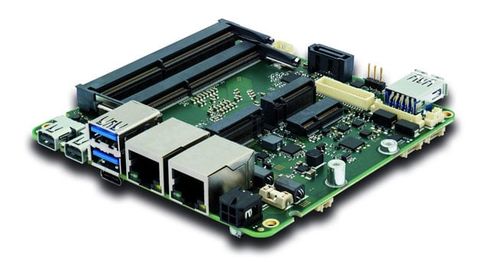
The embedded CPU board of the eNUC Box PC already offers all the standard functions of an industrial computer. Customer-specific interface sets can be easily integrated via expansion cards.
© E.E.P.D.These standardization advantages make the eNUC box PC form factor very attractive for many low-power small form factor applications. The application portfolio is very wide-ranging, as the compact eNUC systems can be accommodated virtually anywhere in mobile and stationary industrial systems. Individual interface extensions are also offered for different industrial and embedded markets. This is why there are also numerous configuration variants from different manufacturers in terms of both the interface configuration and the mounting options. For example, there are robust desktop solutions for the worker's workplace as well as wall-mounted solutions or top-hat rail systems for use in control cabinets.
The eNUC standard is also ideal for automotive applications - provided a suitable integrated power supply unit is used.
Domestic providers
eNUC manufacturers sometimes have to deal with competition that only appears to be particularly inexpensive at first glance - namely the commercial NUC solutions from Asian manufacturers. However, these cannot keep up with the requirements for robustness and long-term availability of the embedded market. This is why there are now many OEM customers and industrial end users in Europe who value systems that comply with the eNUC standard.
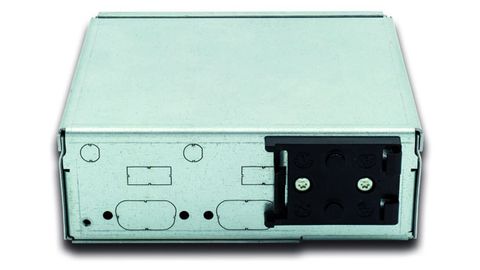
The eNUC Box PCs from E.E.P.D. are also predestined for use in vehicles. This is ensured on the one hand by the high-quality integrated vehicle-compatible wide-range power supply from 8 V to a maximum of 32 V and the inputs for continuous plus (terminal 30) and ignition plus (terminal 15).
© E.E.P.D.Production in the domestic market is just as important to them. The need for this can have a wide variety of motivations. For some, it is important to be able to react quickly to problems in the field, such as in highly sensitive just-in-time automotive production. For others, the development quality embodied by the 'Made in Germany' attribute is generally important because they want to guarantee the highest quality for their own machines and systems.
For many, security against foreign organized industrial espionage or susceptibility to sabotage is also essential, which is why they want to work exclusively with the core countries of the European Union (EU12/15).
Due to all these requirements, there is still a large market for embedded and industrial PCs 'Made in Germany', despite the fact that Asia is now dominant in the IT segment. If you attach importance to high quality - as the German industry does in its own production and/or in its own products - this lowers the customer's TCO in the long term, which is of crucial importance for durable capital goods and production equipment; because failures, unplanned maintenance and poor service are extremely expensive and usually significantly exceed the investment costs in a comparatively inexpensive box PC in the first case of damage.
Author: Christian Blersch is Managing Director at E.E.P.D.


You might also be interested in
Based on the latest Intel and AMD processors
E.E.P.D. has added new members to the 'Profive' family: the 'NUCN' - an industrial single-board computer (SBC) in embedded NUC format (eNUC) - and the 'Mime' - a mainboard in accordance with the Mini-ITX standard.
 read more...
Industrial motherboard in Mini-ITX format
With the Profive MAITX, E.E.P.D. offers an industrial motherboard in the Mini-ITX form factor.
read more...Numerous safety features on board
E.E.P.D. is expanding its product portfolio of single-board computers (SBC) in embedded NUC format with the Profive NUCP. The SBC is based on the 'AMD Ryzen Embedded V1000' and 'R1000' series processors, which can be operated with a thermal design...
read more...Rich in interfaces
E.E.P.D. now also offers the compact, fanless box PCs of the 'EM Tough Box Modular TB-M' series with energy-efficient dual and quad-core variants from AMD's second-generation Embedded G-Series SoC platform family.
read more...Industrial NUC box
The 'New Unit of Computing' (NUC) is an invention by Intel. E.E.P.D has made the form factor suitable for industrial use and installs processors from the 'AMD Ryzen Embedded V1000' platform in it.
read more...New Infrastructure for Photonics
Fraunhofer IMS Opens Photonics Laboratory
Fraunhofer IMS is expanding its infrastructure for photonic chiplets. The new photonics laboratory in Duisburg enables the characterization of photonic circuits at the chip and wafer levels and supports the European APECS pilot line as part of the...
read more...Vertiv and Nvidia link physical infrastructure with digital twins
Digital twins instead of a flood of documents: Vertiv integrates 'SmartRun' into 'Nvidia Omniverse DSX' to accelerate the planning and implementation of AI factories.
read more...Embedded system for OR robotics via voice command
A robotic assistance system is designed to relieve surgeons during minimally invasive procedures by taking over camera control. It is based on an industrial embedded platform designed for low latency, system stability and long-term availability.
read more...Sovereign edge-to-cloud platform for the industry
Hilscher Gesellschaft für Systemautomation and Schwarz Digits have announced a cooperation to provide sovereign European edge-to-cloud solutions for the industry.
read more...