

Part 5 of the TSN series
The key role of configuration
Time Sensitive Networking is gaining ground in convergent networks with critical applications and strict time requirements. But what needs to be considered in network planning? And why does configuration play a key role?
One of the major advantages that Time-Sensitive Networking (TSN) offers in the area of real-time communication is the fact that the TSN mechanisms are part of the IEEE 802 standards. The addition of TSN to long-established Ethernet mechanisms makes it possible to build Ethernet networks that enable real-time communication without having to resort to additional extensions outside this family of standards. Other further developments, such as Single Pair Ethernet, make it possible to use Ethernet in areas where this was not possible in the past, for example for cost reasons. In this way, networks can be set up that allow end-to-end communication from the sensor to the cloud and still only offer and use the mechanisms that are required in the respective network areas. This flexibility enables convergent networks, i.e. networks in which different types of traffic can be transmitted and coexist on the same line. The different types of traffic can be data transmissions with a wide range of characteristics, from the transmission of large volumes of data using TCP to data with highly critical requirements in terms of transmission time, such as control data for motion applications.
Another major advantage attributed to TSN is the assumption that the TSN mechanisms - or at least large parts of them - will become part of standard Ethernet hardware in the future. This is accompanied by the expectation that it will be possible in future to build networks with real-time properties without having to resort to special solutions that require special chips for real-time communication. Instead, standard hardware with TSN mechanisms will be used in the future. In view of the solid foundation provided by the corresponding IEEE standards and the large sales market that already exists for Ethernet devices today, this expectation seems quite realistic.
Many TSN standards - are they all relevant?
A question that often arises in the context of converged network discussions relates to the diversity of TSN mechanisms available. TSN is not a single technology, but rather a variety of standards and mechanisms that cover different aspects of time-critical communication, robust data transmission, high availability and traffic discipline. The question therefore arises as to whether it is necessary for future network participants to always master the complete set of TSN mechanisms in order to be considered TSN-capable, or whether it is sufficient for a device to support only some of these mechanisms.
In view of the different requirements for real-time capability or reliability, for example, which prevail in the diverse and varied areas of application for TSN, it seems obvious that it is not always necessary to support all features from the TSN toolbox. It is therefore important to create a framework that clarifies which TSN mechanisms are supported by a device that is sold as TSN-capable. An established way to achieve such clarification for different application domains and vertical markets is the definition of profiles.
A profile makes it possible to select the mechanisms that are required for the respective market from the wide range of existing mechanisms and make them mandatory. This ensures that devices intended for use in a specific market can be operated interoperably at feature level, while at the same time keeping the costs of the devices manageable. One example of such a profile is IEC/IEEE 60802, a project to define a profile for the industrial automation sector, which is currently being specified within the IEC and IEEE 802.1.
Are all TSN networks the same?
TSN networks can be operated in different ways depending on the requirements of the application domain in which they are used. It is therefore important to define common rules - such as the 'End Station Model' - for operation within a network as well as their properties and the set of TSN features that are required in the network devices.
On the one hand, the common 'End Station Model' describes the mechanisms with which packets are transmitted into the network on a time-controlled basis. It also describes how the corresponding elements of the network configuration can be assigned to individual applications. The common model is particularly important for the configuration, because in order to be able to integrate manufacturer-independent end devices into a network, the behaviour of the devices must be known, which is parameterized by the respective characteristics of the end devices. Properties such as time-controlled transmission and time synchronization in the end device are essential for a common model. Configuration details, such as possible cycle times, number of time-controlled transmission slots and precision of synchronization, do not necessarily have to be defined, but should remain flexible and adaptable to the respective application. If this information is disclosed, a configuration unit can take this into account.
Equally relevant is the minimum set of mechanisms in the TSN bridges, which forms the basis for the quality of service guarantees (QoS guarantees) in the network. Agreement on common mechanisms - such as time-aware shaping and preemption in TSN bridges - forms the basis for domain-wide guarantees. Here too, the exact form must remain open but transparent. For a neutral definition of a network, the selection of TSN features and their minimum characteristics should be based on the purely abstract level of the IEEE mechanisms.

As already mentioned, not every TSN network will be identical in real-life use. As the specifications for end devices and bridges describe a minimum set, the guarantees that can be given in a network can be influenced by adding additional features and by varying the characteristics of these features. It should be noted here that devices with as uniform a set of features as possible should be used within a network. Only then can the respective mechanisms be used network-wide. TSN domains are the key to achieving homogeneity of features in a network area. Within a TSN domain, it must be ensured that all devices support a uniform set of features that are required to achieve the guarantees in the TSN domain and are specified when the domain is defined. Individual devices can also provide additional mechanisms. However, the use of such mechanisms only brings limited additional benefits, as they are not necessarily available everywhere. Another characteristic of a TSN domain is that only one configuration unit - in the central case only one Centralized Network Configuration (CNC), but possibly several Centralized User Configurations (CUC) - may be active within a domain, so that the network configuration can always be kept consistent and is only controlled from one location.
The interaction of these individual components is shown in the image on the next page and ensures uniform behaviour of the network traffic that is controlled by the TSN mechanisms. The exact behavior can be adapted to the applications, the network or the protocols used, but is always based on the features and properties that are available domain-wide.
A concrete example
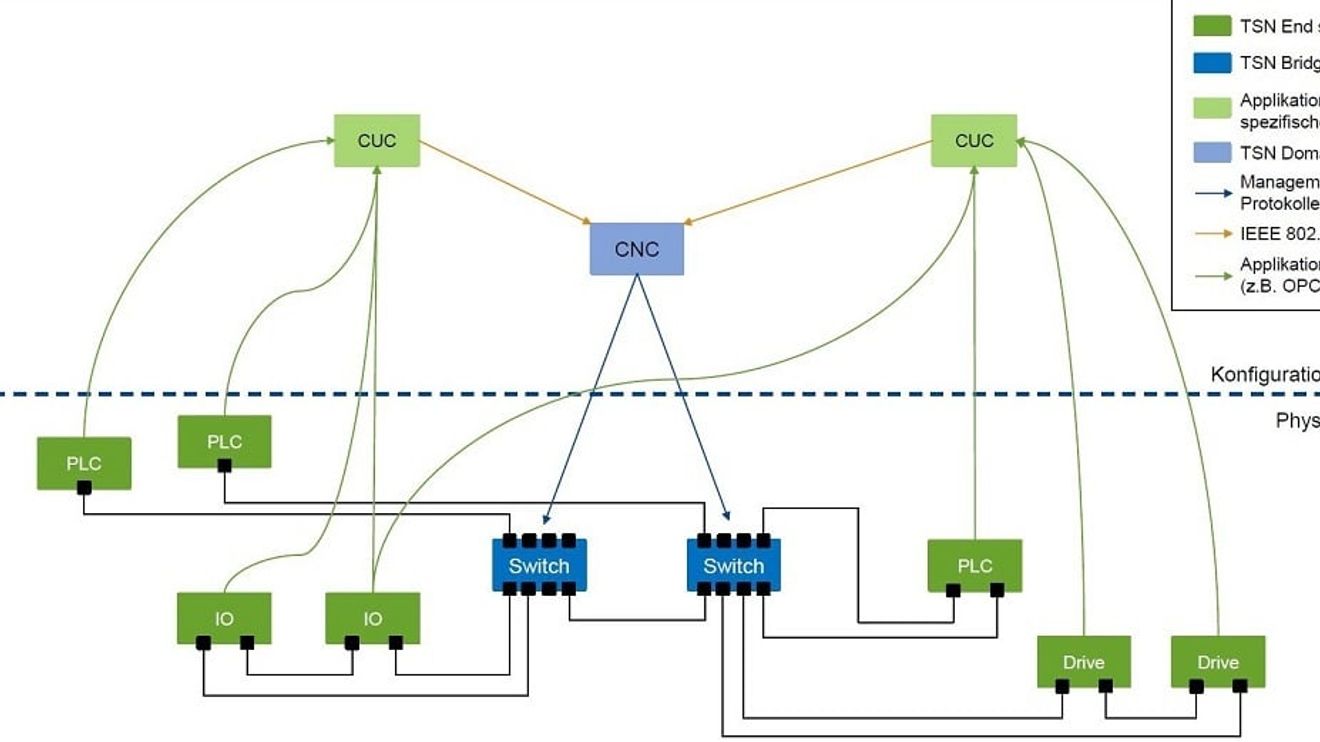
By clearly modeling the behavior of end stations and bridges using the minimal functions, a separation between application and network requirements can be created. This can be clearly seen in the example of OPC FLC. In the planning phase, only the application requirements are modeled with regard to data volume and temporal behavior. All common traffic models, such as deadline, cyclic latency or bandwidth, can be described here. Integration involves a general setup of the network, in which specific guidelines are already preconfigured. Examples of this are domain boundaries at which ingress shaping is to be applied or time synchronization within a domain. In the final step, the operational phase, applications register with their application requirements in the network. These are then resolved in accordance with the network policies already configured in the domain and the properties and mechanisms available in the TSN bridges. This results in a network configuration that ensures that the existing quality of service requirements are met.
Stephan Kehrer is Senior Architect in the CTO Office at Hirschmann Automation and Control.
© HirschmannIn the past, integrating new applications into existing networks was a task that mainly had to be carried out manually if the integration entailed a change to the QoS configuration. However, as configurations can quickly become complex, there is a considerable risk of errors creeping into the configurations if they are reconfigured manually. It is therefore important to automate the translation of application requirements into a configuration for simple and flexible use of the more complex mechanisms from the TSN toolbox. This is done in the central configuration model within a TSN domain using CUCs and the CNC. For OPC UA applications, the OPC UA TSN Working Group is working on standardizing the terminal device interface. Based on the models specified in IEEE Std 802.1Qcc, end stations transmit their application requests via OPC UA and the CUC and wait for the stream configurations, which are returned after successful calculation and configuration. However, testbeds showed some time ago that the basic data structures defined in IEEE Std 802.1Qcc are not sufficient to enable a standardized configuration workflow.
To close this gap, the IEEE 802.1 TSN Task Group launched a project, IEEE P802.1Qdj, in which Hirschmann is playing a leading role. One of the main objectives of this work is to enable application engineers to intuitively define and achieve the time requirements of communication in the future so that the network can automatically provide the corresponding guarantees, provided that sufficient capacity is still available.
What is already available?
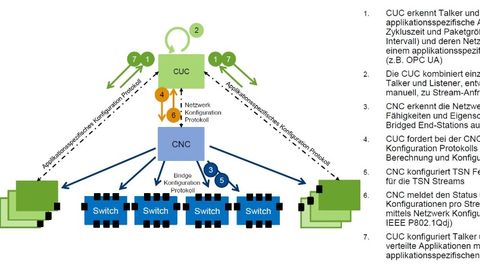
In order to enable the automatic integration of applications into existing networks, a large number of scenarios need to be covered. Implementation in a standardized configuration interface requires many factors to be taken into account. There are various demonstrators and cross-manufacturer projects to ensure that all requirements of real applications are recorded and taken into account as comprehensively as possible and that possible open points in existing specifications are discovered. For example, end device configuration via OPC UA in a TSN network was demonstrated for the first time at SPS 2018. At the TSN/A Conference 2020, Hirschmann and Schneider Electric will present an extension of this demonstrator as a completely automatic end-to-end configuration based on the current IEEE 802.1 and OPC UA standards.
It is important that the interfaces are based on a uniform consensus. Hirschmann has therefore published an exemplary OPC UA CUC under the name 'openCUC' on GitHub. This reflects the current specifications of OPC UA and IEEE in order to obtain extensive feedback for standardization. It shows that automatic TSN QoS configuration is no longer a dream of the future, but is already available to everyone. Testbeds, such as the IIC testbed in this case, are very important for a wider range of activities and for checking the completeness of the specifications.
The role of testbeds

Lukas Wüsteney is a Junior Architect in the CTO Office at Hirschmann Automation and Control.
© HirschmannThe topic of configuration is essential for the successful use of TSN in productive networks. The basic approaches for configuring TSN networks as simply and comprehensively as possible in the future are not a completely new problem. Some models and basic principles have already been specified in IEEE Std 802.1Qcc. Extensions and adaptations for special application areas based on this are currently being discussed in various committees and driven forward in standardization projects such as IEEE P802.1Qdj. These approaches are being tested and further developed as part of various testbeds, demonstrators and projects such as openCUC. Testbeds are therefore a good way of gaining experience with the configuration of TSN networks.


You might also be interested in
With open solutions to your own endpoint
The TSN ecosystem is based on a large number of standards. For specific use cases and the endpoints required for them, often only a few of these are needed. The tutorial provides a practical introduction to how a TSN endpoint can be developed using...
 read more...
SPS Connect 25.11. - 15:00 - 15:20
Real-time controller and field-level OPC UA over TSN applications
OPC UA and TSN fulfill a long-standing wish of the industry: a manufacturer-independent and interface-free communication solution. Modular and flexible machine and production concepts can be easily implemented with OPC UA and TSN.
read more...SPS Connect 25.11. - 15:45 - 16:05
OPC UA for the field level - the status quo
The OPC Foundation's Field Level Communications (FLC) initiative was launched with the aim of bringing OPC UA to the field level and thus has the potential to change industrial communication in the long term and to the benefit of all market...
read more...Interface diversity
Unitronic has added the TRB 245 and TRB 255 industrial gateways from Teltonika Networks to its in-house 'Sensor2Cloud' portfolio. The TRB 245 is a small industrial LTE Cat 4 gateway with a variety of input/output, serial and Ethernet connections
read more...Supports CC-Link IE TSN
The Anybus product family from HMS Industrial Networks enables data exchange between field devices, machines and systems via common fieldbus and industrial Ethernet networks. The company has expanded the modular embedded family 'Anybus CompactCom'...
read more...Turn four into one
Intelligent, digitally networked systems are the hallmark of Industry 4.0, whose largely self-organized production is based on constant interaction between people and machines. Single Pair Ethernet is a good basis for this.
read more...Digital conference with large international participation
The TSN/A Conference took place for the fifth time on October 7 and 8, and yet it was a premiere: for the first time in the form of a virtual conference, the event reached 210 participants from over 20 countries.
read more...TSN alone is nothing!
Yes, TSN is the new basic technology for convergent real-time communication. But which protocols will actually be based on the TSN layers and become established on the market has not yet been decided. In this article, four protagonists have their...
read more...The protocols of the upper layers
TSN only covers the lower OSI layers. There are various protocol approaches for the upper layers. Due to the deterministic requirements, these also have an impact on TSN itself - unlike in the past.
read more...