

Analog Devices
Seamless networking right into the field
With 10BASE-T1L Single Pair Ethernet, a new Ethernet physical layer was adopted as a standard by the IEEE just over a year ago. This new standard will profoundly change process automation.

10BASE-T1L Single Pair Ethernet is a new Ethernet physical layer standard (IEEE 802.3cg-2019) that was adopted within the IEEE on November 7, 2019. It will profoundly change the process automation industry by significantly increasing operational efficiency in factories through seamless Ethernet connectivity down to field devices - sensors and actuators.
10BASE-T1L eliminates the problems that have previously hindered the use of Ethernet to field devices in process automation. These issues include power consumption, bandwidth, cabling, distance, data islands and intrinsically safe Zone 0 applications (for hazardous areas). By eliminating these challenges not only when expanding existing plants but also when building new plants, 10BASE-T1L technology will enable new insights not previously offered, such as aggregating process variables, secondary parameters and plant status feedback and seamlessly relaying this information to the control plane and the cloud.
These new insights will provide new opportunities for data analysis, operational intelligence and productivity gains by creating a continuous network from the field to the cloud.
Advantages of single twisted pair cabling compared to more complex cabling types include lower cost, smaller footprint and easier installation.
The basis of the 10BASE-T1L
The basis of 10BASE-T1L is a full-duplex, DC-symmetrical point-to-point communication technology with PAM-3 modulation and a baud rate of 7.5 Mbaud with 4B3T coding. Two amplitude operating modes are supported, namely 2.4 V peak for cables up to 1000 m long and 1.0 V peak for reduced transmission distances. The option to operate at 1.0 V peak means that this new physical layer technology can also be used in EX-protected systems and meets the strict regulations for maximum energy that apply there. The technology, which belongs to the SPE (Single Pair Ethernet) media family, enables long transmission distances with two-wire technology and transmits power and data on one and the same STP cable.
With 10BASE-T1L, significantly more power can be transmitted to field devices, up to 500 mW in intrinsically safe Zone 0 applications, compared to only around 36 mW for 4-20 mA devices. In non-intrinsically safe applications, up to 60 W is available, depending on the cable used. The availability of significantly more power at the outer limits of the network and the elimination of the existing power limits for 4-20 mA current loops and fieldbuses pave the way for new field devices with extended features and new functionality.
For example, this additional power enables more powerful measurements and more complex data processing at the edge. This in turn provides valuable insights into process variables, which can now be made accessible via the Internet using a web server running in the field devices, ultimately leading to improvements and optimizations in process sequences and asset management.
10BASE-T1L eliminates the need for complex, power-hungry gateways and enables the creation of a continuous Ethernet network that spans IT and OT networks . This converged network allows for simplified installation, easy replacement of devices and faster commissioning and configuration of the network, which ultimately leads to faster software updates, combined with simplified root cause analysis and maintenance of field devices.

Advantages of an Ethernet-based solution
By opting for Ethernet as a uniform communication method for the enterprise, control and field levels, it is possible to move away from the highly fragmented fieldbus infrastructure that has led to the creation of data islands with limited data accessibility in the field devices. By eliminating the gateways, the costs and complexity of these legacy installations are significantly reduced and the data islands they created are eliminated.
Until now, the earlier communication standards listed in Table 1 were used in process automation applications, the disadvantages of which can be avoided with the new 10BASE-T1L standard.
Ethernet standards guarantee that all higher protocol layers work with 10BASE-T1L in the same way as with 10BASE-T, 100BASE-TX and 1000BASE-T, so that complex gateways can be dispensed with.
Devices can therefore now use Profinet, Ethernet/IP, HART/IP, OPC UA or Modbus/TCP and support IoT protocols such as MQTT, providing a simple and powerful way to connect a field device to the cloud. Ethernet also enables simple, centrally controlled software updates right up to the end nodes, allowing networks to be commissioned more quickly.

A host processor with integrated MAC function (Media Access Control), a passive media converter or a switch with 10BASE-T1L ports is required for communication with a 10BASE-T1L-capable device. Additional software is not required, nor is a customized TCP/IP stack or special drivers (see Fig. 1). 10BASE-T1L devices therefore offer clear advantages:
- Although a media converter is required for the connection to 10BASE-T1L, this only converts the physical coding, but not the content of the Ethernet packets, so that it is transparent from the perspective of the software and the communication protocols.
- With Ethernet connectivity, it is possible to configure sensors using a laptop or cell phone - regardless of whether the sensor is located at a laboratory workstation or installed in a factory. For example, temperature sensors are now equipped with an additional interface (e.g. USB) to configure the transducer and, depending on the manufacturer, there may be significantly more than 100 setting options available. Today, these parameters are simply not accessible via a 4-20 mA current loop. HART enables this access, but is often not available for cost reasons. This means that if an error is made during the initial setup in the laboratory, an installed sensor with a 4-20 mA interface must be reconfigured on site. A sensor connected via 10BASE-T1L, on the other hand, can be accessed via the network so that updates can be carried out at any time and from any location.
- Field devices with a 4-20 mA interface can only transmit a single process variable, while Ethernet allows direct access not only to process variables, but to all device parameters (for asset management, lifecycle management, predictive maintenance, configuration and parameterization).
- Due to the increasing complexity of sensors, the likelihood of software updates becoming necessary is growing. With a fast Ethernet connection, these updates can now be carried out at any time and from anywhere in a realistic amount of time.
- The causes of faults are easier to pinpoint thanks to access to advanced diagnostic tools for Ethernet networks.
The network setup
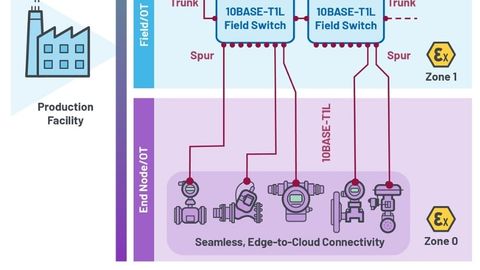
Unlike in building or factory automation, the sensors and actuators - for flow, pressure, level and temperature - are not located near the controller. Distances of 200 m between sensor and I/O are not uncommon, and distances of up to 1000 m may need to be bridged from one switch to another.
Process automation uses type A fieldbus cables, as is already the case today in installations with Profibus PA and Foundation Fieldbus.
The 10BASE-T1L standard does not prescribe a specific transmission medium (cable), but merely defines a channel model (requirements for return loss and insertion loss). Since the channel model of 10BASE-T1L is an excellent match for type A fieldbus cables, some already installed 4-20 mA cables can also be used for 10BASE-T1L, which offers very good prospects for the renewal of existing process automation installations.
As mentioned, 10BASE-T1L offers the option of reducing the signal amplitude to 1 V for cables up to 200 m long. The technology is therefore also suitable for EX-protected installations and can comply with the strict maximum energy restrictions of hazardous areas with a power of up to 500 mW.
Given the significantly greater power range compared to the 4-20 mA current loop (500 mW instead of 36 mW), current four-wire devices that rely on an external power supply due to the limited power of 4-20 mA technology can now be replaced by two-wire devices with 10BASE-T1L. This provides greater flexibility when installing new devices as no external power supply is required.
Figure 2 above shows the network topology designed for the process industry with trunk and spur networks. The main lines can be up to 1 km long with a PHY amplitude of 2.4 V peak and are located in Zone 1, Division 2. The spur lines, on the other hand, can be up to 200 m long, operated with a PHY amplitude of 1.0 V peak and laid in Zone 0, Division 1. A power switch located at the control level acts as an Ethernet switch on the one hand and provides the power supply via the data lines on the other.
At the field level, i.e. in the hazardous areas, there are field switches that are supplied with power via the cable. These field switches provide the Ethernet switch functionality with which the field devices connected to the spur lines are connected to the main line and supply the field devices with power. Several field switches can be connected to a main line in order to support the large number of field devices connected to the network.
To ensure redundancy, the field switches can be connected with a ring topology. At the edge, a data rate of 10 Mbit/s represents a significant advance for most applications that were limited to a data rate of less than 30 kbit/s in the past. When Ethernet is now used to connect end devices at the field level, IT and OT merge into a seamless Ethernet network, which in turn enables IP addressability of any end node from anywhere in the world.
Ethernet-APL with 10BASE-T1L

The Ethernet APL (Advanced Physical Layer) specifies the details of how Ethernet communication is applied to sensors and actuators in the process industry. It is published as part of the IEC. The document is based on the Ethernet physical layer standard 10BASE-T1L and specifies the implementation and explosion protection methods for use in hazardous areas. Under the umbrella of the Profibus user organization, ODVA and the FieldCommGroup, the leading companies in the process automation industry are working together to ensure the functionality of the Ethernet APL on all Industrial Ethernet protocols and to promote its dissemination.
The switch from HART

4-20 mA interfaces with HART have been successfully used in process automation applications for many years and represent a proven, reliable solution that will not disappear overnight, as there is a large installed base of instruments for the 4-20 mA current loop with HART.
Analog Devices is also investing in software configurable I/Os. These provide more installation flexibility for the existing devices by allowing any industrial I/O function to be brought out on any pin, allowing channels to be configured at any time in remote I/O applications. Customization can thus be done at the time of installation, resulting in shorter time-to-market, less design resources required and universal products that can be widely used for different projects and customers.

Figure 3: The discrete cabling used in the past will gradually be replaced by an intelligent Ethernet network covering all sensors and actuators.
© ADIThe picture on the right illustrates the transition from the old 4-20 mA loop connected instruments to a modernized Ethernet solution where new 10BASE-T1L capable instruments coexist with old 4-20 mA instruments. Software-configurable I/O devices are used to connect these old instruments, while remote I/Os serve as a collection point for connecting to a 10 Mbit Ethernet uplink to the PLC.
Applications outside of process automation

Meanwhile, 10BASE-T1L is also gaining a foothold in building and factory automation, energy supply, monitoring technology, automation of waterworks and wastewater treatment plants as well as elevator technology.
Common to all these applications is the need for more bandwidth and seamless Ethernet connectivity (without gateways) to the sensor using a single STP cable for power and data. Table 2 above compares 10BASE-T1L with the previously used wired transmission technologies.
Application examples are the RS-485 technology used in building automation and the I/O-Link standard widely used in factory automation.


You might also be interested in
The autonomous industrial revolution
The fourth industrial revolution requires that the underlying technologies are continuously developed further. Automated and autonomous systems are key pillars.
 read more...
Security at the edge
Experts warn that it is not a question of whether a company or production facility will be the target of a cyber attack, but when. The shifting attack surface for cyber attacks is creating a growing need for security solutions at the edge.
read more...Hans Seifert to Become Chief Sales Officer
Sigmatek has appointed Hans Seifert as Chief Sales Officer (CSO). His area of responsibility includes international sales, marketing, application engineering, and support.
read more...CC-Link certification for modular I/O system
Weidmüller has received the CC-Link Partner Association (CLPA) certificate for its modular I/O system 'u-remote'. This makes u-remote the first modular I/O system with official CC-Link IE safety certification for CC-Link IE TSN.
read more...Profibus & Profinet International
MTP Specification 2.0 published
Profibus & Profinet International (PI) announces the official release of the Module Type Package (MTP) Specification 2.0. The MTP 2.0 standard creates the basis for true cross-industry interoperability as well as more flexibility and efficiency...
read more...New analog input modules
MicroControl is launching the next generation of compact analog input modules. The new modules are µCAN.4.ai-BOX for voltage/current, µCAN.4.sg-BOX for strain gauge sensors and µCAN.4.ti-BOX for temperature sensors.
read more...Profibus & Profinet International
Profinet leads the field in industrial Ethernet protocols
A recent analysis by the market research institute Omdia confirms that Profinet is the leading technology in the field of industrial Ethernet protocols. In addition to its broad market penetration, Profinet's consistent focus on security is...
read more...Dual leadership in Shanghai
Stefan Becker has been appointed Managing Director of Eckelmann Automation Technology in Shanghai and will manage the subsidiary together with Zhongwei Huang.
read more...Smart control cabinets thanks to new Ethernet/IP technology
Rockwell Automation is launching an Ethernet/IP control cabinet solution. The aim of this further development is to meet the growing demand for smarter, faster and better networked production processes.
read more...