

Analog Devices
Low-power processors to Ethernet
Single Pair Ethernet has a great future ahead of it in factory and process automation. But what needs to be considered when developing connections, especially for low-power field or edge devices?

The use cases for single-pair Ethernet 10BASE-T1L, including Ethernet-APL, are becoming increasingly numerous in the process, factory and building automation sector, as more and more devices need to be connected to Ethernet networks. If more devices are given a network connection, the higher-level management systems can be provided with more extensive databases, which on the one hand allows considerable increases in productivity and on the other hand reduces operating costs and energy consumption.
For the field or edge area, Ethernet offers the prospect of connecting all sensors and actuators to a converged IT/OT network (information technology and operational technology). To realize this vision, however, a number of system-related challenges need to be overcome, as some of the sensors in question are limited in terms of available power and space requirements. For sensor and actuator applications, there is a growing range of low-power and ultra-low-power microcontrollers with large internal memory capacity. However, the majority of these processors have in common that they do not support an MII, RMII or RGMII Media Independent (Ethernet) interface due to the lack of an integrated Ethernet MAC.
A traditional PHY can therefore not be connected to these processors.
What are the advantages of a 10BASE-T1L MAC-PHY?
A 10BASE-T1L MAC-PHY is required to equip more and more low-power devices with an Ethernet connection suitable for long distances. This module establishes the Ethernet connection of the processor via SPI. The latter is thus relieved because no integrated MAC is required, as the MAC functionality is now integrated directly into the 10BASE-T1L PHY. A 10BASE-T1L MAC-PHY therefore gives device developers more flexibility and choice, as a large number of ultra-low-power processors can be considered. By optimally partitioning the application, a 10BASE-T1L MAC-PHY allows the realization of low-power field devices for intrinsically safe Zone 0 applications. This is where what is known in the process industry as Ethernet-APL comes into play. In intelligent building applications, a MAC-PHY allows a large number of low-power devices to be connected to an Ethernet network.
Advanced packet filtering

Figure 1: A 10BASE-T1L MAC-PHY significantly reduces the power consumption and complexity of devices with advanced packet filtering.
© Analog DevicesThe integration of MAC functionality in a 10BASE-T1L PHY provides new features that can be used to optimize Ethernet traffic in the network. A 10BASE-T1L MAC-PHY with extended packet filtering considerably reduces the effort involved in handling broadcast and multicast traffic. The decisive factor is filtering according to the destination MAC address. Instead of filtering according to just one MAC address, a MAC-PHY supports filtering using up to 16 unicast or multicast MAC addresses. Address masking for two MAC addresses is also possible. Filtering according to the device address and generally supported multicast addresses such as LLDP (Link Layer Discovery Protocol) provides a high degree of freedom. By supporting an additional path for higher priorities, it is possible to prioritize some messages in order to improve latency and operational reliability. The priority of a frame can be identified using the MAC filter table. For example, broadcast messages can be sent to a queue with a lower priority, while unicast messages go to those with a higher priority. This prevents the receiver from being overloaded by a broadcast storm or a short-term traffic peak. These filter functions of the MAC-PHY enable the realization of devices that are robust in terms of network load. The MAC also collects frame statistics to help monitor network traffic and connection quality (see Figure 1).
The MAC in the MAC-PHY also supports IEEE 1588 and thus also time synchronization according to 802.1AS, as required in process automation. The MAC-PHY also supports a synchronized counter, timestamping of received messages and timestamp capture for messages to be sent. This significantly reduces the complexity of the software design, as no hardware support is required beyond the MAC-PHY to implement time synchronization. The MAC can generate an output signal aligned with the synchronized counter, which can be used to synchronize external processes at the application level. The SPI interface supports the Open Alliance 10BASE-T1x MAC-PHY Serial Interface. The Open Alliance SPI is a new, highly effective SPI protocol developed specifically for use with a MAC-PHY.
10BASE-T1L MAC-PHY or 10BASE-T1L PHY?
A 10BASE-T1L PHY and a 10BASE-T1L MAC-PHY offer significant advantages in different applications. If power consumption is an issue, a 10BASE-T1L MAC-PHY enables a reduction in system power consumption as it allows a more flexible choice of host processor, as ultra-low power processors without an integrated MAC can also be considered. If the Ethernet connection is to be retrofitted to an existing device, a 10BASE-T1L MAC-PHY offers the option of continuing to use the existing processor by implementing the Ethernet connection via the SPI port. It is then not necessary to switch to a more powerful processor with an integrated MAC.

Figure 2: Comparison of the advantages of a MAC-PHY and a PHY for the 10BASE-T1L connection.
© Analog DevicesIn applications with high performance requirements, the field or edge device may already be equipped with a very powerful processor with a built-in MAC. In this case, a 10BASE-T1L PHY with MII, RMII and RGMII MAC interfaces can be used to quickly develop a 10BASE-T1L interface. This is done by reusing the existing MAC interface drivers to retrofit Ethernet connectivity (Figure 2).
For device designers, the availability of 10BASE-T1L PHYs and 10BASE-T1L MAC PHYs means greater flexibility to meet the needs of future manufacturing equipment with Ethernet connectivity. Low power and high performance devices can be deployed on the same Ethernet network while meeting power limits for hazardous area applications. 10BASE-T1L Power Switches and 10BASE-T1L Field Switches require the use of robust, low-power 10BASE-T1L PHYs in conjunction with industrial Ethernet switches to realize a trunk-and-track network topology that transmits both power and data over a single twisted-pair cable - even into hazardous areas.

Figure 3: Network topology based on the trunk-and-track principle for process automation, equipped with 10BASE-T1L MAC-PHY and 10BASE-T1L PHY.
© Analog DevicesBoth 10BASE-T1L PHYs and 10BASE-T1L MAC PHYs are required for the connection of field devices so that a wide range of field devices can be equipped with an Ethernet connection. Field devices with higher power consumption, such as flow meters, are likely to already be equipped with a high-performance processor with integrated MAC and a 10BASE-T1L PHY. In contrast, field devices with lower power consumption, such as temperature sensors, are equipped with an ultra-low-power processor without an integrated MAC and therefore rely on a 10BASE-T1L MAC-PHY for Ethernet connectivity, which is connected to the processor via SPI (Fig. 3).
Comparison of the most important features
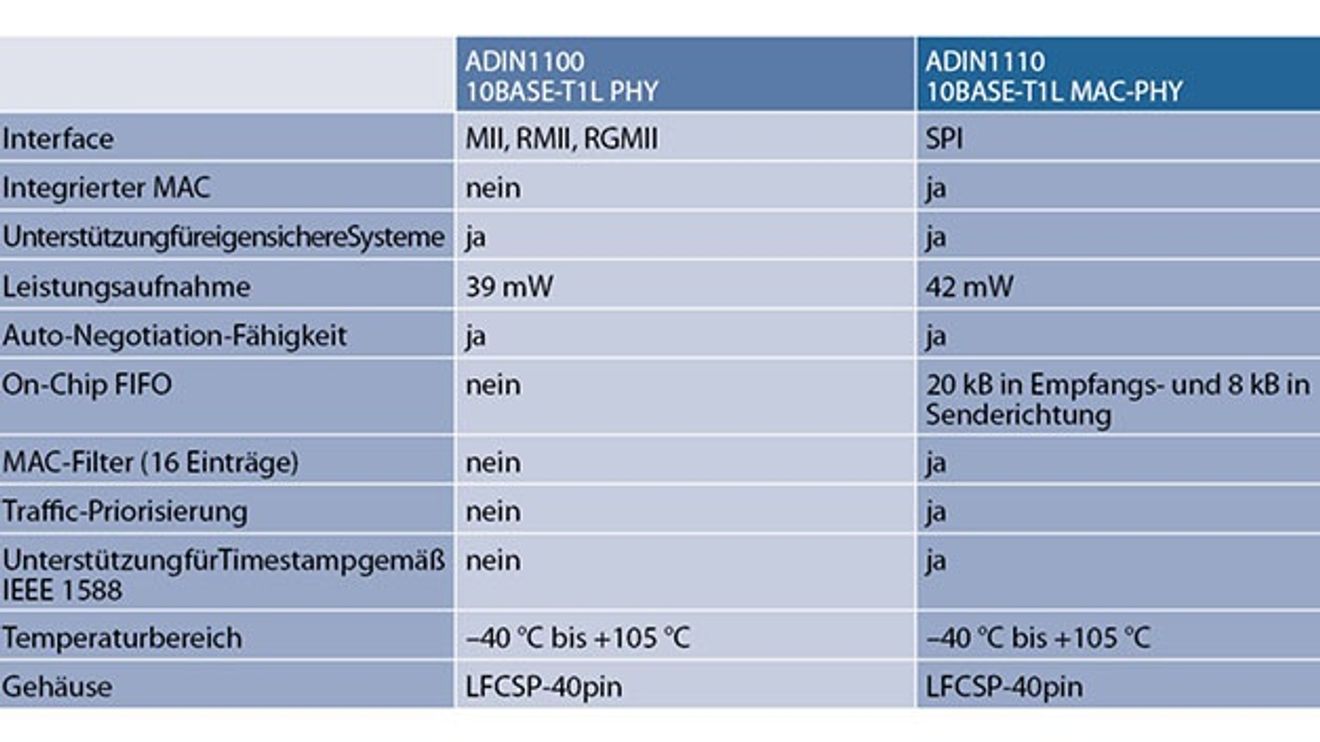
The ADIN1110, a 10BASE-T1L MAC-PHY from ADI, enables a low-power Ethernet connection via an SPI interface to the host processor with a power consumption of only 42 mW. The device supports the Open Alliance 10BASE-T1x MAC-PHY serial interface for full-duplex SPI communication at a clock frequency of 25 MHz.

Maurice O'Brien is Strategic Marketing Manager for Industrial Connectivity at Analog Devices.
© Analog DevicesThe ADIN1100, a 10BASE-T1L PHY from ADI, on the other hand, is used for low-power Ethernet connection via MII, RMII and RGMII MAC interfaces to a host processor with a power consumption of just 39 mW. The table below compares the 10BASE-T1L PHY of type ADIN1100 with the 10BASE-T1L MAC-PHY of type ADIN1110. Both products are based on the central suitability of 10BASE-T1L for full-duplex-capable, DC-free point-to-point communication with PAM-3 modulation at a symbol rate of 7.5 MBaud with 4B3T coding.

10BASE-T1L supports two amplitude modes: 2.4 Vpp for cable lengths of up to 1000m and 1.0 Vpp for shorter distances. With the 1.0 Vpp mode, this new physical layer technology can also be used for systems in potentially explosive atmospheres, as it meets the strict requirements for power limitation.


You might also be interested in
The standard is
Standardization work has been underway since 2015 and the intrinsically safe physical layer designed for 2-wire cables called Ethernet-APL is now available; the first products are ready for the market.
 read more...
Hans Seifert to Become Chief Sales Officer
Sigmatek has appointed Hans Seifert as Chief Sales Officer (CSO). His area of responsibility includes international sales, marketing, application engineering, and support.
read more...Dual leadership in Shanghai
Stefan Becker has been appointed Managing Director of Eckelmann Automation Technology in Shanghai and will manage the subsidiary together with Zhongwei Huang.
read more...Clemens Maier takes over industry sector management
Clemens Maier is taking over the management of the industrial sector at Bachmann electronic. The 41-year-old automation expert is following in the footsteps of Leopold Matouschek, who will focus entirely on the management of the subsidiary Bachmann...
read more...OCT solutions for servo and motor cables
SAB Bröckskes has developed application-specific product series for hybrid and One Cable Technology (OCT) cabling for industrial Ethernet cabling.
read more...Dr. Sebastian Durst becomes CEO
The Weidmüller Group is strengthening its first management level as of October 1, 2024: Dr. Sebastian Durst, previously Chief Operations Officer, will take over the newly created position of Chief Executive Officer (CEO).
read more...Chip start-up founded
The start-up milli IC from Karlsruhe specializes in the development of ASICs - and Vega Grieshaber is 'on board' to ultimately develop radar measuring devices with radar frequencies of more than 100 GHz.
read more...New member of the management board
On September 1, Dr. Sebastian Schatt will take over responsibility for the further development of the electrical connection technology division as a member of the Wago Group's management board.
read more...The top articles in July 2024
Innovative spirit and entrepreneurial thinking characterize the most-read articles from July. Find out more about competitive advantages through AI, click through award-winning developments and read more about model-based design and quantum sensor...
read more...