

Siemens
Merging the virtual and real worlds
At the beginning of March, Siemens held an online press conference to provide an outlook on the innovations for this year's Hannover Messe - at that time it was not yet clear that the trade fair would be canceled this year.
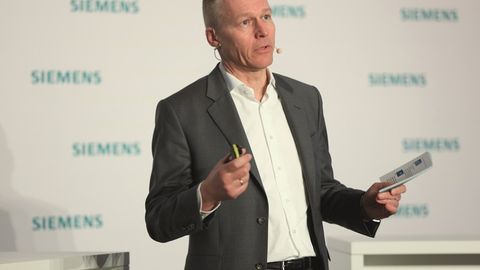
The press conference on March 4 was dominated by the coronavirus. Journalists were therefore connected online for the first time to the pre-press conference at the Hannover Messe. It was not yet known at the time that the Hannover Messe would be canceled this year.
Jan Mrosik, COO Digital Industries at Siemens, emphasized Siemens' unique selling point right at the start of the conference : "We are the only company to tackle the topic of the 'digital enterprise' with such a comprehensive, integrated approach to digitalization. - We are merging the virtual world with the real world!"
In this context, he is convinced that the vertical integration of OT and IT is becoming increasingly important. An integration that Siemens customers should implement in particular with edge technologies, Mindsphere and the Mendix low-code app development platform.
Clock software
Mrosik uses a graphic to explain that conventional automation technology is becoming increasingly less important in this context: Siemens has spent EUR 10 billion on the acquisition of software companies in the last 20 years and now sees software as the driving force behind the implementation of digitalization in industry.
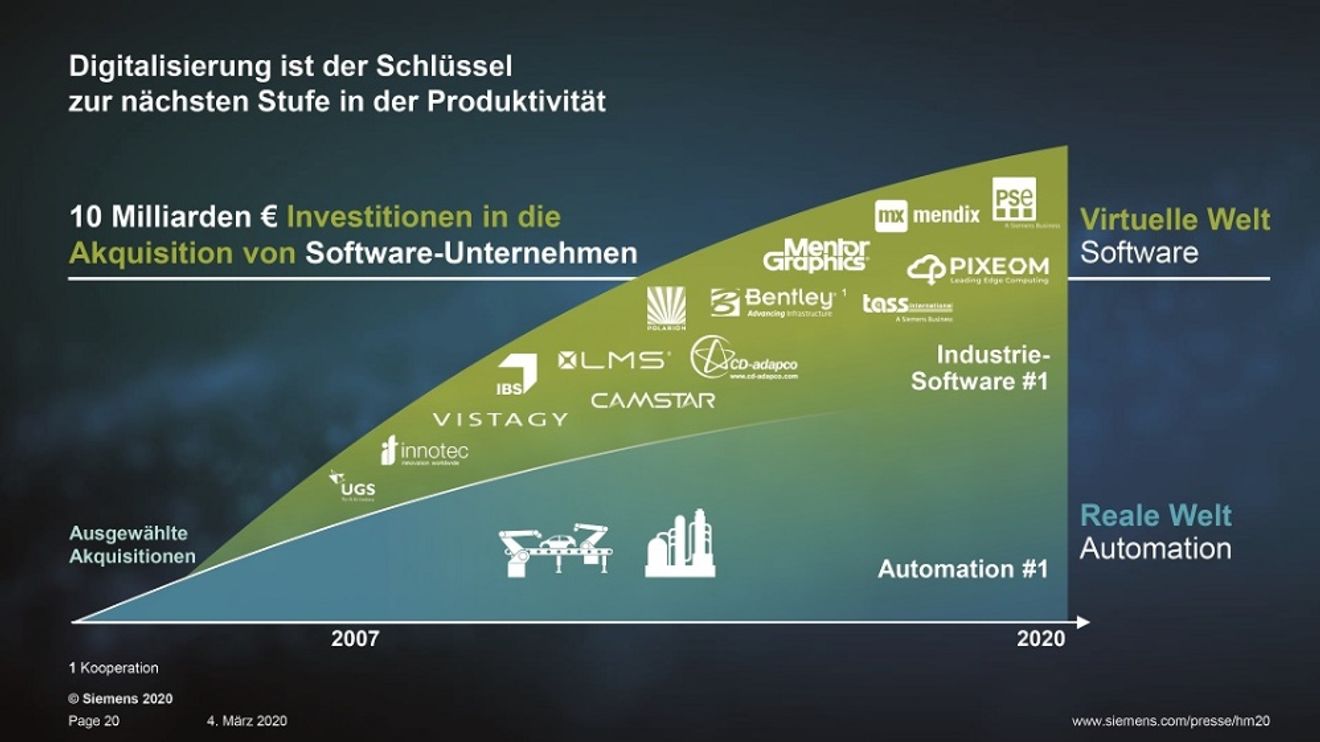
Just some of the software acquisitions made by Siemens this century. Siemens has invested a total of 10 billion euros in the digitalization of industry in this way.
© SiemensMrosik highlights two of the latest software acquisitions: The acquisition of the edge technology of the US company Pixeom, which was announced in mid-October. The purchase is intended to strengthen Siemens' Industrial Edge offering with software components for the running environment of apps (Edge Runtime) and for device management. Under the name 'Siemens Industrial Edge', an ecosystem is currently being created that will enable the flexible provision and use of apps. Suitable apps can be used to analyze data locally on the machine and send relevant data to the superimposed industrial edge management system for global analyses. With the resulting ecosystem, industrial companies can use production data more efficiently and react more flexibly to changing conditions. Siemens is relying on the standard IT container technology Docker: this should make it just as easy to deploy apps in the management system as it is to reload functions and updates to edge devices in the factory from a central location.
In mid-September of last year, Siemens also announced the acquisition of the British
British provider of software and services for advanced process modeling, Process Systems Enterprise (PSE). The model-based technologies are intended to complement Siemens' digitalization portfolio for the process industry.


You might also be interested in
IIoT communication from the sensor to the...
Data exchange from IO-Link via JSON and MQTT becomes possible
The IO-Link community has published a specification that describes how data from IO-Link can be exchanged via JSON REST and MQTT - in the sense of transparent communication in the IIoT.
 read more...
The new products
This year's innovations from Siemens include the Sitrans MS Multisensor, which is used primarily for monitoring the condition of mechanical system components such as pumps, compressors, gearboxes and valves.
read more...5G or Wi-Fi 6?
We hear everywhere: 5G will change the world! But what about Wi-Fi 6? Has the IEEE hit the jackpot with the new WLAN standard? Will 5G and Wi-Fi 6 vie for pole position as the future wireless standard for the Industrial Internet of Things (IIoT)?
read more...Implementation is still stuttering
When it comes to implementing the digital transformation, companies are now focusing on their core business - the days of wild experimentation are over. But where exactly is it still stuck?
read more...The new e-paper is now available
Our latest issue 4 is now available as an e-paper. Read now what's happening in the automation industry in April.
read more...Ready for take-off towards Industry 4.0
Industry 4.0 applications use a large number of OT components that provide data for IT applications. But how can the integration of automation and IT be designed efficiently?
read more...Hannover Messe canceled for 2020
Hannover Messe has been canceled for 2020. Deutsche Messe cited the extensive restrictions surrounding the coronavirus pandemic as the reason.
read more...Update - Covid-19 and all trade fairs at a glance
Due to the coronavirus, there are new announcements from organizers and exhibitors every day regarding cancellations, postponements or digital versions of individual trade fairs. Our overview will help you to keep track.
read more...First control cabinet made of green steel
The Siemens subsidiary Alpha Verteilertechnik claims to offer the first control cabinet for industry made entirely of green steel.
read more...