

Rosenberger OSI
LWL in a harsh environment
Until now, there have often been concerns about reliability and manageability when using fiber optic cables (FO) in harsh environments. However, current plug contacts also enable safe fiber optic connections in industrial environments, aviation and medicine.
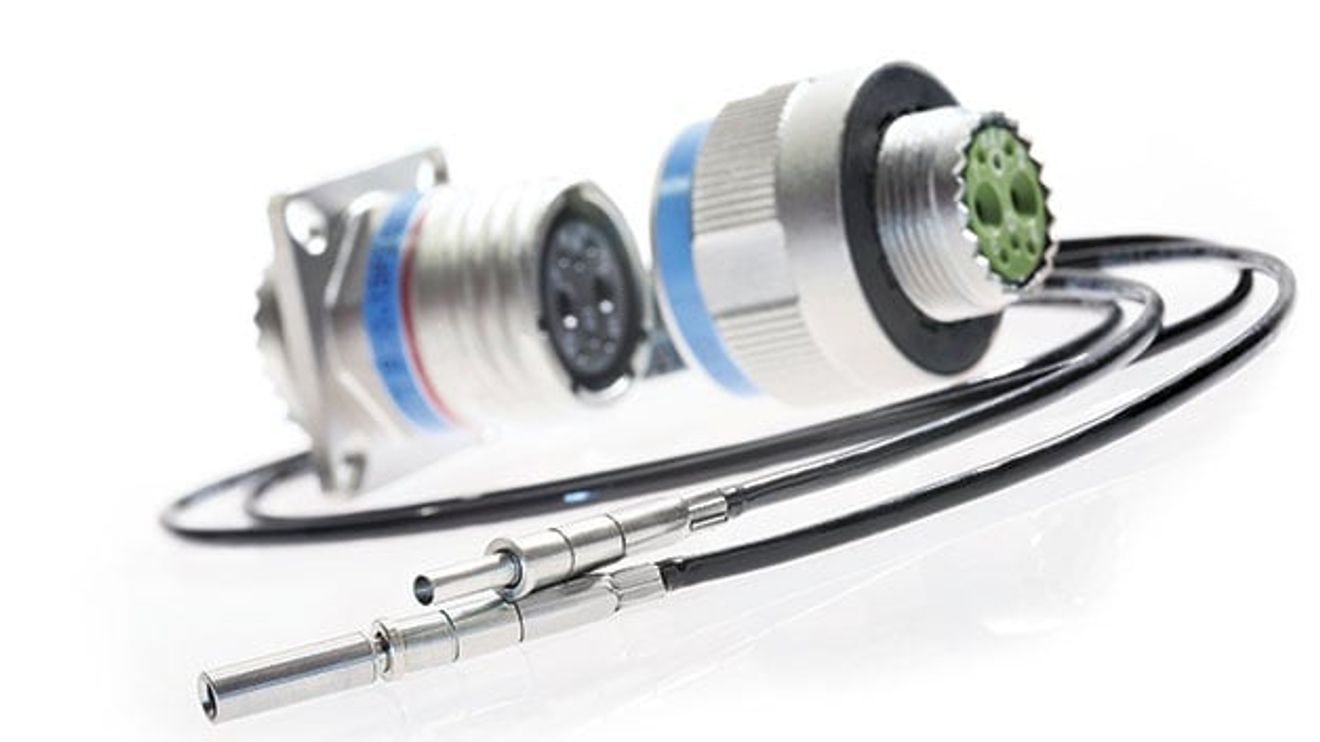
In the protected environment of a data center or office complex, fibre optic cables are now standard. However, the situation is different in harsher environments where dust, strongly fluctuating or extreme temperatures, corrosive liquids and vapors, vibrations and similar stresses occur. In addition, use in the field often places higher demands on the number of mating cycles - anything but ideal for the use of fiber optic cables with their sensitive contacts. However, the rapidly growing demand for bandwidth does not stop at industrial sectors with harsh environments:
Industry 4.0: Highly automated industrial production requires unrestricted availability of data from a variety of sources - from sensors, controllers and cameras for optical control, to edge servers with AI applications that process large amounts of data in real time.
Aerospace: A large number of highly sensitive sensors and remote applications as well as high-resolution optical applications and radar systems provide a huge amount of data that needs to be processed, stored and transmitted. In addition, there are extreme requirements for reliability and low maintenance.
Medical technology: Image data from digital X-rays, magnetic resonance imaging (MRI) and computer tomography (CT), patient monitoring and data transmission between different buildings or to the attending physician, monitoring and control of the IT infrastructure in operating theaters - all of this requires enormous bandwidths. Furthermore, as a critical infrastructure, a hospital network demands absolute reliability.
Transportation: In transport and rail technology, fiber optic cables are not only important because of the bandwidth they can achieve. The galvanic isolation achieved with optical fibers and the insensitivity to electromagnetic interference that occurs with copper cables also speak for the use of optical fibers in this industry.
Mining, oil and gas extraction: Highly complex technical systems are used in the mining of raw materials underground and also in oil and gas extraction on production platforms, which are remotely controlled and monitored in real time using extensive sensor technology and numerous cameras. The high bandwidth requirements are offset by the extreme environmental conditions with dirt and dust, extreme temperatures and vibrations.
Broadcast: Immense amounts of data have to be processed not only in the studio, but also during the transmission of live events. Television images in 4k and 8k resolution with complex sound, recorded by numerous cameras and microphones, deliver a large data stream. This in turn has to be distributed to control room monitors, reporters' booths and the broadcasters' pick-up points. The event sector in particular involves countless set-ups and conversions, i.e. an enormous number of plug-in cycles.
Defense: Military defense and communication systems with optical and acoustic systems as well as remote controls also have high bandwidth requirements.
Connections for special requirements
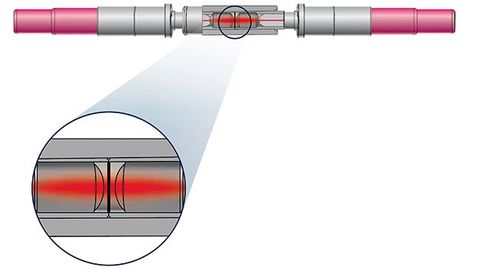
The Size 12 lens plug contact from Rosenberger OSI in pin and socket versions is suitable for use in circular connectors, but can also be used in hybrid systems, such as those commonly found outdoors and in industrial environments where the contacts need to be sealed against external influences.
© Rosenberger OSIThe industry has responded to this need by developing robust connection technologies. One example is Expanded Beam Optical technology (EBO), which uses a simple principle of beam expansion to make fiber optic connectors less sensitive to contamination. For this purpose, the light emerging at the end of the fiber is expanded via lens optics (e.g. spherical lens) to form a parallel beam of light with a much larger surface area. It then passes through the contactless connection zone and is also bundled into the glass fiber on the opposite side by an identical lens to the original diameter.
Impurities, such as dust particles or pollen, which would block the bundled beam to a considerable extent or even completely, only obscure a small part of the light surface during beam expansion, so that correct signal transmission is not jeopardized. While standard fibre optic connectors have to be laboriously cleaned before each installation, sometimes several times depending on the degree of soiling, to prevent a loss of performance, the effort required to clean the contacts is significantly reduced with EBO technology, as interference from particles is minimized. The light beam is no longer completely blocked, but only slightly weakened. This means that the ability to transmit data is fully retained. EBO technology thus contributes to the spread of fiber optics in harsh environments in which dust-free work or maintenance of the contacts at short intervals is not possible or not economically feasible.
For a flexible plug design
In addition to ready-made EBO connectors, there are lensed plug contacts that can be used to integrate EBO technology into your own connector designs. They are designed for connection to multimode optical fibers and also use the principle of beam expansion for reliable data transmission. As the lenses do not come into direct contact, there is also no mechanical wear, which increases the service life of the plug contact.
For use in environments such as mining, aerospace or the military industry, however, further requirements must be met. This applies in particular to the reliable hold of the plug connection, which must be able to withstand vibrations or thermal and mechanical loads over a long period of time, for example. The number of mating cycles that the manufacturer specifies for its product has become established as a quality feature. While plug contacts with a service life of 1000 to 5000 mating cycles are sufficient for simple and medium requirements, there are components for a much longer service life that also meet extreme connection reliability requirements. For example, size 12 lens plug contacts from Rosenberger OSI based on EBO technology can be used to create connectors that can withstand up to 100,000 mating cycles. This lens plug contact is suitable for use in round and rectangular connectors in accordance with MIL-DTL-38999, a standard for connectors in the aerospace industry.


You might also be interested in
Strategic partnership strengthens competitiveness
With the entry of Luxshare, Leoni and its Wiring Systems Division (WSD) has gained another strong shareholder. At the same time, Luxshare subsidiary Time Interconnect Singapore is taking over the Automotive Cable Solutions (ACS) division.
 read more...
The e-paper of issue 9/2024
The hype surrounding AI is inspiring, but the reality requires a sober approach to the technology. Computer&Automation 9/24 looks at topics relating to AI & security, the EU AI Act, secure IIoT projects and OPC UA FX "From the cloud to the...
read more...The e-paper of the January issue
Computer&Automation turns 25 this year! Throughout the year, we will be looking back at exciting aspects: What has happened in 25 years? What changes has the industry undergone? Until then, enjoy reading our first issue in 2023.
read more...Data volume demands infrastructure
Big data, cloud computing, IoT, Industry 4.0 and digital workplaces - data growth is enormous and the digital transformation is changing the IT world forever. How must the cabling be designed so that the network infrastructure can cope with the data...
read more...Rosenberger joins the EBO MSA initiative
Rosenberger has joined the newly formed Expanded Beam Optical Multi-Source Agreement (EBO MSA). This industry initiative is developing open and interoperable standards for optical connectivity in next-generation AI data centers.
read more...Markus Grabmeier becomes CEO Electrical Products
Siemens has appointed Markus Grabmeier as CEO of the Electrical Products (EP) business unit at Smart Infrastructure as of June 1, 2026. He succeeds Andreas Matthé, who has led the business since 2010 and will retire at the end of September 2026.
read more...Authorized distributors made visible online
Lapp is expanding its digital service portfolio and is the first B2B industrial company to provide its authorized distributors with a verifiable online seal from authorized.by. The company aims to create more transparency and security for buyers and...
read more...Rittal wins Electrifying Ideas Award 2026
The ZVEI has chosen Rittal as the winner of the Electrifying Ideas Award 2026. With this award, the German electrical and digital industry honors innovations and solutions that use energy efficiently, conserve resources and have an economic and...
read more...Computer&Automation International May 2026
Artificial intelligence is reshaping industrial automation across procurement, production, and cybersecurity. Its relevance lies not in the technology itself, but in its ability to create faster, more resilient, and more efficient operations. Read...
read more...