

Study on AI and the World of Work
Human-Machine Teamwork becomes central
A C-level survey by valantic and the Handelsblatt Research Institute examines how AI will transform the world of work by 2030. Managers expect creativity, empathy and ethical judgment to remain crucial skills in the future.

Together with the Handelsblatt Research Institute (HRI), Valantic surveyed more than 1,000 managers from the DACH region on the impact of artificial intelligence (AI) on companies and work processes. The results of the study "Digital Excellence Outlook - AI at Scale" show that AI will drive the automation of routine tasks and redefine the role of human employees and managers.
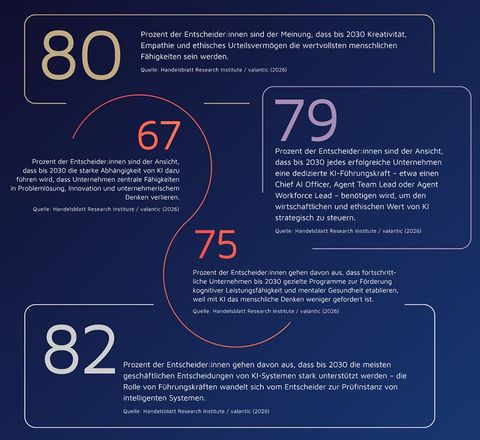
79% of respondents expect that companies that do not consistently integrate AI will be at a competitive disadvantage by 2030. AI can increase productivity, efficiency and performance, provided it is used in a targeted manner in line with corporate goals.
Human skills are crucial
The study underlines that human skills such as creativity, empathy and ethical judgment will be crucial for innovation and corporate success in the future. 80% of respondents rate these skills as particularly valuable as analytical and operational tasks are increasingly automated.
The role of managers will also change: 82% of respondents assume that AI will have a significant influence on decisions in companies by 2030. Managers will increasingly act as reviewers for AI systems instead of performing traditional decision-making functions.
Dependency risk
At the same time, 67% of respondents see risks in the strong dependence on AI. There is a danger that key human skills such as problem-solving, innovation and entrepreneurial thinking will be lost. To counteract this, 75% expect companies to introduce programs to promote cognitive performance and mental health.
In addition, four out of five respondents believe that companies need new leadership roles such as Chief AI Officers or Agent Workforce Leads to manage the economic and ethical use of AI.

Laurenz Kirchner, Managing Director and Head of the Data & AI Practice at Valantic, explains: "The real challenge is to combine technological progress with the targeted promotion of human skills such as creativity, empathy and ethical thinking. Only companies that take responsibility for the impact of AI seriously will be successful in the long term."
The study shows that companies must act strategically to maintain the balance between technological automation and human expertise and prepare for the ethical and economic challenges of the AI age.


You might also be interested in
Extended three-member Management Board for Deutsche Messe
Deutsche Messe AG is reorganizing its personnel and consistently focusing its Management Board on the further development of the company and the exhibition grounds in particular. With an expanded three-member Management Board, the company is...
 read more...
Federation Architecture | Part 1
Rethink IT-OT Convergence in an AI-Driven World
AI is shifting threat models for industrial infrastructures. Federation Architecture proposes a disciplined middle ground between isolation and full integration - with edge autonomy, one-way data flow, and human approval.
read more...AI-enabled rugged mobile workstation
With 'Z14I-HG' Durabook presents an AI-ready Fully Rugged Mobile Workstation with Nvidia RTX 5000/3500 Ada graphics.
read more...Siemens and Nvidia are accelerating Chip Testing
Siemens and Nvidia have significantly accelerated the verification of AI chips. With the help of FPGA-based prototypes, tens of trillions of design cycles could be tested within a few days before production. This should improve the development and...
read more...IFS relies on Asset-based Pricing Models
IFS is introducing a new pricing model designed to simplify access to 'Industrial AI'. Instead of paying per user, companies will in future pay per asset operated, enabling company-wide use without cost increases.
read more...Robust AI Performance at Temperatures from -40 °C to +85 °C
Congatec is expanding its portfolio of Computer-on-Modules (COMs) to include variants with Intel Core Ultra Series 3 processors for the industrial temperature range from -40 °C to +85 °C.
read more...Q.ANT hires Michael Krüger for Sales
Photonics specialist Q.ANT is expanding its management team. Michael Krüger is taking on the newly created position of Vice President Commercials and will be responsible for driving forward the marketing of the processor technology.
read more...AI-supported infrared Analysis Camera
Flir has developed a thermal imaging camera for perimeter surveillance that expands the manufacturer's range of mid-range infrared security products.
read more...Fraunhofer develops Chatbot for Expertise
The 'STARK' research project has been launched at the Produktionstechnisches Zentrum Berlin. The aim is to develop an AI-supported system that secures and makes experience-based knowledge in companies accessible - particularly against the backdrop...
read more...