

Industrial Networks
Industrial Ethernet dominates
Every year, HMS Networks conducts a market analysis of industrial networks. The latest study shows that the market for industrial networks is continuing to expand, with expected growth of 7% in 2024.
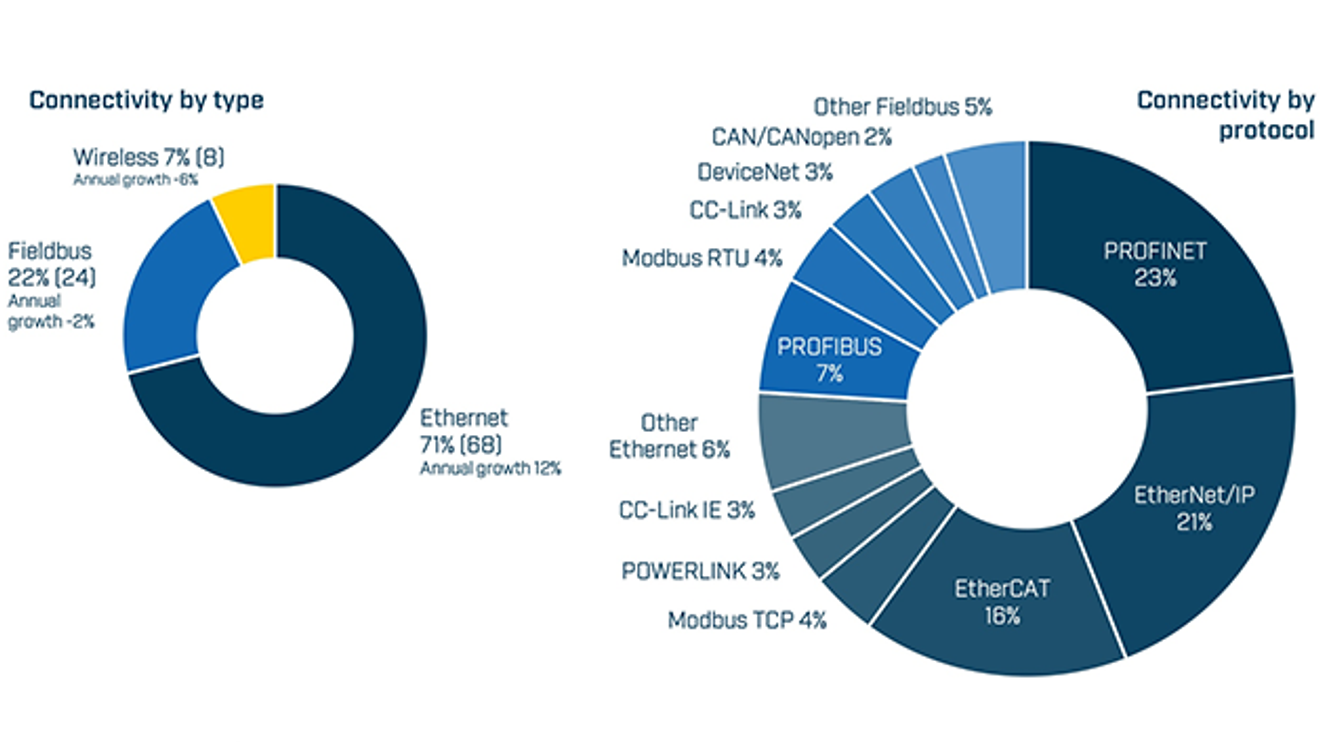
[DE] With its annual industrial networking market analysis ,HMS Networks aims to estimate the penetration of new connected nodes by type and protocol within factory automation. The latest study shows that the market for industrial networks continues to expand, with an expected growth of 7% in 2024. Industrial Ethernet continues to dominate with a 71% share of all newly installed nodes, compared to 68% in the previous year. The share of fieldbuses has fallen from 24% to 22%, while the share of wireless technologies has fallen slightly from 8% to 7%. In the network ranking, Profinet is in the lead with a 23% share of newly installed nodes, closely followed by EtherNet/IP with 21% and EtherCAT with 16%..
Industrial Ethernet with steady growth
Mit einem Wachstum von 12 % beschleunigt Industrial Ethernet sein Wachstum und erobert weiterhin Marktanteile. Industrial Ethernet hat mittlerweile einen Anteil von 71 Prozent am weltweiten Markt für neu installierte Knoten in der Fabrikautomation. Profinet ist mit einem Marktanteil von 23 % am weitesten verbreitet und übertrifft damit EtherNet/IP, das 21 % der neuen Knoten ausmacht. Die Popularität von EtherCAT ist ungebrochen hoch und liegt mit einem Marktanteil von 16 % sicher auf dem dritten Platz.
Feldbusse mit erwartetem Rückgang
Conventional serial fieldbus installations are increasingly losing momentum. Although fieldbus installations still account for a significant proportion of new nodes, annual growth is expected to decline by -2% in 2024. Profibus leads the fieldbus ranking with a market share of 7%, followed by an even distribution among other well-known fieldbus protocols.
Together, fieldbuses will account for 22% of the market in 2024. Despite the decline in new fieldbus nodes, it can be assumed that the proven and reliable fieldbuses will continue to be used in many devices, machines and factories in the coming years.
Wireless technologies with a constant presence
Wireless technologies have seen steady growth in recent years, even if the pace of growth has now slowed slightly. Wireless solutions still account for 7% of the total share by type. More and more products supporting industrial wireless solutions are being introduced to the market and the acceptance of wireless solutions in factory environments is increasing. Typical use cases include cable replacement applications, wireless machine access and the integration of mobile devices into industrial networks.


Das könnte Sie auch interessieren
KI – Wegbereiter für TSN?
Welche Anforderungen stellt der Einsatz von KI an die Automatisierung und die Vernetzung? Bilden vielleicht die Mechanismen von Time Sensitive Networks in Kombination mit Profinet die optimale Architektur für Anwendungen der KI?
 mehr...
Ein ressourcenbasierter Ansatz
Der Mehrwert von TSN ergibt sich vor allem durch die IT/OT-Konvergenz in den Endpunkten. Das Potenzial auszuschöpfen ist noch komplex und erfordert tiefe Kenntnisse der Netzwerktechnik. Als Alternative wird ein applikationszentrischer,...
mehr...Federation Architecture | Teil 2
Keine Architektur ist perfekt
Nachdem Teil 1 die Grundsätze der Föderierten Architektur (FA) vorgestellt hat, befasst sich dieser Artikel mit den praktischen Effekten. Er beschreibt die betrieblichen Auswirkungen, Einschränkungen und Anwendungsbereiche und ordnet FA in...
mehr...PNO-Mitgliederversammlung 2026
PNO bestätigt Vorstand und setzt auf Ausbau
Auf der Hannover Messe 2026 hat die Profibus Nutzerorganisation (PNO) Vorstand und Beirat neu gewählt. Im Fokus standen Technologie-Updates, Finanzzahlen sowie der strategische Ausbau hin zu integrierten Kommunikations- und Automatisierungslösungen.
mehr...Effiziente Schneidtechnik durch TSN
KFT integriert CC-Link IE TSN in seine Schneidemaschinen und erreicht damit eine zuverlässige Echtzeitkommunikation, vereinfachte Architektur und bessere Skalierbarkeit für komplexe Motion-Anwendungen.
mehr...Pragmatisch ins Industrial IoT
Die Integration einer Profinet-Schnittstelle in ein bestehendes System ist oft komplex – insbesondere dann, wenn Zeit, Entwicklungsressourcen und Stück-zahlen begrenzt sind. Genau diese Herausforderung galt es bei der Netzteilerweiterung einer...
mehr...CC-Link-Zertifizierung für modulares I/O-System
Weidmüller hat für das modulare I/O-System 'u-remote' das Zertifikat der CC-Link Partner Association (CLPA) erhalten. Damit ist u-remote das erste modulare I/O-System mit offizieller CC-Link-IE-Safety-Zertifizierung für CC-Link IE TSN.
mehr...Profibus & Profinet International
MTP Specification 2.0 veröffentlicht
Profibus & Profinet International (PI) gibt die offizielle Veröffentlichung der Module Type Package (MTP) Specification 2.0 bekannt. Der Standard MTP 2.0 schaffe branchenübergreifend die Grundlage für echte Interoperabilität sowie mehr...
mehr...Profinet V2.5 ermöglicht sichere IT/OT-konvergente Netzwerke
Das neue Profinet V2.5 integriert Echtzeit- und TCP/IP-Kommunikation, verbesserte Cybersicherheit sowie moderne Ethernet-Technologien. Alle Aktualisierungen sind in den GSD/GSDX-Dateien und den Testsystemen abgebildet.
mehr...