

Safety
Safe sensor technology for robots
Increasingly automated production processes cannot do without robot applications sooner or later. The robots work together with the worker at different levels of proximity. A challenge for safe sensor technology.
Safety can be achieved relatively easily through the use of various mechanical protective devices by enclosing machines and systems. However, although such a strict separation of work areas achieves the greatest possible safety, it comes at the expense of flexibility.
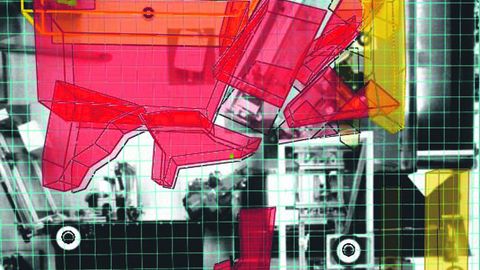
For dynamic safety concepts, sensors should be able to distinguish, for example, whether a person is in the potential area of action of a dangerous movement or has already entered a zone with increased safety requirements.
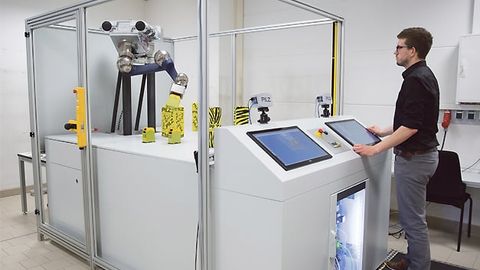
© MushroomIf there is no enclosure, the joint working area of the robot and human must currently be safeguarded in two steps: In the first step, the position of the human is usually reliably detected using an external sensor system that is not integrated into the robot. Camera-based sensors such as three-dimensional safe camera systems, laser scanners or spatially resolving, pressure-sensitive floor sensors are suitable measures for this.
A safe three-dimensional camera system can be used to visually monitor the working areas of humans and robots. For this purpose, the camera system is mounted at an appropriate height above the application so that it always has the entire application area in view. This area is by no means static: The application area can be divided into different zones - for example, warning or protection zones. This defines the robot's behavior when a worker enters a zone. In addition, these zones can be adapted as required so that the application remains 'dynamic'.
Optical or camera-based sensor systems are a good solution, provided the conditions of the industrial environment are right. Harsh environmental conditions, such as poor lighting conditions, high levels of soiling, shading or obscuring by the robot itself, can affect the availability of this type of sensor technology. For such environments, a pressure-sensitive and location-resolving floor covering can be designed in the application area as an alternative - for example, a safe step mat that detects the position of the person and relays their position data. The complex sensor data from the spatial resolution can either be evaluated individually or - by cleverly combining them in the configuration - configured into warning and protection zones for the robot.
Machinery Directive also for robots
Recognizing the position of humans and robots is the basis. In a second step - safeguarding an application for human-robot collaboration (HRC) - the data from the sensor is transferred to the robot controller.
This is the step in which the safety of the HRC application must be examined more closely. After all, robots are partly completed machinery as defined by the Machinery Directive. Since spring 2016, the technical specification ISO/TS 15066 "Robots and Robotic Devices - Collaborative industrial robots" can be used when creating a robot application. After appropriate validation, it enables safe human-robot collaborations to be implemented for the first time. ISO/TS15066 describes four types of collaboration in more detail as safety principles: 'safety-oriented monitored standstill', 'hand guidance', 'speed and distance monitoring' and 'power and force limitation'.
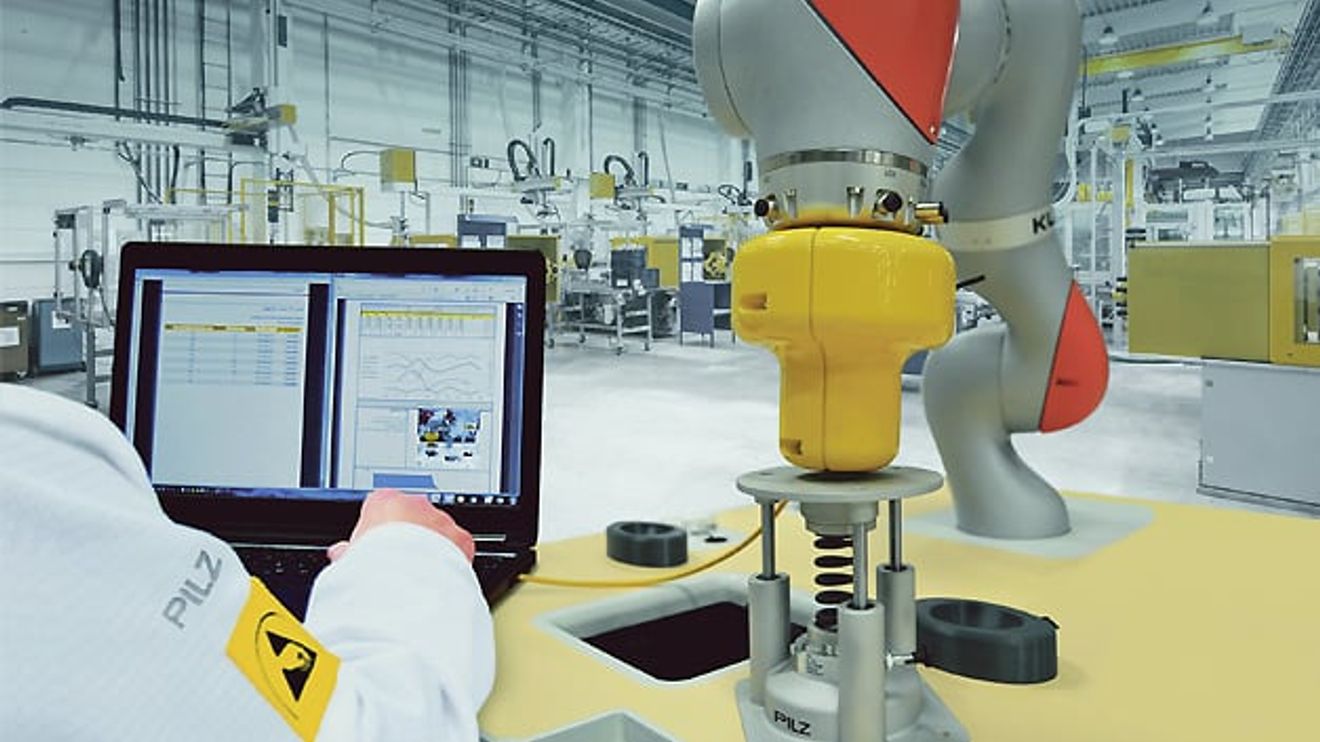
When implementing safe human-robot collaboration, the system integrator can select a single or a combination of these collaboration types for their application. The Technical Specification is also the first standard to provide detailed information on pain thresholds for different body regions in its Annex A. These values form the basis for implementing the application with a 'power and force limitation'. The robot must be set up in such a way that it complies with the limit values for collision forces and pressures defined in ISO/TS 15066. The document divides the human body into different regions, with each body region being assigned a specific spring constant in order to simulate the flexibility of the body during measurement. This force measurement can be carried out with a force measuring device specially developed by Pilz for this purpose, which is suitable for practical use in industry and whose spring can be easily exchanged depending on the body region. The pressure measurement is carried out simultaneously with the force measurement, using pressure measurement foils.
Analogous to the collaboration types in ISO/TS 15066, ISO 10218-2 "Robots and robotic devices - Safety requirements for industrial robots" specifies four methods of human-robot collaboration: Method 1 specifies safety-oriented monitored standstill, method 2 specifies manual guidance, method 3 specifies speed and distance monitoring and method 4 specifies power and force limitation.
In order for a robot to be used in a safe HRC application according to method 3 and/or method 4, it must fulfill a number of safety-related requirements such as Safe Speed Reduction (SLS), Safe Force Power Reduction, Safe Workspace Monitoring and Safe Torque Off (STO).
In order to comply with the force and pressure limits, the robot usually has to reduce its speed considerably. This has an enormous impact on productivity. In order to increase productivity, it is therefore necessary to minimize downtimes, which can be caused by a collision with a human, for example. On the other hand, the robot's movement speed must be increased.
This is precisely where safe sensor technology comes into play - that which is integrated directly in or on the robot and that which surrounds the robot.
Dynamic path planning
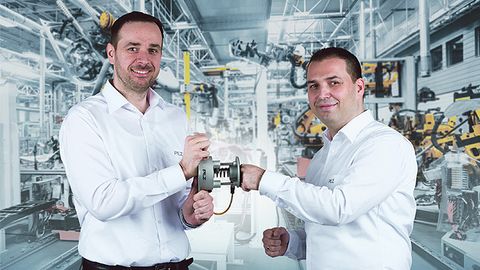
Pilz has developed a collision measuring device to measure forces and speeds: 'PROBmdf' can precisely record the forces acting in a collision with a robot and compare them with the specifications from ISO/TS 15066.
© MushroomIn order to avoid collisions with humans, it is necessary to move away from rigidly predefined motion paths and switch to dynamic path planning: In many HRC applications, the path - from the starting point to the target point - is not as relevant as the specified end position that the robot should reach. The appropriate sensor technology detects both static and dynamic obstacles in the environment. These influence the robot's path of movement: if an obstacle is detected, the robot attempts to adapt its path so that no collision occurs. If a collision cannot be avoided, a braking process is initiated in good time. Once the work area is clear again, the robot continues its movement without the need for human intervention. In this way, the collision avoidance strategy minimizes uneconomical downtimes and increases the speed of movement.
Reliable object detection
The safe 3D camera system 'SafetyEye' from Pilz monitors warning and protected areas three-dimensionally thanks to a combination of sensors, controls and actuators.
© MushroomTo achieve this, safe near-field or close-range sensors are used. They must be able to reliably detect people and objects at a distance of a few centimetres to several meters, i.e. they must be able to implement proximity detection. The earlier the robot detects an object in its movement range, the better it can adapt its movement planning and, if necessary, take evasive action in good time.
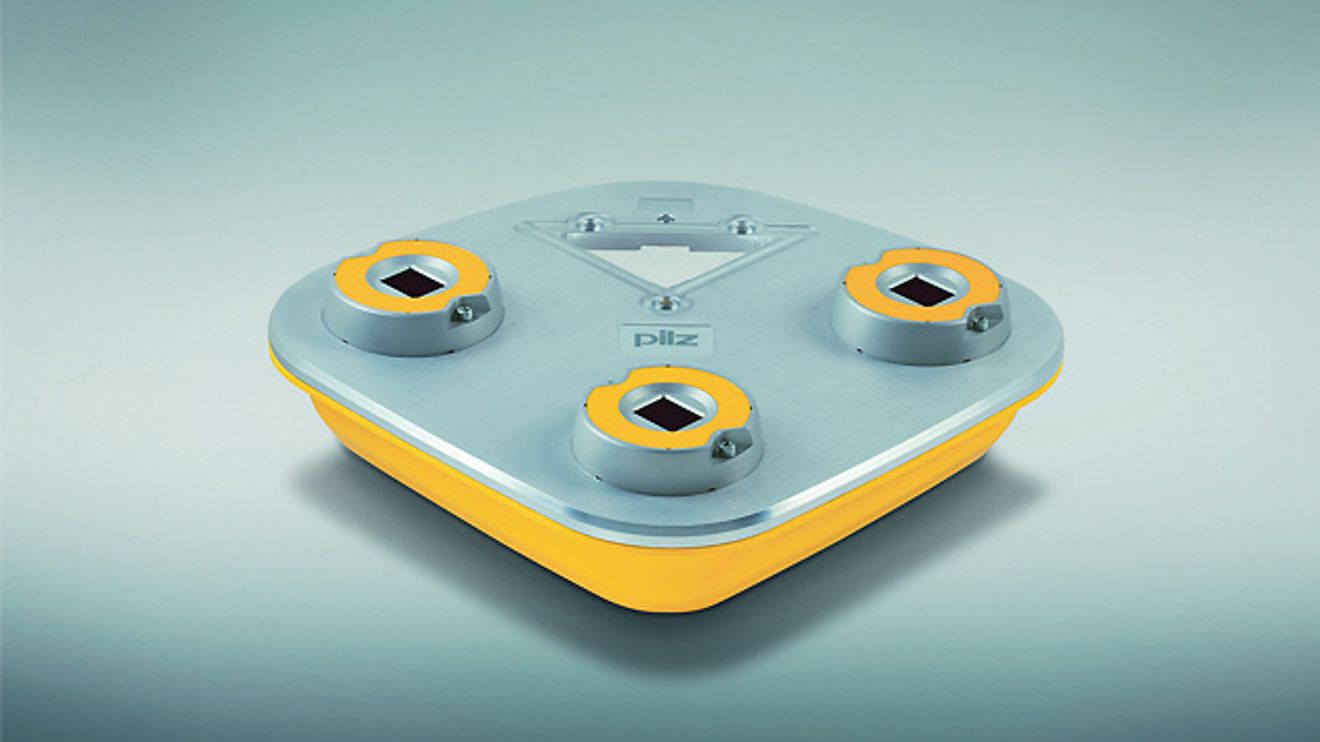
Tactile sensors for determining the position of people: A step mat detects the position and direction of movement of the person and transmits the data to the robot controller to prevent unintentional collisions between man and machine.
© MushroomProximity detection in the range of a few centimetres can be achieved, for example, by a 'tactile skin' surrounding the robot arm with integrated safe capacitive sensors. Monitoring in the meter range can possibly be implemented using a combination of different sensors - such as cameras, infrared, TOF (Time of Flight), radar or ultrasound. Such a complex sensor system must be able to combine, evaluate and interpret large amounts of data from the different sensors (sensor fusion). This brings the sensor system and the sensor fusion interface to the robot controller closer together. This requires high performance in order to enable fast reaction times. It is therefore necessary to integrate the sensor system into the robot, which also simplifies handling for the user. For example, the user no longer has to worry about where to mount which sensor and how to supply power and route cables.
At present, the market does not yet offer any sensors that can meet these increased requirements. However, the first steps towards a safe future with HRC are emerging with products such as the collision measuring device from Pilz, which enables standard-compliant validation of HRC.
Authors:
Daniel Bakovic is Senior Manager Control Technology and Mechatronic Systems at Pilz in Ostfildern;
Onedin Ibrocevic is Senior Manager Sensor Technology at Pilz in Ostfildern.


You might also be interested in
Festo at the Hannover Messe 2017
New bionic approaches for robotics
The engineers from Festo's Bionic Learning Network are presenting new concepts for robotics at the Hannover Messe 2017. Models from nature served as inspiration: the elephant's trunk and octopus tentacles.
 read more...
Fraunhofer experts explore the world's oceans
Fraunhofer IOSB is the only team from Germany to have qualified for the semi-finals of the Shell Ocean Discovery XPrize. This highly remunerated international competition recognizes innovations for research into the seas and oceans.
read more...5G for intelligent manufacturing
Ericsson and robot manufacturer Comau have signed a cooperation agreement. Together, they want to explore the potential of 5G technologies in the context of Industry 4.0 and smart manufacturing.
read more...Safety first
The development of cobots into a commodity product is closely linked to the issue of safety in robotics - a challenge that needs to be mastered efficiently.
read more...Locking with need for clarification - help with risk assessment
DIN EN ISO 1419 has already been available for five years. However, there are always uncertainties regarding the actual safety functions of a guard locking device, which the machine manufacturer must evaluate based on his risk assessment. Here is...
read more...Safe operation via radio - (how) does it work?
Many machine builders want to use tablets in addition to the existing machine operation. Demanded features such as WLAN, camera, multi-touch and much more are available here - but if safety functions are required, these devices reach their limits.
read more...Heavy-duty HRC requires new safety approaches
The topic of HRC is not just for 'lightweights'. In the field of heavy-duty robotics, solutions will also be in demand in the future that allow humans and robots to work together directly without the need for a safety fence. However, this requires...
read more...Secure hold in the slip ring
Transmitting safety-relevant data via slip rings is no trivial matter. Motion control experts from Kollmorgen have developed a TÜV-certified safety solution, including UL approval, together with slip ring manufacturer Stemmann-Technik.
read more...Validation neglected
EN ISO 13849 is decisive for the integration of safety-related control functions in machines. However, the part of the standard relating to validation is often neglected in practice - a major shortcoming.
read more...