

Sensor-actuator communication
IO-Link - but wireless!
IO-Link is used for simple wiring of intelligent, complex sensors and actuators using a standardized 3-wire sensor cable. In future, devices will also communicate wirelessly via IO-Link.
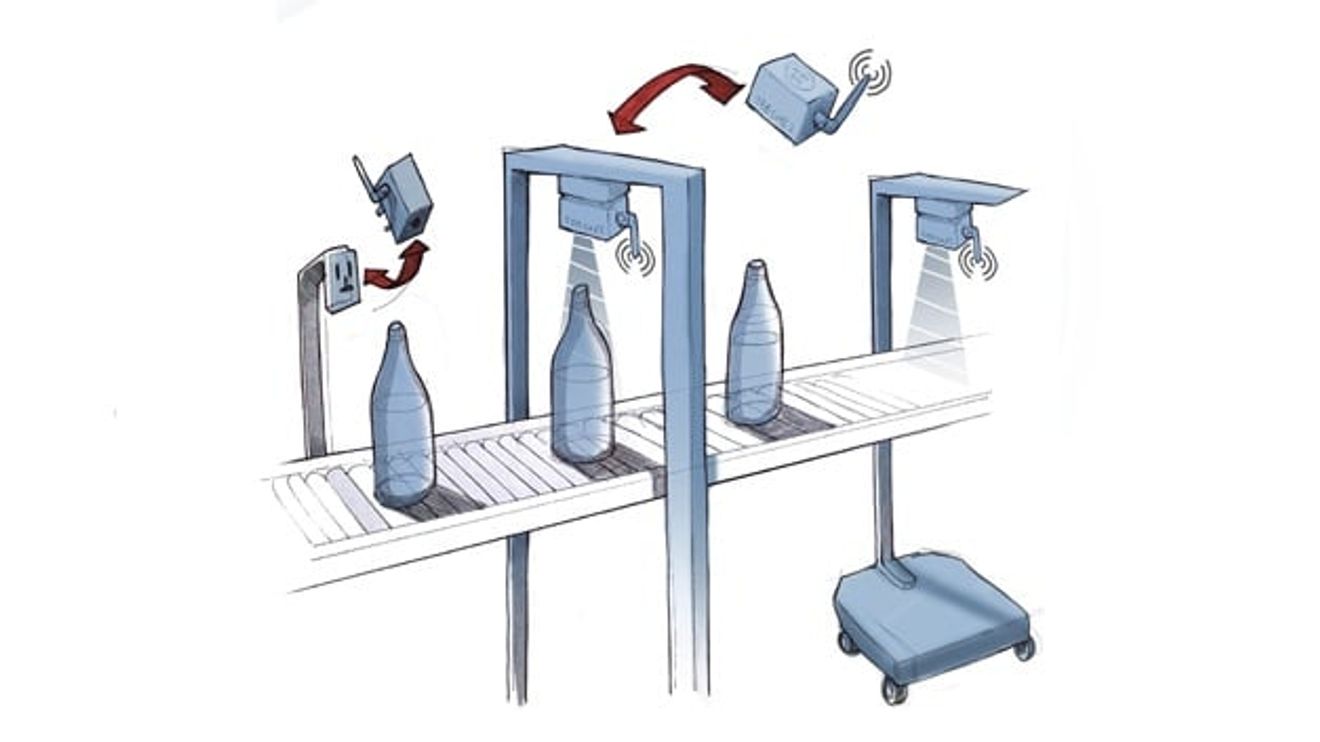
There is still great potential for savings when wiring sensors and actuators. It is therefore only logical that IO-Link is now also opening up to the topic of wireless when it comes to field device wiring. The IO-Link community has been working on creating a specification for IO-Link wireless technology since 2016. The requirement profiles and use cases for this have been formulated and, based on this, the technical requirements have been defined and the specification document created in the corresponding technical working group.
A challenging task
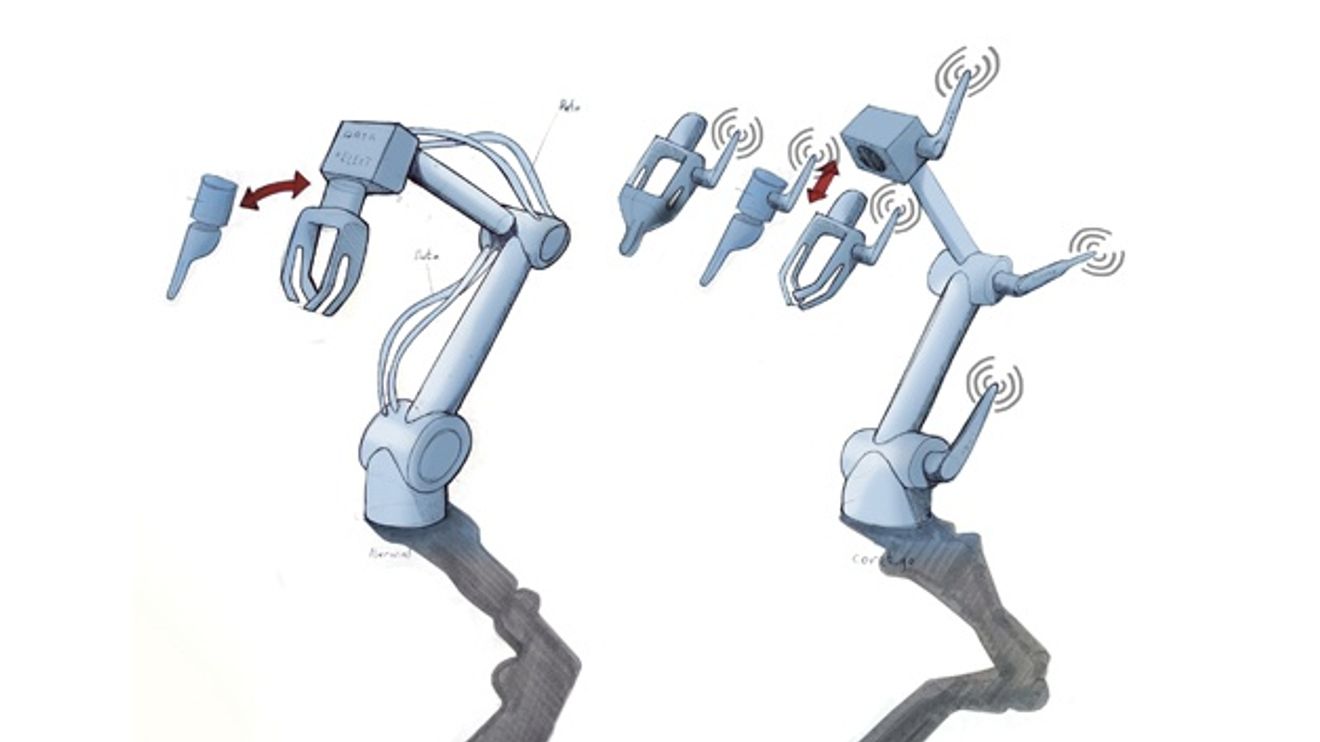
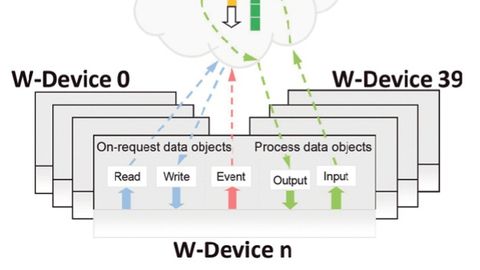
IO-Link Wireless communication principle: There is no difference for the user whether wired IO-Link information or IO-Link wireless data is processed.
© IO-Link CommunityIn order to achieve the system performance of hard-wired sensor-actuator systems with wireless technology, different requirements need to be met. For example, a cycle time of less than 10 ms is required for updating the I/O data. The demands on reliability are at least as high as for wired systems. More than 30 devices should be able to communicate with a master via one radio channel. The 2.4 GHz band is to be used as the frequency band - coexistence with other systems on this frequency band is a prerequisite. In addition, up to three masters should be able to communicate with a total of up to 120 devices within a high-frequency range.
Previous wireless technologies do not fully meet these requirements. WiFi, for example, fails the requirement for reliability and determinism due to the 'listen before talk' mechanism used. With Bluetooth, neither the required number of participants nor the real-time requirements or the problem-free coexistence with other technologies can be realized. Zigbee cannot guarantee the desired update rates either, as the data rate of 250 kbps with 16 frequency channels used and 5 MHz bandwidth is too low. Wireless Hart, on the other hand, does not achieve the speed required in factory automation with a cycle time of several 100 ms.
The technical implementationThe technical implementation
The IO-Link Wireless working group has defined characteristics for the technology in order to be able to fulfill the defined requirements with IO-Link Wireless. One of the key specifications is that the application interface for cyclical data (process data) and acyclical data (on-request data) is compatible with the existing IO-Link description. This means that there is no difference for users whether wired IO-Link information or IO-Link wireless data is processed. In order to be able to handle the large number of devices, a master should be able to contain up to five transmission channels. Each of these supports a maximum of eight devices. This results in a total of 40 wireless devices per master. Three masters will be able to work in parallel in one cell. This results in a maximum number of 120 devices in one cell. A pairing service is implemented to assign the devices to the corresponding masters. A scan service enables 'unpaired' devices to be added to the system. For moving devices, there will be no limits on the speed at which they can move within a cell. A defined handover mechanism ensures the controlled roaming of devices between different masters.
IO-Link Wireless uses 2.4 GHz ISM band RF transceivers. The 2.4 GHz band is divided into 80 channels, each 1 MHz apart. General coexistence with other wireless systems is made possible by the so-called blacklisting mechanism - certain channels that are known to be used extensively by other systems are hidden from the outset. Within this fixed framework, 'frequency hopping' can be used. This allows a bit error probability of 10-9 to be achieved - similar to wired systems. In the future, it is planned that low-power devices will also be supported by the system. The cycle time is 5 ms. In order to comply with legal requirements, the transmission power is limited to ≤10 dBm (10 mW) EIRP. Nevertheless, an extension of 20 m is achieved within a master cell with one communication channel; with more than one communication channel, 10 m can still be achieved.
The specification is available
The specification for IO-Link Wireless has been available since Hannover Messe 2018. This is also where the technology was presented to the public for the first time in the form of a demonstrator at the PI joint stand.
Author:
Stephan Langer is Director Industry Portfolio Management Packaging, Food & Beverage at Balluff in Neuhausen auf den Fildern.


You might also be interested in
esd electronics at the SPS 2025
Gateway connects Ethercat with CAN FD
With the 'CAN-EtherCAT/2-FD', esd electronics presents a stand-alone gateway that allows a direct connection from CAN FD to Ethercat.
 read more...
Innovation partner for automation
Bihl+Wiedemann is a medium-sized, owner-managed company - founded in 1992 by Jochen Bihl and Bernhard Wiedemann in Mannheim. It develops and manufactures complete solutions for functional safety and data communication in machines and systems.
read more...IIoT gateway or soft PLC
With 'IndustrialPI', Pilz presents an open and modular industrial PC based on the Raspberry Pi with freely available open source software.
read more...Efficient Modbus gateways
Spectra's tGW-700 series Modbus TCP to RTU/ASCII gateways allow Modbus/TCP hosts to easily communicate with Modbus RTU/ASCII serial devices over an Ethernet network.
read more...Lütze Group is acquired by Amphenol Corporation
The international Lütze Group will be acquired by the US-based Amphenol Corporation on October 1, 2024.
read more...Certified according to IRIS Rev.04
Rail technology specialist Lütze Transportation has successfully completed certification in accordance with ISO 22163:2023 / IRIS Rev.04. The certification underlines Lütze's commitment to meeting the highest quality requirements of the rail...
read more...Industrial routers and gateways
Hy-Line Technology is expanding its portfolio of 5G-capable industrial routers and gateways.
read more...Innovation partner for automation
Bihl+Wiedemann is a medium-sized, owner-managed company - founded in 1992 by Jochen Bihl and Bernhard Wiedemann in Mannheim. It develops and manufactures complete solutions for functional safety and data communication in machines and systems.
read more...Fast and secure access to the IoT
IoTmaxx offers freely programmable Linux gateways for a quick and cost-effective entry into the Internet of Things (IoT).
read more...