

Mushroom
The individual path to robot safety
Increased productivity and demographic change are the driving forces behind the potential of human-robot collaboration. However, when humans and robots share a workspace, the issue of safety plays a central role.

In practice, this means that each application - whether stationary or mobile robot - must be considered individually in terms of safety. Wherever humans move closer to the machine or both share a task and a workspace, safety plays a decisive role: in mobile robot applications, flexible safety concepts take the place of spatially separating systems. Only these allow forms of collaboration that combine safety and productivity. With an autonomous mobile robot platform, for example, in which kinematics such as a robot or conveyor belt are integrated, hazards can arise for people working next to this platform. For this reason, care must be taken in mobile applications to ensure that both the normative requirements of mobile platforms and those of robots and collaborative robots are met.
Collision not (or no longer) ruled out
Reliable control systems and intelligent, dynamic sensors on the robot itself are prerequisites for injury-free interaction between humans and robots. This enables the robot to sense when a collision occurs. On the other hand, reliable safety standards must be set by normative principles. The technical specification ISO/TS 15066 'Robots and Robotic Devices - Collaborative industrial robots' plays a key role here. This technical specification can be used to implement safe human-robot collaborations (HRC) after appropriate validation. ISO/TS 15066 describes four methods in more detail as protection principles:
- Safety-oriented monitored standstill
- Manual guidance
- Speed and distance monitoring
- Power and force limitation
During implementation, the system integrator can select one or a combination of these 'methods' for their application. In practice, it has been shown that ISO/TS15066 human-robot collaborations can often be implemented using a combination of speed and distance monitoring and power and force limitation.
A body zone model is listed in the annex to the ISO/TS 5066 technical specification. This provides information on the respective collision limit values for each body part - for example on the head, hand, arm or leg. If the application remains within these limits during an encounter between a human and a robot, it is compliant with the standard. These pain thresholds are used in practice to validate safe human-robot collaboration.
To measure forces and speeds, the automation company Pilz, for example, has developed the PRMS collision measuring device, which uses springs and corresponding sensors to precisely measure the forces and pressures exerted in the event of a collision with a robot. Software evaluates the values and compares them with the specifications from ISO/TS 15066.
Modular sensor system for safe robots

The PRMS collision measurement set from Pilz is helpful in the validation of HRC applications: equipped with springs and corresponding sensors, the forces and pressures acting in the event of a collision with a robot can be precisely recorded, evaluated by software and compared with the specifications from ISO/TS 15066.
© MushroomSafe sensor technology plays a key role in the technical implementation of robot applications: in order to meet the safety requirements of all applications, a modular system of sensors is required that can be tailored to the individual needs of the application. In the case of human-robot collaborations, for example, a distinction must be made as to whether a person is in the potential action area of a hazardous movement (warning zone) or has already entered a zone with increased safety requirements (protected zone). Ideally, these areas must be able to adapt dynamically and, for example, track the safely monitored movements of the machine or a robot. In this environment, HRC applications can be realized in which static protective devices would reach their limits. Protection concepts based on safe radar systems or safety laser scanners are more flexible.
In robot applications, on the other hand, where only human inspection, insertion of parts or reworking is required, for example, electro-sensitive protective equipment such as safety light curtains are often used as access protection. It may also be necessary to install rear access protection in the form of horizontally installed safety light grids or a safety laser scanner.
If protective devices have to be placed close to a dangerous movement in confined spaces, for example, there is a risk of dangerous overtravel. The use of a safe guard locking device is still absolutely essential here. Mechanical guard locking devices with spring force interlocking or integrated safe guard door sensors perform these tasks on appropriate safety gate solutions.
Safe automation of mobile robots
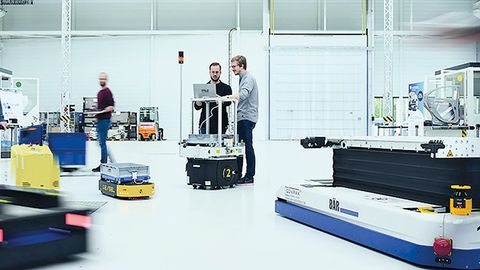
Everything is in flux thanks to an individual but holistic approach to the necessary safety concepts for mobile robotics.
© Arena2036/Corinna SpitzbarthThe use of autonomous mobile robots (AMR), which are increasingly autonomous, flexible and less dependent on the fixed infrastructure in which they are operated, is on the rise. With this change, appropriate safety concepts must also be taken into account so that no accidents occur where the workspaces of humans and machines intersect.
ISO 3691-4 'Automated guided vehicles and their systems' provides the normative framework. Safety sensors and controllers are used for the technical implementation of the safety functions on the vehicles - such as monitoring the warning and safety zones in accordance with ISO 3691-4. Safety laser scanners provide this type of protection and, in comparison to solutions with light curtains, offer barrier-free, more productive area monitoring for collision protection.
Freely navigating autonomous mobile robots can avoid obstacles or people without stopping. The required safety functions are therefore complex. It must be possible to switch between several safety zones, especially when steering around bends. Safe sensors, such as safety laser scanners, permanently record the surroundings for free navigation. The up to 70 protective fields of the 'PSENscan' safety laser scanner from Pilz, for example, allow such dynamic protective field adjustment: at high speeds, these protective zones are larger in order to detect obstacles at an early stage. At slower speeds, they are correspondingly shorter in order to generate as few standstills as possible. This allows the AMR to move efficiently.
The complexity of the safety zones also requires corresponding parameterization options from the safety controller. The configurable small controller 'PNOZmulti 2' from Pilz monitors one or two axes (per module) using motion monitoring modules, for example. An independent module program is parameterized in the associated configuration tool using software modules, so that reliable selection of the corresponding zone of the safety laser scanner can be implemented with just a few clicks.
No safety without industrial security
In addition to machine safety, industrial security plays an important role. Increasing networking requires additional protection. AMRs, for example, communicate as freely navigating automated guided vehicles (AGVs) via radio with their control system. This makes them vulnerable to external data access or manipulation. Map data could be interrogated and, in the worst-case scenario, AGVs and therefore ongoing production could even be brought to a standstill. An industrial firewall, such as the 'SecurityBridge' from Pilz, protects the control network from manipulation and ensures that nobody can access the mobile robot's internal IT network without authorization during operation.
In addition to pure data and network security, comprehensive identification and access management provides a solution that not only protects the AGV from physical manipulation or incorrect operation. For example, an access authorization system can be used to protect robot applications from unauthorized access, as only authorized persons are granted access to the application.
Legislators have now also recognized that safety and security go hand in hand. The new Machinery Directive therefore prescribes mandatory security measures, which also has an impact on CE marking.
At the end there is the CE marking
As in other areas, legislation obliges the manufacturer of a robot application - whether stationary or mobile - to carry out a conformity assessment procedure with CE marking. The affixing of the CE marking confirms that the robot application meets all the necessary health and safety requirements. The challenge of the underlying risk assessment for robot applications is that the boundaries between the two working areas of man and machine are becoming blurred. In addition to the hazards posed by the robot, human movements must also be taken into account. However, these are not always calculable with regard to speed, reflexes or the sudden entry of additional persons.
This is followed by the 'safety concept' or 'safety design' steps, including the selection of components. These are usually a combination of intelligent sensors that are linked together and control systems that make the necessary dynamic work processes possible in the first place. The selected safety measures are then documented in the risk assessment and implemented in the 'system integration' step. This is followed by validation, in which the previous steps are reflected on again.
Each application has its own safety-related consideration

There is no such thing as one safe robot or one safe sensor system that covers all possible cases from the applications in terms of safety. The requirements for safety and industrial security always depend on the respective application. Safe robot applications are only created when the robot, tool and workpiece as well as associated machines such as conveyor technology are considered as a whole. In practice, this means that each application requires its own safety-related consideration.


You might also be interested in
Pilz celebrates its 75th anniversary
Pilz celebrates its 75th anniversary with a reception at the Hannover Messe. In attendance: employees, companions, family and lots of warmth.
 read more...
Error? Unacceptable!
High-end systems from Brainware Solutions check the quality features and functions of door panels at an automotive supplier. Integrated into a production line, a test run of the black box takes 23 seconds. The operating and safety concept is...
read more...Quantum-resistant hardware security for Nvidia robotics platform
Infineon Technologies integrates the hardware security module 'Optiga TPM SLB 9672' into Nvidia's 'Jetson Thor' computing platforms for robotics and autonomous systems. The module secures cryptographic keys directly at chip level and thus protects...
read more...6 Criteria for the objective comparison of humanoid robots in industry
A new benchmark from Fraunhofer IPA is intended to enable the first standardized and neutral analysis of humanoid robots for industrial use based on six key criteria.
read more...AI-supported lighting robot wins German Innovation Award 2026
Ledvance, provider of innovative lighting solutions, was named "Winner" in the Excellence in Business to Consumer Lighting category at the German Innovation Awards 2026. With the AI Companion Lighting Robot 'Elix', the company presents an...
read more...Regulation and safety slow down robotics projects in Germany
QNX has published the study "Inside the Robot: Architecture Benchmark Report". The results of the global survey of 1000 robotics developers show that software and safety requirements are increasingly becoming the central bottleneck for innovations...
read more...Michael Ardelt becomes first COO at Robco
Robco, a company for autonomous industrial robotics, is further expanding its management team. As the company's first Chief Operating Officer, Michael Ardelt will assume responsibility for structuring and scaling Robco's growth in operational terms.
read more...Schaeffler cooperates with VinDynamics
Schaeffler and VinDynamics, a company of the Vietnamese Vingroup, have agreed on a strategic partnership in the field of humanoid robotics. The collaboration focuses on the development and supply of planetary gearboxes, central components of...
read more...International Federation of Robotics
China puts AI robotics at the center of its national strategy
With its 15th five-year plan, China has placed robotics at the center of its new industrial strategy. The aim is to focus AI research on physical applications and use robotics as the main driver of economic growth.
read more...