

Pilz - with video interview
Field communication via IO-Link Safety
The manufacturer-independent, standardized communication system IO-Link has been further developed into a system that can also be used for functional safety. Manufacturers currently offer system solutions for IO-Link Safety (IOLS).

When transporting materials, access and safety gates must be well secured. IO-Link Safety enables simple integration of access protection and protection of the safety gate(s).
© MushroomThe IO-Link Safety (IOLS) communication protocol is standardized worldwide in IEC 61139-2 and offers maximum safety up to PL e according to EN ISO 13849-1 (or SIL 3 according to IEC 61508/62061). The integration of safety sensors and actuators is also possible with IO-Link safety systems in any existing fieldbus system, regardless of higher-level systems.
Secure connectivity - easy to implement
Large amounts of data are required to optimize processes. This is where IO-Link Safety opens up new possibilities: As point-to-point communication, the technology enables the simple and safe integration of safety sensors right into the field. It also offers the opportunity to optimize the area of self-diagnosis and data evaluation. The first IO-Link safety devices are now available for safe communication in the field: Pilz, for example, relies on a complete solution with master, sensors, field devices and suitable configuration tools. Such packages from a single source mean that users can further simplify the integration of IO-Link safety technology into plant and machinery, as the appropriate configuration tools make it easier to integrate the devices. The IO-Link Safety Master from Pilz also enables the integration of IO-Link products and standard safety sensors. This is because the requirements that users focus on include simple installation and the reduction of storage space: in other words, the systems must be easy to handle in terms of wiring and product configuration, with fewer components in the warehouse - and later in the control cabinet - being the practical goal.
Practical case: Interlinked systems

When transporting materials, access and safety gates must be well secured. IO-Link Safety enables simple integration of access protection and protection of the safety gate(s).
© Monty Rakusen/Cultura/Getty Images, MushroomSeveral sensors are usually used in an interlinked packaging system, which not only requires a lot of space for the cabling, but also means that a lot of time is needed for installation. A solution with IO-Link Safety looks like this:
The master is used decentrally in the field, so that the reduced cable length already saves space. Point-to-point communication makes the wiring of safety sensors much easier to implement. At the same time, users can use the system flexibly, as standard safety sensors as well as IO-Link safety sensors and IO-Link devices can be connected to the eight ports of the IO-Link Safety Master, for example. Both IOLS safety sensors and IO-Link standard sensors can be connected to four IOLS ports.
Video tip: |
Industrial communication with IO-Link Safety |
|---|
Dual-channel connection options are essential to ensure safety redundancy: with so-called FDIO ports (Failsafe Digital Input Output), the user can choose between a safe input or a safe output and also whether this should be dual-channel. This allows classic safety sensors such as safety switches, solenoid interlocks or emergency stop devices to be connected. OSSD (Output Signal Switching Device) signals can also be processed in this way. The Pilz solution offers four FDIO ports, providing a high degree of flexibility with regard to the connection options via the IO-Link Safety Master.
Easy and space-saving installation
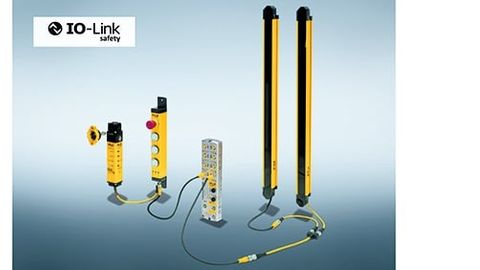
The IO-Link system solution from Pilz includes masters, sensors, field devices and suitable accessories. The devices equipped with IO-Link safety functionality include the safety light curtains PSENopt II advanced IOLS, the control unit PITgatebox IOLS and the IO-Link safety master PDP67 IOLS.
© MushroomCommunication via IO-Link Safety always takes place via unshielded cables, as only a distance of up to 20 m can be bridged. IO-Link Safety uses industry-standard connections for this purpose. This means that fewer cables are required, simplifying installation and device replacement. In practice, it takes less than a minute to connect a standard M12 connection - in contrast, conventional wiring takes over an hour. The connection is also less susceptible to wiring errors: as IO-Link safety technology supplies the data for diagnostics at the same time, a device connected to the wrong port can also be detected immediately and the error rectified.
Another advantage: all devices in the interlinked system are identified and parameterized independently. The secure communication protocol therefore significantly optimizes installation, commissioning and maintenance times. Downtimes, for example when repairs are due, can be significantly reduced and maintenance can be planned in advance. The power supply and data transfer take place via a simple, unshielded cable: IO-Link Safety can transfer up to 32 bytes of data bidirectionally at up to 230.4 kbit/s.
Practical case: Material transport
The secure communication protocol has to meet completely different requirements when it comes to production cells in the material handling sector, for example, which contain integrated robotics.
Video tip |
Industrial communication with IO-Link Safety |
|---|
Access and safety doors in such applications often need to be well secured and machine downtimes minimized. IO-Link Safety ensures that both the integration of access guarding and the safeguarding of the safety gate(s) is simple and time-saving. The Pilz solution is as follows: The push-button unit 'PITgatebox IOLS' with the solenoid interlock 'PSENmlock' is connected to the IO-Link Safety Master ('PDP 67 IOLS') via just one port. This means that the push-button unit enables the connection to the guard locking device without occupying any other ports on the IOLS master. This is because both the safety light curtains and the push-button unit can be connected directly to the field device - the IOLS master; keyword: fast cabling.
In addition, the solution monitors the application 'smartly', insofar as the data from the safety light grids can be evaluated. For example, they provide information about the temperature status within the sensors, allowing conclusions to be drawn about the ambient temperature: this means that temperature fluctuations above the normal level can be detected early enough before they can have an impact on production.
Produce with foresight
The IOLS devices have a self-diagnostic function that can predict and therefore rule out or minimize potential machine downtime. This can bring advantages during repair and maintenance: The relevant data on the machine status is delivered directly to the responsible interface in the person of a production manager, for example. The IOLS sensors provide information on the actual status - for example, information on how often the maintenance door has been opened, the emergency stop has been activated or light grids have been accessed can be recorded in the higher-level control system. Such data can be used to create concepts for maintenance and repair in order to rectify faults as quickly as possible.
In general, IOLS can significantly optimize the safety of optoelectronic devices through specific diagnostics: Each inactive light beam is immediately detected via a so-called single beam evaluation. This means that object size detection can also be monitored during material transport. If, for example, pallets with a size of 1 m are permitted in the process, smaller or larger pallets are detected by the individual beam evaluation. The higher-level control system can use this information to initiate a corresponding action.

The safety light grid also offers advanced functions such as blanking and muting, different ways of safely interrupting beams in order to carry out material. It is also possible to evaluate the signal strength in order to permanently ensure the correct alignment of the safety light curtains. With the data stored in the control system, the machine operator can draw conclusions about possible problems and prevent a standstill, or schedule a repair or maintenance to proactively prevent machine failures. Ultimately, IO-Link Safety can also significantly increase machine uptime in the field as a predictive maintenance measure.


You might also be interested in
Function modules for safe workspace monitoring
The 'Lasal SafetyDesigner' engineering tool from Sigmetek includes two new safety function blocks for workspace monitoring of serial kinematics, 'Denavit-Hartenberg (DH) Transformation' and 'Collision Detection'.
 read more...
Safety via software
'Codesys Virtual Safe Control SL' brings functional safety to any standard hardware. The solution should be certified for FailSafe over Ethercat (FSoE) by the end of the year.
read more...OT systems as a gateway for cyber attacks
The security of OT systems is a high priority for many companies. Sophos conducted a survey to find out exactly how these companies protect their OT systems against cyberattacks and asked 201 companies in the DACH region about their security...
read more...Germany is top 3 target for ransomware attacks
A recent report by the Var Group sheds light on the cyber security situation in Europe. The so-called Y-Report shows a significant increase in security incidents; the manufacturing industry is particularly affected.
read more...4.5 billion euro fine in six years
The GDPR turns six. Spain, Italy and Germany are the frontrunners when it comes to breaches of the General Data Protection Regulation. The individual data protection authorities have identified 2072 infringements, resulting in fines amounting to 4.5...
read more...New management in DACH region
Trend Micro bundles its business in Germany, Austria and Switzerland: Hannes Steiner is the new Vice President DACH, Nicholas Pook takes over responsibility for channel sales in the region.
read more...AI and ML in focus at the European Data Protection Day
January 28, 2024 is European Data Protection Day. Reason enough to raise awareness of privacy and data protection and sensitize people to relevant IT security issues. Here is a commentary by Carla Roncato, Vice President of Identity, WatchGuard.
read more...Manage IT and OT systems remotely
Maintaining and managing IT and OT infrastructures remotely is no trivial matter. The security standards defined by the BSI for remote maintenance solutions in the IT and OT environment are correspondingly high. An approach.
read more...India withdraws planned machinery safety law
The Indian government has completely withdrawn the planned 'Machinery and Electrical Equipment Safety (Omnibus Technical Regulation) Order, 2024'. The law would have created a new legal framework for machinery safety in India.
read more...