

Check Point Cyber Security Report 2026
More attacks on German companies
The new "Cyber Security Report 2026" from Check Point shows a significant increase in cyberattacks on German organizations by 2025. The education sector is particularly affected and is well above the national average.

The 14th "Cyber Security Report" from Check Point Software Technologies analyzes global attack data from 2025 and compares it with 2024. In Germany, an average of 1223 cyberattacks per company and week were registered - an increase of 14%. Austria recorded 1665 attacks (+12%) and Switzerland 1138 (+6%).
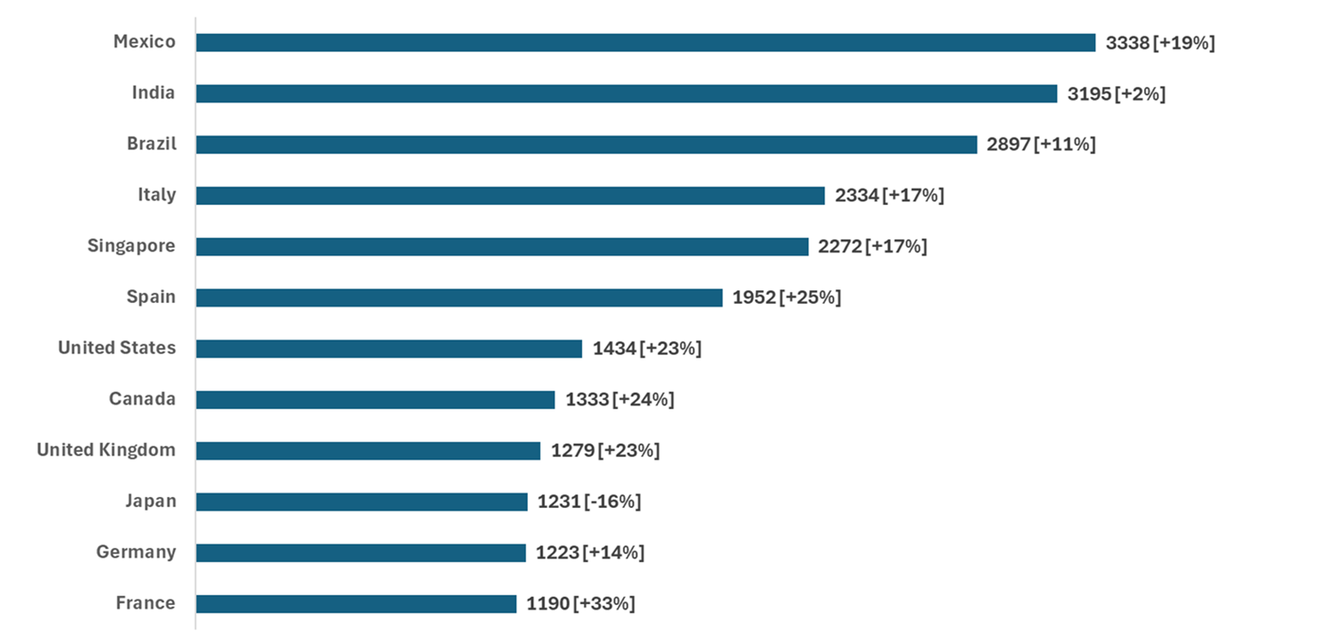
Globally, the average value was 1968 weekly attacks per organization, an increase of 18% compared to 2024 and 70% compared to 2023. According to the report, attackers are increasingly using automation and artificial intelligence to execute campaigns in parallel across multiple attack surfaces.

Thomas Boele, Regional Director Sales Engineering CER/DACH at Check Point Software Technologies, says: "AI is changing the mechanisms of cyber attacks, not just their scope. We are observing that attackers are moving from purely manual operations to an ever higher degree of automation. On top of this, we are also seeing the first signs of fully autonomous attacks. To withstand this change and adapt to the AI era, we need to completely overhaul our current security strategies and their implementation. More than ever, defenders need the ability to stop threats before they can spread."
Germany in 11th place worldwide
With 1223 attacks per week, Germany is the eleventh most attacked country in the world. In an international comparison, this does not come close to the figures of higher-ranking countries such as the USA (1434; + 23%) or the UK (1279; + 23%).
The education sector was particularly badly affected in Germany, with an average of 2885 attacks per institution per week, 235% more than the national average. This was followed by energy and utility companies (2011) and the telecommunications sector (1932). Other heavily targeted sectors were biotechnology and pharmaceuticals (1686), healthcare and medicine (1617) and the automotive industry (1573). Media and entertainment (1557), construction and engineering (1536), information technology (1453) and business services (1397) followed in 7th to 10th place.
The most commonly used tactics
The report describes an increasing shift towards multi-channel attack campaigns that combine social engineering with automated processes. Over a three-month period, 89% of organizations faced risky AI-related requests, with around one in 41 requests classified as high-risk. At the same time, the number of extorted ransomware victims grew by 53%, while new ransomware-as-a-service groups increased by 50%.
The analysts also recorded a sharp increase of 500% in so-called ClickFix techniques, which work with fake technical prompts. According to the report, vulnerabilities in edge devices, VPN appliances and IoT systems are increasingly being misused as entry points. A study of 10,000 MCP (Model Context Protocol) servers identified security vulnerabilities in AI infrastructures in 40% of cases.
Recommendations for security officers
Based on the trends observed, Check Point therefore recommends that all companies:
- Security fundamentals need to be revised for the age of AI: AI-driven attacks exploit speed, automation and trust in environments not designed for machine-driven threats. Organizations should re-evaluate controls for networks, endpoints, cloud, email and SASE to stop autonomous, coordinated attacks early.
- Enable secure adoption of AI: As AI becomes embedded into daily workflows, blocking its use can actually increase risk, as users will then simply use it surreptitiously and possibly out of sight of security teams. Therefore, they should control and be transparent about authorized and unauthorized AI usage to reduce the risk of risky prompts, data leaks and misuse.
- Protect the digital workspace: Social engineering now extends across email, browsers, collaboration tools, SaaS applications and voice channels. Security strategies must protect the workspace where human trust and AI-driven automation intersect.
- Securing the edge and infrastructure: Unmonitored edge devices, VPN appliances and IoT systems are increasingly being misused as stealthy gateways. Actively inventorying and securing these systems helps to prevent hidden dangers and reduce the time attackers spend in the system during an infiltration.
- Emphasize the prevention-first approach: With attacks happening at machine speed, preventative security is essential to stop threats before lateral movement, data loss or extortion occurs.
- Unified visibility across hybrid environments: Consistent visibility and enforcement across on-premises, cloud and edge environments reduces blind spots, reduces complexity and strengthens resilience.
The full Cyber Security Report 2026 is available for download at https://www.checkpoint.com/security-report/.


You might also be interested in
New Vice President of Global Partner Ecosystem appointed
Effective immediately, John Ryan is the new Vice President of Global Partner Ecosystem at Claroty, a specialist in the security of cyber-physical systems (CPS).
 read more...
Increasing cyberattacks on the manufacturing sector
A report from Check Point Exposure Management on the threat landscape in the manufacturing industry shows a dramatic increase in ransomware, supply chain attacks and OT-related cyber incidents. As smart factories and connected supply chains become...
read more...Cybersecurity is a top priority for car manufacturers
The latest "Automotive Manufacturing Outlook Survey" from ABB Robotics shows that cyber security has become the most important focus for automotive manufacturers around the world. This indicates a clear change in the perception of digital risks.
read more...Cloud security often inadequate
According to Red Hat's "State of Cloud-native Security" Report 2026, 97% of the companies surveyed with hybrid cloud environments reported security incidents within a year. This is based on data from around 600 IT specialists.
read more...CRA guide for Powerlink checked
TÜV Rheinland has audited the "CRA Guide for Powerlink" from B&R. The guide is one of the first independently audited technical documentations for the implementation of the EU Cyber Resilience Act in automation.
read more...Dragos expands collaboration with Microsoft
Dragos, a global provider of cyber security for OT environments, is expanding its collaboration with Microsoft. The aim is to support companies in modernizing and securing their cyber-physical operating processes.
read more...All for One acquires stake in BrightFlare
All for One acquires a minority stake of 25.1% in the Austrian company BrightFlare. BrightFlare is a cybersecurity services provider for the protection of industrial plants and critical infrastructures.
read more...Claroty appoints new Chief Revenue Officer
James Love is the new Chief Revenue Officer (CRO) of Claroty, a specialist in the security of cyber-physical systems (CPS).
read more...Rising fraud figures - Germany defies the trend
For Cybersecurity Month, the Adyen Index 2025 shows how differently digital forms of fraud are developing worldwide. While cases of fraud on the consumer side are increasing massively in some markets, they are falling slightly in others, such as...
read more...