

Karlsruhe Institute of Technology
New AI methods for picking robots
Researchers at the Karlsruhe Institute of Technology (KIT) are working with partners from Germany and Canada to make order picking robots more intelligent using distributed AI methods.
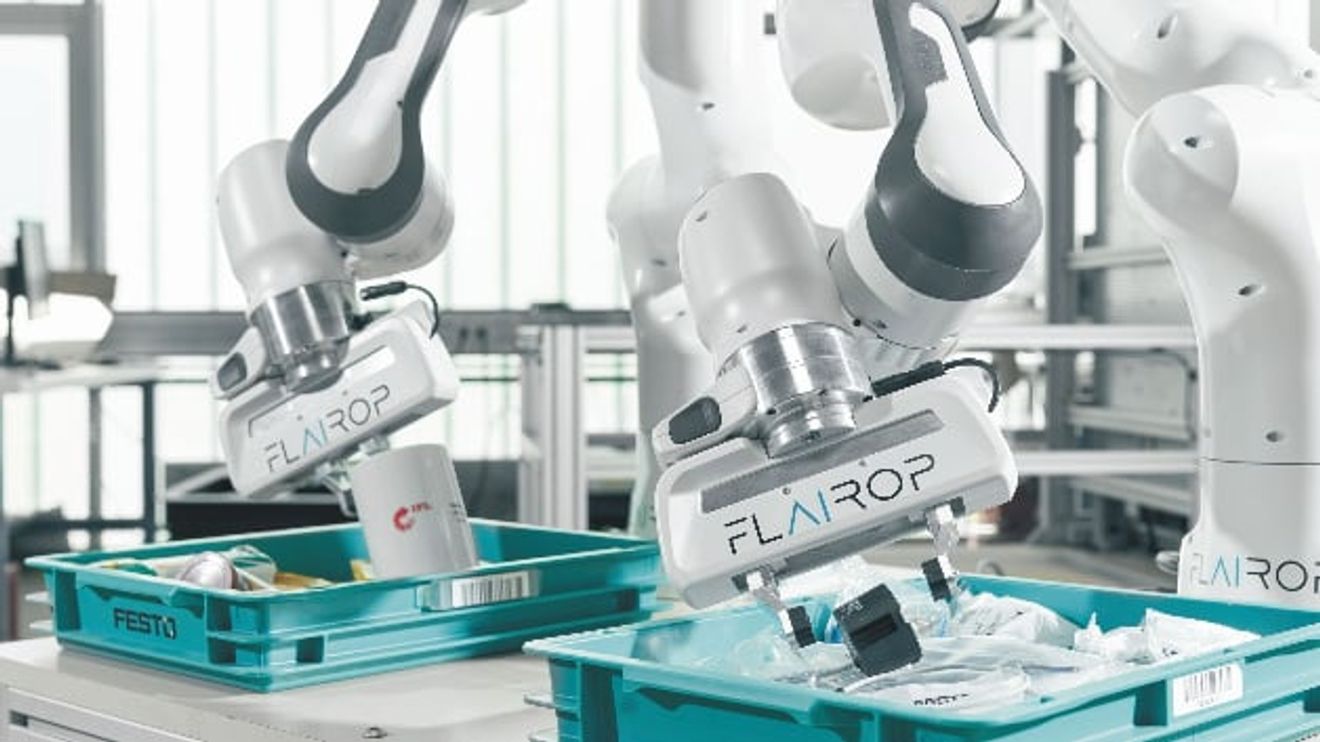
"We are investigating how the most versatile training data possible from multiple locations can be used to develop more robust and efficient solutions with the help of artificial intelligence algorithms than with data from just one robot," says Jonathan Auberle from the Institute of Materials Handling and Logistics Systems (IFL) at KIT. Autonomous robots process items at several picking stations by gripping and moving them. The robots are trained with different articles at the various stations. At the end, they should also be able to pick items from other stations that they have not yet learned to pick. "The distributed learning approach, also known as federated learning, allows us to strike a balance between data diversity and data security in an industrial environment," explains Auberle.
The FLAIROP (Federated Learning for Robot Picking) project is a partnership between Canadian and German organizations. The Canadian project partners focus on object recognition through deep learning, explainable AI and optimization, while the German partners contribute their expertise in robotics, autonomous grasping through deep learning and data security. FLAIROP is funded by the Canadian National Research Council (NRC) and the German Federal Ministry for Economic Affairs and Energy (BMWi).
To date, federated learning has mainly been used in the medical sector for image analysis, where the protection of patient data is particularly important, explains Auberle. Consequently, there is no exchange of training data such as images or grasping points for training the artificial neural network; instead, only the local weights of the neural network, i.e. parts of stored knowledge, are transferred to a central server. There, the weights from all stations are collected and optimized using various criteria. The improved version is then transferred back to the local stations and the process is repeated. The aim is to develop new, more powerful algorithms for the robust use of artificial intelligence for Industry and Logistics 4.0 while complying with data protection guidelines.
During the project, a total of four autonomous picking stations will be set up to train the robots: two at the Institute of Materials Handling and Logistics Systems at KIT and two at Festo in Esslingen. Other partners are the Institute for Applied Informatics and Formal Description Methods (AIFB) at KIT, Darwin AI and the University of Waterloo.
"In the FLAIROP research project, we are developing new ways for robots to learn from each other without sharing sensitive data and trade secrets. This has two major benefits: We protect our customers' data and we gain speed because the robots can take on many tasks faster this way. For example, the collaborative robots can support production workers with repetitive, heavy and tiring tasks," says Jan Seyler, Head of Advanced Develop. Analytics and Control at Festo.


You might also be interested in
Mechatronics & Automation Cluster
The Mechatronic Joint Initiative
The 'Mechatronic-Joint Initiative' (Mejoin) is a cooperation between German and Japanese SMEs, universities and industry-related institutions. The aim of the project is to strengthen the exchange of knowledge between industry and science.
 read more...
First robotics festival in Dresden
Experts and companies meet in Dresden for the first Dresden Robotics Festival. Saxony wants to establish itself as an international location. The DRV calls for more commitment from the federal government.
read more...The shelf comes to the employee
At the Amazon logistics center in Graben, the mountain comes to the prophet and the shelf to the employee. Robots make it possible.
read more...The "GeMeKI" research project
The GeMeKI research project at the WZL at RWTH Aachen University is investigating the use of transferable AI applications to optimize production.
read more...Tesla wants to build humanoid robots
Tesla CEO Elon Musk has announced the development of a humanoid robot called 'Tesla'. A prototype is expected to be available next year, Musk said at Tesla's 'AI Day'.
read more...FZI Research Center for Information Technology
Research for robots in everyday life
Service and assistance robots are increasingly finding their way into everyday life and will also take on more tasks in public spaces in the future. The BMBF is therefore funding the 'Transfer Center Robots in Everyday Life (RimA)' project with 2.25...
read more...Working safely with cobots
At the Fraunhofer Institute for Factory Operation and Automation IFF in Magdeburg, the European COVR project is researching and promoting the 'safety' aspect of collaborative robotics in practice.
read more...Robotics&AUTOMATION 2/2021
The 'robot colleague' is establishing itself - in large companies, in SMEs, in private and public spaces. What trends are accompanying its appearance? What are the benefits of swarm robotics? How can it help to understand it as an edge component?...
read more...Printed circuits protect sensors
Electronic sensors can benefit many applications in industry, for example in automotive engineering. However, they must be protected against attacks and falsification. This is where the 'sensIC' joint project comes in.
read more...