
Force sensors
The piezoelectric alternative
The piezoelectric principle can be used to construct force sensors that differ greatly in their properties from sensors based on strain gauges. But which are the best choice and when?
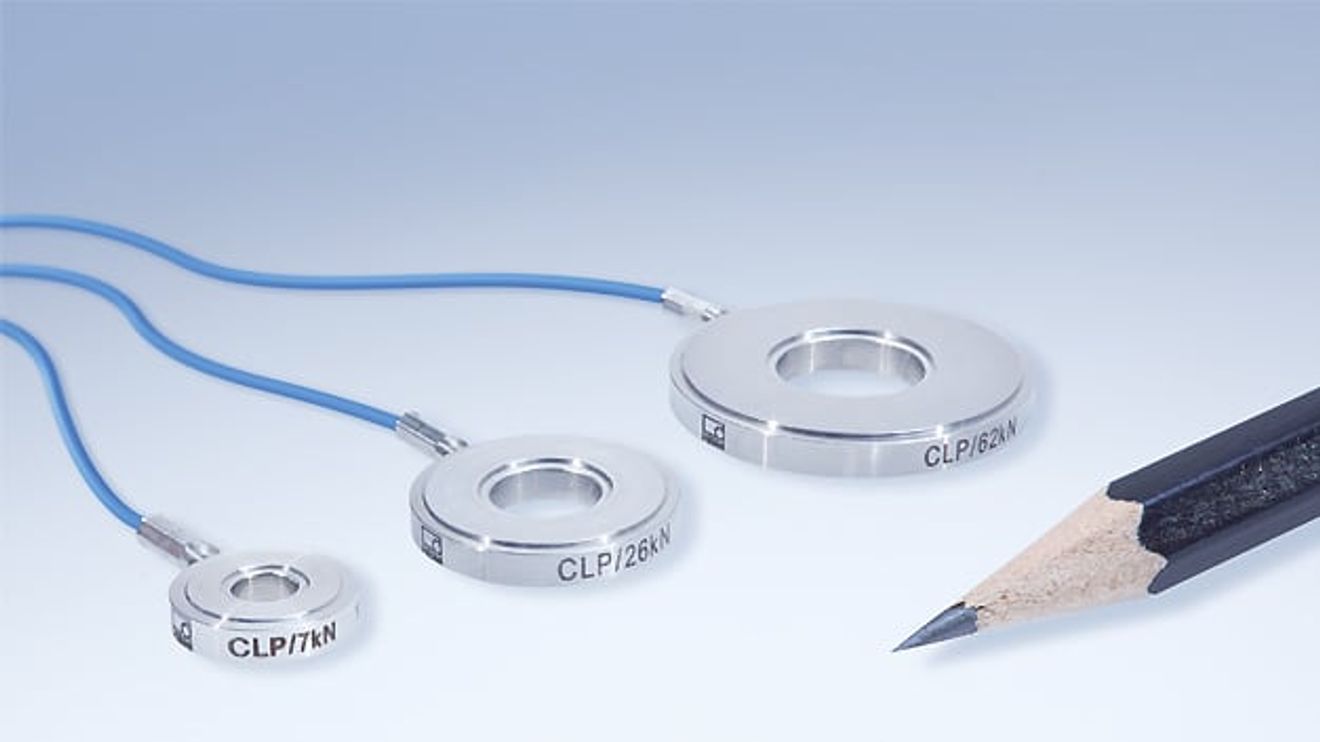
Piezoelectric force sensors consist of disks of piezoelectric crystal that generate a charge when subjected to a compressive force. Generally, two such disks are used, between which an electrode is inserted. This absorbs the resulting charges. The surrounding housing also serves as an electrode. The requirements for the surface quality of the crystal and housing are very high and determine the quality (linearity, response behavior) of the force sensors.
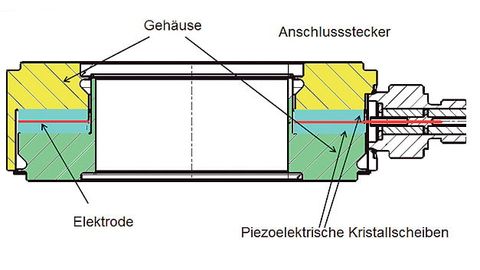
Structure of a piezoelectric sensor. Shown in green are the quartz disks that convert the applied force into a charge that is absorbed by the electrode between the sensors.
© HBMThe decision between piezoelectric force sensors and sensors based on strain gauges depends on the application. Piezoelectric sensors are particularly preferable if the application has one of the following requirements:
- Limited space for installation of the sensor;
- Measurement of small forces with high preload;
- Large measuring range;
- Measurement at very high temperatures;
- Extreme overload capacity;
- High dynamics.
If you decide to use a piezoelectric transducer, the question arises as to which force transducer is the right one. Different fields of application need to be considered here.
Piezoelectric force sensors can be built very compactly. This makes such sensors ideal for integration into existing structures where space is limited. The sensors in HBM's CLP series have an integrated cable, as plugs cannot be accommodated due to the low overall height. Sensors are available for all threads from M3 to M14. However, the low overall height requires the force to be distributed as evenly as possible over the sensor surface.
Various applications
Users often need to measure small forces with a high preload. Piezoelectric sensors generate an electrical charge when a force is applied. However, forces also act on the sensor outside of the actual force measurement, for example during assembly. However, the resulting charge can simply be short-circuited, whereby the signal at the input of the charge amplifier is set to 'zero'. This allows the measuring range to be set according to the actual force to be measured. A high resolution is therefore guaranteed during measurement even if the ratio of preload to measured force is very unfavorable. Modern charge amplifiers, such as the CMD600 model, enable an almost infinitely variable adjustment of the measuring range and thus support such applications.
Use at very high temperatures
Piezoelectric force transducers also show their strengths in multi-stage processes. For example, in a multi-stage pressing process: Initially, large forces act during the actual pressing process. The piezoelectric measuring chain is set accordingly. In the second part of the process, the force is to be tracked, i.e. smaller fluctuations in the force are to be measured. Here too, the property of piezoelectric sensors of physically eliminating the signal at the input of the charge amplifier is utilized. The input of the charge amplifier is set to 'zero' again and the measuring range can be adjusted to achieve a high resolution.
Some applications require force measurement at very high temperatures. This is where force transducers based on strain gauges reach their limits. Piezoelectric measuring rings from the CHW series, on the other hand, are designed precisely for such applications. The CHW-2 model can be used at temperatures up to 200 °C, CHW-3 even at temperatures up to 300 °C. These measuring rings must also be calibrated. The low temperature sensitivity allows calibration at room temperature.
With a few exceptions, all piezoelectric sensors have the same sensitivity. Conversely, this means that the output signal of a force sensor with a nominal force of 20 kN at a given force is just as large as that of a sensor with 700 kN. In terms of resolution and accuracy, it is therefore irrelevant which of the two sensors is used. The measuring chain can be designed for the maximum force and still allows the measurement of small forces.
Piezoelectric sensors also offer ideal conditions for use in dynamic applications. This is because the measuring paths are very small and their stiffness is correspondingly high. However, the entire measuring chain influences the dynamic properties. The stiffness of the add-on parts and the downstream electronics must also be taken into account. In general, piezoelectric measuring chains are ideal for highly dynamic measurements of small forces. Force transducers based on strain gauges, on the other hand, are the first choice for dynamic measurements of large forces.
Measuring rings mostly preferred
Most users prefer piezoelectric measuring rings, as they can be integrated without major mechanical changes to the measurement object or machine. However, these sensors always require installation under preload, i.e. they must be subjected to a preload by means of screws or preload sets in order to prevent damage and guarantee suitable bending moment stability. Calibration is also necessary, as the installation of the sensors also determines the sensitivity of the measuring point. This means that the sensitivity of the measuring point must be determined by calibration after installation in order to obtain high-quality results.
If you cannot calibrate but still want to use piezoelectric sensors, there are sensors that are already preloaded and calibrated, such as type CFT force sensors, which are ready to measure immediately. A test report supplied with the sensor provides information about its sensitivity.
Users often want a sensor that is easy to integrate, whereby the application requires a plug connection. In addition, point loads can occur and very high forces must be taken into account. Compact force washers - such as those in the CFW series - are suitable here. The overall height is relatively high, which means that there is more material between the force application and the measuring element. The largest measuring ring in the series is the CFW/700 kN, which has an internal diameter of 36 mm. As a result, it is less sensitive to unfavorable installation situations. CFW series force washers are also equipped with a plug connection and are therefore very flexible.
Users want a sensor that is easy to integrate
Various cables can be connected, such as the robust KAB145 charging cable, which uses an O-ring to seal the connection to the sensor housing, for example for use in harsh environments.
If users cannot accommodate a measuring ring and a sensor based on strain gauges or a CFT transducer takes up too much space, there are still suitable sensors: strain transducers from the CST series are very small and can be attached with a screw. The functional principle can be explained as follows: If forces are applied to the structure, deformations occur that are often proportional to the force applied - the sensor measures the deformation. CST can be mounted on welding tongs or pressing tools, for example, and reliably measures the deformation of these components. These transducers also need to be measured or calibrated. Such strain transducers are very sensitive and are also suitable for use with very rigid structures. The measuring accuracy depends in particular on the material on which the sensor is mounted.
Author:
Thomas Kleckers is Product Manager for force transducers at HBM.


You might also be interested in
Torque transducers for quick application tests
HBM is launching the 'T40CB' torque transducer, which is particularly suitable for testing automotive parts in confined spaces thanks to its central bore.
 read more...
Measuring amplifier 4.0
Accuracy class, measurement inputs and interfaces - these have been the key features of measuring amplifiers to date. In the course of Industry 4.0, others will be added, such as remote diagnostics, web interface and pre-calculation in the module.
read more...News from the field of measurement technology
What innovations are there for industrial users on the measurement technology market? Computer&AUTOMATION has summarized a selection of new products in a series of pictures
read more...Merger of HBM and BKSV
The companies Hottinger Baldwin Messtechnik (HBM) and Brüel & Kjær Sound and Vibration (BKSV) are to merge their businesses. The merger will come into effect on January 1, 2019 - under a new company name.
read more...News from measurement technology
What innovations are there for industrial users on the measurement technology market? Computer&AUTOMATION has summarized a selection of new products in a series of pictures
read more...News from measurement technology
What innovations are there for industrial users on the measurement technology market? Computer&AUTOMATION has summarized a selection of new products in a series of pictures.
read more...News at the Sensor+Test 2016
From May 10 to 12, around 580 exhibitors at Sensor+Test will be presenting their latest products from the fields of sensor and measurement technology. Computer&AUTOMATION shows a selection of these in a picture gallery.
read more...Strain gauge load cells on the rise
The digitalization of weighing technology can begin: Digital strain gauge-based load cells are now more robust, more durable and less expensive than their analog counterparts. In addition, analogue weighing technology can be digitized using...
read more...News about sensor technology
What would the smart factory of today and tomorrow be without sensors? Sensors are indispensable as the basis of every industrial production system. Computer&AUTOMATION summarizes current trends from spring 2016 in a series of images.
read more...