
Fujitsu
Dedicated platform for companies in Japan and Europe
Fujitsu has announced the launch of a dedicated AI platform that enables organizations to independently manage the entire lifecycle of generative AI - from optimal model development, operations and incremental learning to continuous improvement of models and agents. The platform will be rolled out gradually in Japan and Europe, with pre-registration for trial versions set to begin in February 2026.
Going forward, Fujitsu will accelerate the adoption of the platform for all AI application areas - from enterprise-wide AI solutions to edge and physical AI. Fujitsu will continuously evolve generative AI to adapt to business changes, ensuring its safe and reliable use across all industries and operations. In this way, the platform will support customers' digital transformation and growth. For European companies, this means They can use AI confidently and in compliance with the law, even at the core of production or for sensitive data applications.
Overview of the platform
Companies that use generative AI need an environment that meets sovereign requirements - such as the protection of confidential data and the ability to independently control AI models and agents that are tailored to their processes. However, deploying such an AI platform in a dedicated internal environment is fraught with challenges: These include a shortage of skilled AI engineers, complex operational management, increasing demand for computing resources and minimizing new security risks.
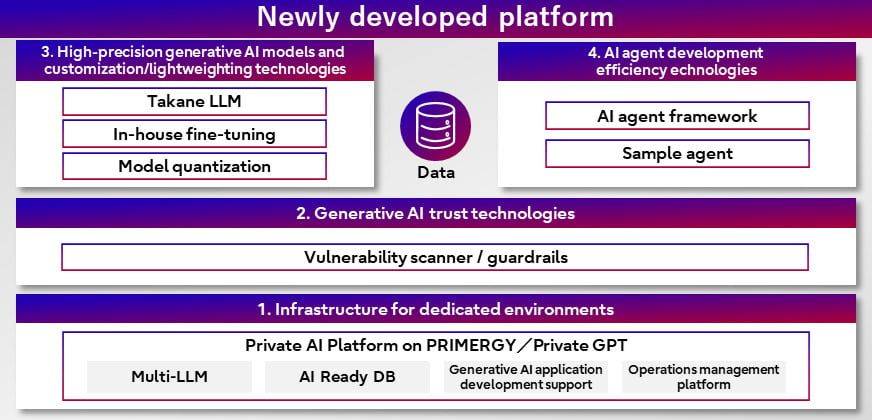
To address these challenges and enable the deployment of highly sovereign AI, including in Europe, Fujitsu will offer a dedicated AI platform that can be used directly on site. The new platform will be deployed on the Private AI platform on Primergy and Private GPT. It combines Fujitsu's AI technologies and platform products, including the Fujitsu Kozuchi AI solution, into a complete package. Through this bundled deployment, Fujitsu significantly lowers the barrier to entry and enables rapid implementation, even without extensive expertise.
Functions of the platform
According to the provider, the platform ensures the secure use of generative AI in a dedicated, closed environment and thus prevents the disclosure of external data. Customers can choose their preferred installation location, including their own data centers or those of Fujitsu, depending on their specific requirements. Fujitsu also offers comprehensive services ranging from infrastructure provisioning to advanced operationalization to fully support customers.
The platform relies on a vulnerability scanner that identifies more than 7700 vulnerabilities, including Fujitsu-defined types, and Guardrail technologies that detect and prevent malicious attacks such as prompt injections, inappropriate output and unexpected behaviors both before execution and at runtime. The automated creation of rules for detected vulnerabilities and their application to the guardrails enable stable, secure and reliable AI operation, even for users without in-depth expertise. In addition, Fujitsu plans to further expand technologies to prevent model-related inaccuracies and thus continuously increase the reliability of the information generated.
The platform is based on Takane, a language model that enables high-precision Japanese language processing and image analysis. This is supplemented by an integrated fine-tuning function that allows business-specific models to be continuously developed. The AI models are deliberately designed to be lightweight, which, according to the provider, reduces memory requirements by up to 94 percent and makes generative AI more widely applicable through more efficient use of computing resources. By integrating modern quantization technologies, the costs for AI operation can be significantly reduced, while at the same time increasing the performance of the models.
The AI agent framework provides low-code/no-code capabilities that accelerate the building of these agents, significantly increasing the efficiency and speed of development for on-site teams. The platform supports MCP (Model Context Protocol) and communication between agents, enabling seamless integration with existing systems and data, as well as the cooperative operation of multiple AI agents for demanding applications. Fujitsu is currently exploring containerizing its proprietary technologies and making them available as on-demand AI agents.
Prior to the official market launch, pre-tests for selected functions, such as internal fine-tuning and model quantization, will be offered from 2 February 2026. The functions will be made available in stages from February, while the official market launch is planned for July 2026.


You might also be interested in
VDMA at the Hannover Messe 2026
Relocation concerns in mechanical engineering
The German mechanical and plant engineering industry is under increasing pressure from regulation, high costs and geopolitical risks. According to the VDMA, many companies are considering investing abroad. At the same time, the industry remains...
 read more...
RobCo at the Hannover Messe 2026
Robotic system for dynamic environments
RobCo is presenting a new industrial robotics system for dynamic tasks in industry at the Hannover Messe. With 'Autonomous Alfie', the company is opening up a new category of robotic solutions. This allows tasks in which processes, objects and...
read more...Fraunhofer at the Hannover Messe 2026
Data, AI and material innovations for the industry of tomorrow
Under the motto "Innovations for our Future", nine Fraunhofer Institutes and Groups and the Research Fab Microelectronics Germany (FMD) will be presenting concrete solutions for a resilient, digitally networked industry at Hannover Messe 2026.
read more...Funding project on embedded AI
The "Edge AI Platform" project is entering its third round of funding: three Fraunhofer Institutes are further developing the platform to version 3.0 in order to provide companies with even more efficient access to embedded artificial intelligence...
read more...automatica to be held in China for the first time in 2027
automatica is expanding its global brand strategy and will take place in China for the first time in 2027. automatica Shanghai 2027, organized by Messe München Shanghai and the VDMA Representative Office in Shanghai, will celebrate its premiere from...
read more...Generative AI delivers more than 300 picks per hour
Sereact presents the latest generation of the Vision-Language-Action (VLA) model 'Cortex' and the associated visual intelligence 'Lens'.
read more...World's largest robotics training center planned
The Munich Institute of Robotics and Machine Intelligence (TUM MIRMI) at the Technical University of Munich (TUM) and Neura Robotics are joining forces to create the world's largest research and training center for robotics in the scientific field....
read more...Dragos expands collaboration with Microsoft
Dragos, a global provider of cyber security for OT environments, is expanding its collaboration with Microsoft. The aim is to support companies in modernizing and securing their cyber-physical operating processes.
read more...Generalized physical AI pipeline for production automation
Vention launches 'GRIIP (Generalized Robotic Industrial Intelligence Pipeline)'. The end-to-end pipeline for physical AI enables the use of autonomous robot cells in highly unstructured manufacturing environments.
read more...