

VDMA
Double-digit growth in machinery exports
Machinery and plant exports increased by 23.5% in the second quarter. This was reported by the VDMA. The supply chain situation remains tense.
German machinery exports saw double-digit growth in the first half of the year.
© Pixabay / CC0In the second quarter of 2021, Germany exported machinery and equipment worth €44.5 billion. This corresponds to growth of 23.5% compared to the same period of the previous year. In the first half of the year, machinery exports increased by 11.2% compared to the previous year. These provisional figures are based on the Federal Statistical Office.
In the first quarter, exports were only 0.8% higher than in the previous year. It should be noted that machinery exports fell by 21.5% in the second quarter of 2020 - the peak of the coronavirus pandemic. In the first quarter of 2020, the decline was only 5%. In this respect, the strong increase in the second quarter of the current year is also due to a lower prior-year base.
Supply chain remains tense

The supply of primary products is becoming a bottleneck. "The strong comeback of machinery exports to almost all regions of the world is very pleasing," says VDMA economic expert Olaf Wortmann. "However, the positive picture should not obscure the fact that the further upturn in mechanical engineering is being significantly hampered by material shortages."
The supply of primary products from the electronics and steel industries is particularly problematic and is causing tense supply chains, as revealed by a survey of VDMA members at the beginning of April. "And the situation has deteriorated further since then. The pressure on supply chains is high and is further exacerbated by logistics bottlenecks. For example, a single case of coronavirus in a port employee in China led to a partial closure of the world's fourth and third largest ports in Shenzhen in June and Ningbo in August. This, in turn, is causing a major disruption to the international movement of goods, increased delivery times and a rise in freight costs," explains the VDMA economic expert. "Freight rates between China and Europe have already increased more than sixfold so far this year."
More machinery exports to China and the USA
Most recently, machinery exports to the two most important individual markets, the USA and China, showed a contrasting dynamic: In the second quarter, 32.4% more machinery and equipment was exported from Germany to the USA, while the previous year's result was still 6.6% lower in the first quarter. In China, machinery exports from Germany were up 9.9% year-on-year in the second quarter and 20.4% in the first quarter. "A year ago, the USA and China were affected by the pandemic to varying degrees. After a brief dip at the beginning of last year, the rapid ramp-up of industrial production ensured a rapid recovery in machinery exports to these countries. The pre-crisis level was already exceeded in the first quarter of 2021," summarizes Wortmann. "The slowdown in growth momentum was to be expected at this level."
In the USA, on the other hand, the pandemic set in a little later. Here, the sharpest decline was recorded in the second quarter of 2020 at minus 22.6 %. However, machinery exports to the USA are also likely to exceed their pre-crisis level in the near future, as the multi-billion economic stimulus package is providing momentum for the American economy.
Successful vaccination campaign in the UK boosts exports
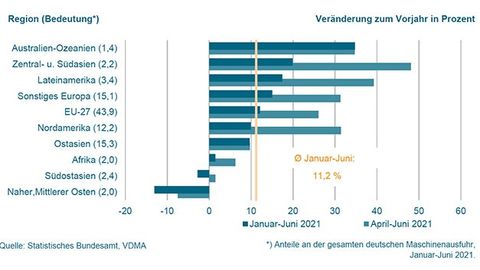
In the second quarter, total machinery exports from Germany to the EU-27 were 26.1% higher than in the previous year. The export business with the three most important customers from the EU-27, France (+ 28.8%), Italy (+ 39.3%) and the Netherlands (+ 14.0%), all recorded double-digit growth - partly due to high declines in the previous year. Turkey (+ 46.6 %) and the United Kingdom (+ 68.1 %) also recorded high export growth.
"In Turkey, the investment backlog that has built up as a result of the currency crisis in 2018 and the coronavirus crisis is unloading. It remains to be seen how long the positive development will last, as the lira is still on a downward trend, making imports more expensive for Turkey. In the UK, public life has recently almost returned to normal, which favors a rapid economic upturn. This will ultimately also benefit machinery exporters," says Wortmann. South Korea is the only country among the top 20 sales countries with a decline in machinery exports from Germany (- 6.1%).


You might also be interested in
Exports above pre-crisis level
The German electrical and electronics industry significantly increased its exports in the first half of 2021 and exceeded pre-crisis levels.
 read more...
Supply bottlenecks slow down upswing
Strong export growth expected in 2021 despite uncertainties
The industry is complaining about a lack of materials, which is slowing down production. Container capacities for transporting goods are hard to come by. How are Germany's exporters getting through the second year of coronavirus?
read more...Almost 30 % more orders
The VDMA reports a 29% increase in incoming orders for the first half of 2021. This will also enable the mechanical engineering sector to make up for last year's deficits.
read more...Material bottlenecks impact mechanical engineering
The shortage of materials is hampering production in the German mechanical engineering sector. Despite these circumstances, the VDMA does not believe that its sales forecast is at risk.
read more...Sales forecast raised to +10
A strong order intake has led the VDMA Drive Technology Association to raise its sales forecast by five percentage points. However, no one is talking about pre-crisis levels yet.
read more...Supply Chain Act - overdue or superfluous?
The planned German Supply Chain Act makes companies more responsible if suppliers violate human rights and environmental standards. We asked the industry associations VDMA, VDW and ZVEI what exactly this means for industry and companies.
read more...ebm-papst is growing again thanks to AI and data centers
ebm-papst returned to a growth trajectory in fiscal year 2025/26. Air Technology, data center applications, and artificial intelligence are driving revenue and investments.
read more...Authorized distributors made visible online
Lapp is expanding its digital service portfolio and is the first B2B industrial company to provide its authorized distributors with a verifiable online seal from authorized.by. The company aims to create more transparency and security for buyers and...
read more...Flexible analog mix module
The analog mix module 'AM 821' from Sigmatek's S-DIAS series has eight analog differential inputs with 16-bit resolution and two analog outputs.
read more...