

Step towards the European Quantum Internet
KIT couples Quantum Computer with Quantum Memory
Researchers at the Karlsruhe Institute of Technology (KIT) and European partners are networking a superconducting quantum computer with a spin-based quantum memory for the first time in the 'Superspin' project. The project aims to advance the development of a quantum internet.
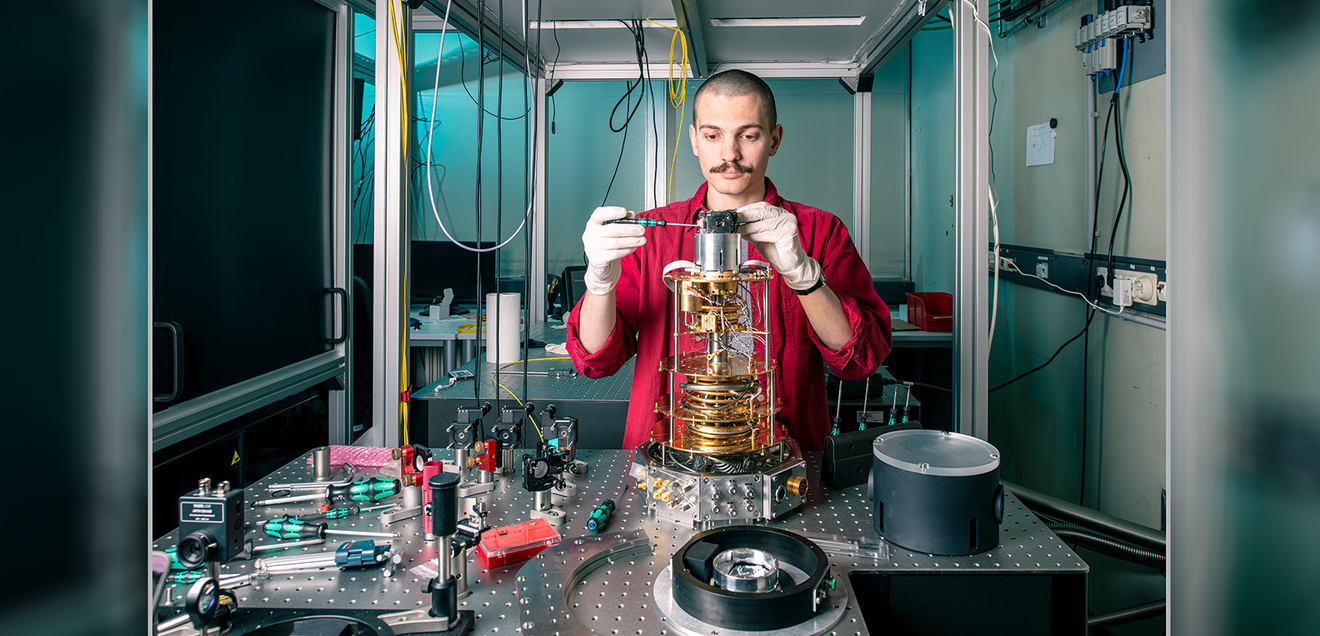
Quantum networks are considered a key technology for secure communication and digital sovereignty. In the EU-funded 'Superspin' project, researchers at the Karlsruhe Institute of Technology (KIT) are working with partners from Finland, the Czech Republic and the Netherlands to develop an interface between a superconducting quantum computer and a spin-based quantum memory.
"Many quantum systems are currently working independently of each other," explains Professor David Hunger from the KIT Institute of Physics. "In the Superspin project, we are developing a technology with which a quantum computer and a quantum memory can be reliably coupled. In this way, we are also creating the basis for linking quantum computers in the future, realizing distributed quantum computing and building a quantum internet."
Development of special quantum transducers
The technical challenge lies in combining two systems that are based on different physical principles. Superconducting qubits work in the microwave range, while diamond-based quantum memories store information in spin states and are addressed with visible light. In order to couple both components, the researchers are developing so-called quantum transducers. These convert quantum states into individual photons whose wavelength is adapted to the telecommunications band so that they can be transmitted via optical fibers.
A quantum memory made of special diamond defects that combine light and spin properties is being created at KIT for this purpose. The memory will be compatible with one of the two transducers so that the converted photons can be efficiently stored and retrieved when required. "Our project goal is to connect the physically completely different systems and create an entanglement between a superconducting qubit and a spin-based quantum memory," says Hunger. "This would not only be a technical breakthrough, but also an important step towards modular and scalable quantum technologies."
'Superspin' as part of the 'Pathfinder' program
The Superspin project is one of 44 projects that the European Innovation Council is funding with a total of over 140 million euros as part of the Pathfinder program. The partners involved are Aalto University (Finland), Palacký University in Olomouc (Czech Republic) and the Dutch start-up 'QphoX'.


You might also be interested in
Secure PCI Express-based industrial communication
Hilscher presents the 'cifX PCIE90-RE' and the 'cifX LPCIE90-RE', two new PC cards for secure industrial communication.
 read more...
Fanless industrial PC for edge computing
With the 'MIC-785', BMC Solutions is expanding its portfolio with a compact industrial PC for demanding edge computing applications. The platform is designed for data-intensive scenarios such as machine vision, industrial control and automation and...
read more...Industrial PCs for OEMs in the GSA Region
Spectra and Cincoze deepen Engineering Alliance
Following the merger of Spectra with Compmall, Spectra has taken over the exclusive marketing rights for Cincoze in the GSA region (Germany, Suisse, Austria). The aim is to create robust industrial PC platforms with long-term availability.
read more...27 Nominees have been chosen
The jury for the embedded award 2026 has nominated 27 innovations from over 110 submissions from more than 90 companies. The innovation award will be presented on March 10 at embedded world.
read more...Siemens makes a strong Start to Fiscal Year 2026
Siemens raises its forecast for 2026 after a strong first quarter. Order intake and sales increased significantly, industrial earnings rose at a double-digit rate. The order backlog reached an all-time high of 120 billion euros.
read more...Taming the AI's Hunger for Data
Artificial intelligence works fast, but its hunger for energy is growing rapidly. A German-Taiwanese research team from Fraunhofer IPMS, Fraunhofer IMWS and the Taiwanese research institute TSRI is now developing a solution: new memories for the...
read more...New Industrial PC for Smart Automation
Kontron has introduced the 'AL Pi-Tron CM5', a compact, Linux-based industrial PC. The system is designed for top-hat rail mounting and offers robust hardware, a wide range of interfaces and permanent data storage using FRAM technology.
read more...Fujitsu develops superconducting quantum computer
Fujitsu has launched a project funded by the Japanese National Institute for Research and Development to develop a superconducting quantum computer with a capacity of over 10,000 qubits. Completion is planned for the 2030 financial year.
read more...Congatec takes over Kontron's Module Business
In January, Kontron bundled its Computer-on-Modules (CoM) business in its subsidiary JUMPtec, thereby reviving a traditional brand. Congatec has now announced its majority stake in Kontron's module business.
read more...