

Fieldbuses / Industrial Ethernet
The market shares of industrial networks in 2017
How is the market share of industrial networks in the field of factory automation developing? The latest market assessment from HMS Industrial Networks provides an answer to this question.
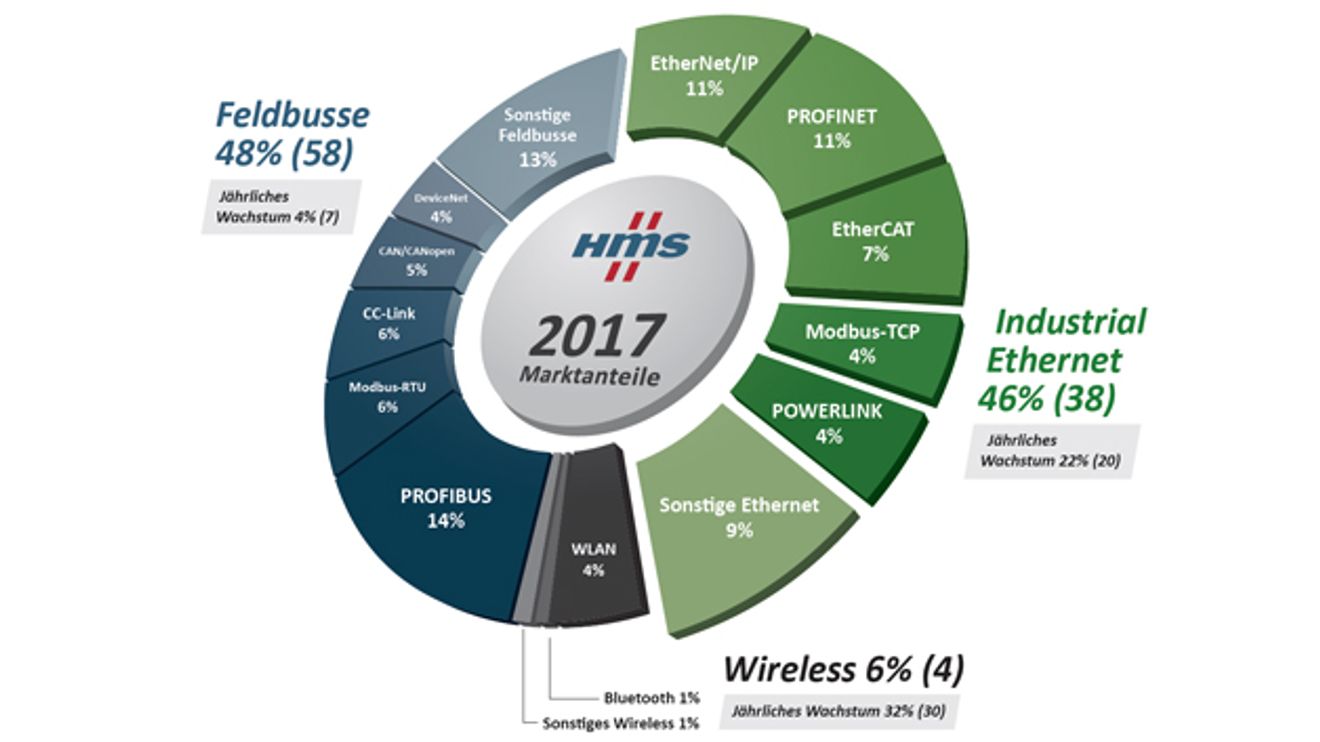

Estimate for 2017 based on newly installed nodes in factory automation in 2016 (previous year's market shares in brackets).
© HMS Industrial NetworksAccording to estimates by HMS - based on around 600,000 communication interfaces sold annually, its own estimates and the evaluation of various market studies - , 48% (2016: 58%) of new industrial networks will still be implemented on the basis of tried-and-tested fieldbuses in 2017. Profibus is the most widespread at 14%. HMS is convinced that fieldbuses have not yet passed their peak; the communication technology provider puts the annual growth rate for fieldbuses in 2017 at around 4% (2016: 7%). However, growth in fieldbus systems has slowed noticeably compared to previous years.
Industrial Ethernet, on the other hand, continues to show strong growth. HMS estimates the annual growth of Industrial Ethernet in 2017 at around 22% (2016: 20%) and the overall market share at 46% (2016: 38%). Industrial Ethernet is the preferred technology for industrial communication in new systems. Profinet and Ethernet/IP are neck-and-neck with a market share of around 11% each, with Profinet dominating in Europe and Ethernet/IP in America. Ethercat is also continuing to gain ground and is particularly widespread in the semiconductor industry and in motion control applications.
According to HMS estimates, wireless networks are the fastest growing segment in industrial communication with a growth rate of 32% (2016: 30%). HMS estimates the market share of newly installed wireless networks at around 6% in 2017 (2016: 4%). WLAN and Bluetooth have established themselves from special solutions to standard networks for mobile or rotating applications as well as basic technologies for the use of smart devices as a replacement for traditional HMIs.


You might also be interested in
Ethernet overtakes fieldbuses
In terms of newly installed nodes in factory automation, Industrial Ethernet has overtaken traditional fieldbuses. This is the conclusion of the latest study by HMS Industrial Networks on the market share of industrial networks.
 read more...
Thilo Döring replaces Michael Volz
With effect from June 30, 2017, Michael Volz is handing over his responsibilities within the HMS Group and the chairmanship of the management board to Thilo Döring. After 17 years, Volz is retiring from the operational business.
read more...2 billion mark in sight
Phoenix Contact has announced its figures for 2016. According to the figures, the Blomberg-based group of companies was able to increase its turnover by 3.2% last year. This year, the 2 billion euro mark is set to be reached.
read more...Fieldbus / Ethernet / Wireless
More "freedom of movement" for industrial networks
Industrial radio systems are the basic technology for implementing modern operating concepts using standard smart devices such as tablet PCs or smartphones - keyword 'Bring your own device' (BYOD).
read more...Review of the PI Conference 2017
The fifth PI Conference took place in Frankfurt at the end of March. The central question during the two-day event: What role can Profibus and Profinet play in the networking of Industry 4.0 in the future?
read more...HMS-Ixxat / Peak System Technology
Prepared for CAN FD
More and more components are coming onto the market for the extended CAN version CAN FD - for automotive and industrial applications. HMS Industrial Networks, Peak-System-Technik and Göpel electronic presented CAN FD components at embedded world.
read more...Bosch, Vodafone and Huawei test LTE-V2X
Bosch, Vodafone and Huawei are testing the new LTE-V2X technology live on the test track of the A9 highway near Allershausen. The new mobile communications technology enables the direct and instantaneous exchange of information between vehicles.
read more...Operates between -40 and +85 °C
MSC Technologies has introduced the PAN1761 Bluetooth Smart / NFC module from Panasonic, which is based on the "TC35xxx" chipsets from Toshiba.
read more...Six CAN FD channels in one housing
With the PCAN-USB X6, Peak-System accommodates six CAN FD channels in an aluminum profile housing. This enables the connection of several CAN FD and CAN buses via one USB port on the computer.
read more...