

Industry networks
The interaction of Ethernet TSN, OPC UA and 5G
Only the reliable and structured interaction of all units in an ant colony ensures its survival. Data communication in a modern industrial network works no differently in a figurative sense.

From the outside, an ant colony appears quite unstructured. The cooperation of many ants, which seem to carry out a wide variety of activities in an uncoordinated manner, is not really clear to us humans. And yet, over time, a small hill becomes a large mountain. Each ant knows its place and its task in the 'network' in order to maintain and expand the colony. The more complex the interdependencies are, the more important the mechanisms are that ensure the reliable functioning of the ant collective.
Like ants, communication data in industrial networks fulfills a specific purpose and must be sent from the sender to the receiver. This must always function reliably - even if networks become ever larger and more complex. And even in an industrial network, information is distributed both horizontally and vertically - just like in an ant hill. High-performance communication structures are therefore indispensable when more and more intelligent individual components exchange data with each other. Last but not least, the performance of a network is crucial for the amount of data that can be transported - across all network structures and into the cloud.
While confidentiality and integrity are paramount in traditional corporate networks, functions such as real-time capability play a decisive role in industry in addition to protection for people and the environment. Just as ants react at lightning speed to unforeseen events, data must reach its destination in a predictable time to trigger actions quickly. New technologies such as Time-Sensitive Networking (TSN) will make this possible in the future on the basis of international standards.

Transparent communication: Production data is exchanged horizontally between the machines, while diagnostic data, for example, is sent vertically via TSN and higher networks to MindSphere for analysis purposes.
© SiemensTSN is the further development of Ethernet with standardized real-time mechanisms and, in conjunction with gigabit switches, allows deterministic data exchange via extended quality-of-service mechanisms (e.g. bandwidth reservation with predictable latency times) as well as time synchronization and bumpless redundancy. Specified in IEEE 802.1 of the Institute of Electrical and Electronics Engineers, TSN is made up of several IEEE standards that extend the standard Ethernet. Different individual standards are required depending on the industry and area of application: While IEEE 802.1DG is used in motor vehicles for internal communication between the individual components, the real-time capable transmission of audio/video data is important in public transportation, for example. This is guaranteed by the IEEE 802.1BA standard, among others. In industrial networks, on the other hand, the focus is on real-time communication; with this in mind, several new sub-standards have been added to the IEEE 802.1Q standard.
TSN alone is not enough
One of these sub-standards is IEEE 802.1Qcc, which describes the stream reservation for TSN. This can be clearly explained using the example of an ant colony: Many workers have to transport building materials or food within the anthill at the same time without getting in each other's way and thus losing valuable time in building up the colony. In terms of the industrial network and the data transmitted in it, TSN achieves this by transporting several protocols - now also real-time capable - on different paths (so-called streams) but on one and the same line in parallel without collision. There are three different configuration options for stream reservation - decentralized, centralized or centralized with a distributed approach.
The most common variant - the decentralized configuration - is discussed below: First, end devices that want to send data to the network register their streams via a so-called UNI interface (user network interface) on their network connection. This registration is distributed to all potential end devices in the network via network components. These end devices reserve the network connections of the streams they wish to receive via their UNI interface. With TSN, the transmitting end devices are referred to as 'talkers' and the receiving end devices as 'listeners'. Each network component or 'bridge' in the data path between listener and talker ensures that the network resources are sufficient for the requested streams, are allocated for them and that all streams that have already been transmitted can be continued.

Whereas with OPC UA Client/Server there is always a 1-to-1 relationship and a further connection is required for each additional communication, with OPC UA PubSub all participants are supplied with data equally.
© SiemensStream reservation therefore enables real-time capability in the medium. However, this only offers an advantage for communication if the transport protocol itself is also real-time capable. The standardization committees of the IEEE, IEC and OPC Foundation initially agreed on OPC UA in general for automation - starting at the control level. OPC UA was specified by the OPC Foundation a few years ago and combines the existing OPC protocols OPC DA, OPC HDA and OPC A/E. Among other things, OPC UA is used to exchange data between devices from different manufacturers or for vertical communication.
This protocol - often referred to as client/server - uses TCP/IP mechanisms, but these have one major disadvantage: They are not real-time capable. This is due to the process itself: After the sender has transmitted its data frame, it waits for confirmation from the receiver before the next data frame is sent. Depending on the load on the network, it is therefore not possible to predict exactly when the confirmation of receipt will arrive at the sender and therefore no real-time prediction can be made.
OPC UA PubSub is therefore another protocol that compensates for this disadvantage. With OPC UA PubSub, a publisher continuously sends data to a TSN network, which is distributed to the subscribers in the same TSN network. The fact that the sender (publisher) continuously transmits data into the network without waiting for any feedback from the receiver makes this process faster. The combination of real-time capable communication technology TSN and real-time capable language OPC UA PubSub ultimately makes it possible - based on generally available standards - to realize real-time capable applications in the industrial environment.
Although Profibus & Profinet International (PI) has already specified a real-time-capable protocol in conjunction with TSN at field level with the Profinet V2.4 specification, it will still be years before corresponding products and an entire ecosystem based on Profinet with TSN are available at field level. The following explanations therefore focus on OPC UA PubSub with TSN and thus the control and operator level.
One of the possible applications of TSN and OPC UA PubSub is real-time capable machine-to-machine communication, as has already been implemented at Siemens using a demo application. Two robots in a typical machine-to-machine application move synchronously with each other. Each robot is connected to a Simatic controller and communicates with it via Profinet. Synchronization between the two robots is carried out by the two Simatic communication processors (Taker and Listener), which are connected to the controller. The Talker communication processor constantly sends synchronization data to the Ethernet network, which is received by the Listener communication processor. To later illustrate the real-time capability of TSN, an HD camera was used to display video streams on the monitor without delay in parallel to the M2M communication in the same network.
Real-time capable M2M communication
In the demo application, the talker and listener communication processor establish a connection to the associated TSN bridges (e.g. Scalance X switches) using standardized IEEE protocols. The TSN talker sends a request (Advertise) to the connected TSN bridge and receives a confirmation (Ready) from the bridge once it has been established. The same process is repeated for each connected TSN listener. If the connection of all TSN participants has been successfully established, a predefined stream is set up time-stamped via IEEE 1588v2 between the talker, the TSN bridges in the line and the listener. The TSN network is thus created.
OPC UA PubSub is used so that deterministic data exchange can now take place between the TSN talker and listener. Using this protocol, the TSN talker continuously sends data (publisher) in the predefined stream, which is received by the TSN listeners (subscriber). The result visible to the observer is that the end devices (e.g. robots) connected to the TSN talkers and listeners behave in a synchronized manner. The position data of both robots is evaluated and displayed on a screen in order to show the short reaction times of rather 'sluggish' mechanical components in more detail.

Robust, reliable and secure industrial network components and high-performance network management software are essential in discrete manufacturing and the process industry.
© SiemensSynchronization is not disrupted even if the network is subjected to a load. To demonstrate this, a load generator is switched on in the demo application, which 'floods' the network with a large amount of data comparable to the continuous transmission of HD video films. The result is that all communication in the network, with the exception of communication between the TSN talker and listener, comes to a standstill. This can be seen
The connected HD camera, whose video streams no longer reach a monitor that is also connected - and the monitor image ultimately 'freezes'. However, as the data exchange between the TSN talker and listener takes place via the predefined stream, this communication remains unaffected by the additional load. This ensures real-time capable productive data exchange even under unfavorable constellations. The TSN network is also monitored by network management software in order to keep the network under control at all times and to be able to react to undesirable effects in good time.
The realization of real-time capable M2M communication is not new and could already be realized with industrial Ethernet mechanisms such as Profinet with IRT functionality. But only Ethernet with TSN makes it possible to provide real-time capability on the basis of a globally accepted technology. And this acceptance is the reason why other technologies can now also benefit from the advantages of TSN. One of these is the new 5G mobile communications standard, which enables the secure and reliable implementation of future-proof industrial applications.
TSN and 5G - two technologies that complement each other
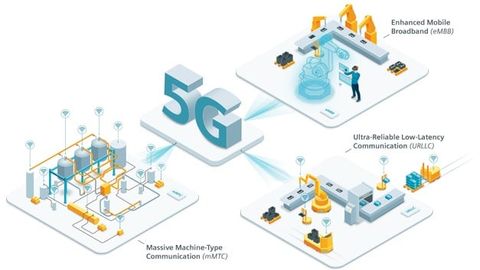
With the new 5G mobile communications standard, for example, ultra-short latency times in the single-digit millisecond range will make industrial applications such as mobile robots feasible for the first time.
© SiemensThe 5G Alliance for Connected Industries and Automation (5G ACIA) was founded under the umbrella of the German Electrical and Electronic Manufacturers' Association (ZVEI) and is working intensively to promote the use of 5G in industry. Germany has a locational advantage here, as special industrial radio frequencies are available for private industrial networks.
Such private industrial 5G networks efficiently meet a wide range of requirement priorities and open the door to comprehensive wireless networking of production, maintenance and logistics. In addition to full-area coverage and high data rates, ultra-short latency times also play a decisive role in the implementation of applications such as mobile robots in production, autonomous vehicles in the transport and logistics sector or virtual reality applications. So what could be more obvious than combining TSN and 5G - TSN for real-time wired networks and 5G for real-time wireless networks. The future sounds promising and invites you to embark on a voyage of discovery to new concepts and fields of application - like flying ants swarming out to build new colonies.
Author:
Manfred Wolf is Marketing Manager at Siemens.


You might also be interested in
The status quo
Time-Sensitive Networking (TSN) has an impact on the automation industry and the IT world like no other standard. What is the status quo?
 read more...
Open source stack officially certified
The OPC Foundation has now announced the official certifiability of OPC UA servers based on version 1.0 of the open OPC UA stack open 62541. To date, the stack is the only open implementation of OPC UA programmed entirely in C.
read more...Wago gears up for Time Sensitive Networking (TSN)
In the future, Ethernet TSN will enable continuous communication in machine and plant engineering without gateways and interruptions. Wago is launching two new automation systems on the market for the SPS, with which users can take advantage of all...
read more...Arrive in reality!
Time Sensitive Networking has firmly established itself in the vocabulary of the automation industry. All well-known suppliers have started activities to evaluate or even introduce TSN. But where exactly are the goals for the use of TSN and what is...
read more...OPC UA and DDS combined
To date, OPC UA and DDS have often been presented as competitors. Competitors that will both be based on the Ethernet standard TSN. - However, the key to successful automation in the future lies in a combination of the three standards DDS, OPC UA...
read more...Where there are still problems with 5G
5G in automation - a hot topic at the moment. How quickly can we actually expect 5G to be used in industry? What obstacles still need to be overcome? Thomas Schildknecht summarizes the key points in this interview.
read more...Data pipeline ASi-5
High data width, short cycle times, improved integration of intelligent sensors and actuators using IO-Link and cloud connectivity via OPC UA - ASi-5 makes AS-Interface fit for the requirements of digitalization.
read more...OPC UA - a must for the industry (Part 2)
OPC UA is regarded as the new communication standard for industrial automation. Part 1 explained why a new communication technology is needed in automation and described the OPC UA methods. Part 2 deals with the OPC UA pub/sub methods and the power...
read more...OPC UA, MQTT and co.
The Industrial Internet of Things (IIoT) covers very different areas of application. The available connectivity technologies and standards are just as diverse as the application areas. How can the right technology be filtered out in each case?
read more...