

Comment
Just get started!
Florian Frick, Group Leader Real-Time Communication and Control Hardware at ISW Stuttgart and Meinrad Happacher, Editor at Large of Computer&AUTOMATION with a commentary on Part 6 of the successful TSN series.
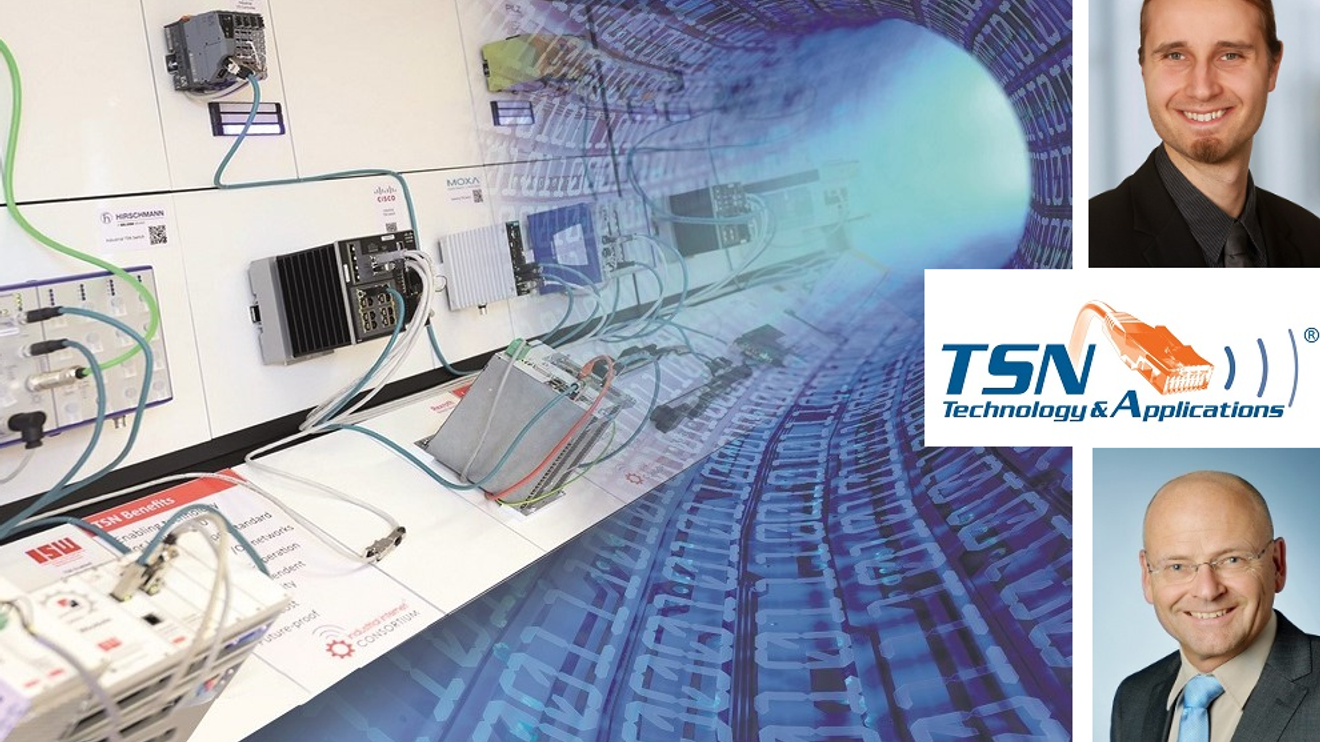
The hopes and expectations for TSN could hardly be greater: TSN is supposed to
bridge between IT and OT and also guarantee convergent networks.
networks. Furthermore, TSN is regarded as a symbol of the standardization of fieldbuses and
as the basis for wireless real-time communication! All hopes and expectations
expectations that bring with them a multitude of political and technical discussions.
with them.
We have already addressed many of these topics in our TSN series,
presented different perspectives, discussed many standards and outlined solutions.
and outlined solutions. Some of those interested may be shocked by the
the complexity of the issue and have put themselves on hold.
But should we really wait until the IEEE, FLC, IEC and co.
come to a final agreement? This is certainly a basic requirement for some applications
- but by no means for all! For many tasks, the already established
TSN components are sufficient - you can already benefit from them today.
benefit from them today.
Therefore, in part 6 of the TSN series, we are not focusing on standards, theory and politics, but rather on practice: With a hands-on tutorial, we want to help you get your first TSN application up and running in no time at all.
As always, we welcome your feedback, comments and suggestions on this series.
Yours, Florian Frick and Meinrad Happacher
Read part 6 of the TSN series here: With open solutions to your own endpoint


You might also be interested in
The best of both worlds
A standardized approach for combining the DDS and TSN standards is currently being developed. However, there are also reasons to use DDS and TSN together today.
 read more...
"Three questions for..." - in December
The company roadmap to TSN
Time Sensitive Networking - TSN for short - is in the process of establishing itself as a real-time Ethernet standard. What is the state of play in the industry? As part of the "3 questions for ..." series, we asked experts from companies about this.
read more...A TSN starter package
A starter package for setting up, configuring and testing TSN networks. TTTech is now launching it.
read more...The key role of configuration
Time Sensitive Networking is gaining ground in convergent networks with critical applications and strict time requirements. But what needs to be considered in network planning? And why does configuration play a key role?
read more...TSN alone is nothing!
Yes, TSN is the new basic technology for convergent real-time communication. But which protocols will actually be based on the TSN layers and become established on the market has not yet been decided. In this article, four protagonists have their...
read more...Embedded community votes for favorites
In addition to the coveted 'embedded award', the 'community choice award' will also be presented for the first time at embedded world. The special feature: The award winner is determined by the embedded community.
read more...Preview on embedded world 2024
Inference can be as Compute Intensive as the Training
With CPUs, GPUs and FPGAs, AMD has all architectures that are used for AI. embedded world Keynote Speaker Dr. Salil Raje shares his view on AI.
read more...International meeting places for the embedded community
From April 9 to 11, the embedded industry will meet in Nuremberg - but not only there, because embedded world will also take place in China and the USA in 2024. How did it go in China? What can we expect in Nuremberg? And a look ahead to the 1st...
read more...In focus: Artificial intelligence
The e-paper of the January 2024 issue
ChatGPT has given artificial intelligence a huge boost over the past year - especially in terms of public perception. In this issue, we want to take a closer look at AI and categorize it in more detail for potential industrial users.
read more...