

TSN and OPC UA - status quo
From TSN testbed to convertible production
With the TSN Testbed, the ISW in Stuttgart is supporting the establishment of a deterministic and open network standard in production facilities. Florian Frick describes the status quo.

Mr. Frick, four weeks ago you had your TSN Plugfest at the ISW in Stuttgart. How many participants did you have and what were your findings?
Florian Frick: We held our 21st Plugfest as a hybrid event and the 14 participants on site were only a fraction of the typical number of participants before the pandemic. Specifically, we were able to make great progress in setting up the next generation of our test infrastructure and conducting initial tests with it. This has shown the importance of face-to-face meetings. We have now created the basis for continuing to work efficiently on our core topic of interoperability and hopefully we will soon be able to move forward very efficiently in a larger group again. Our central topic of configuration will now also return to full focus.
What topics did you want to focus on at the trade fair?
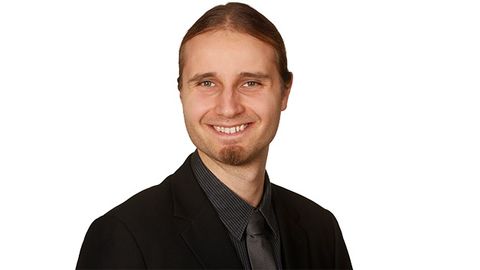
Florian Frick, Group Leader 'Real-Time Communication' at ISW Stuttgart and Chair of the IIC TSN Testbed of the Industrial Internet Consortium: "Configuration is a key topic this year."
© University of StuttgartThe most important messages of our planned presentation were certainly the cross-manufacturer character and interoperability of TSN. One key aspect that we wanted to emphasize was configuration. On the one hand, we would have presented the results achieved with regard to cross-manufacturer configuration. On the other hand, we also wanted to use the stand as a meeting point to discuss this topic, which is still in the standardization phase.
As far as our target group is concerned, we are currently making a shift: whereas in the past we still focused on technology-driving companies, we are increasingly concentrating on TSN users. We want to give this clientele in particular a good first-hand impression of the current state of affairs.
Where do you still see the biggest stumbling blocks on the way to putting TSN into practice?
While the TSN standards are still being worked on, it is already accepted across all industries as a key technology of the future and there are high hopes for its potential. TSN as a technology is only of secondary importance, the focus is on the associated ecosystem. That's why I see the biggest challenge in the near future as transforming existing technological solutions into a usable overall system! To make this vision a reality, we obviously still have to solve many practical, purely TSN-related problems, such as configuration.
What time horizon do you see for these tasks?
As a further development of Ethernet, TSN is part of a continuous process. That's why I prefer to talk about an evolution rather than a sudden revolution. A lot of things will be usable in the near future, but we will also see research and standardization activities for years to come.
However, 2022 is likely to be a very interesting year from several points of view: In 2022, further gaps will be closed on the part of the standards. In addition, the announcements made by practically all manufacturers give us hope that a wide range of products for infrastructure, endpoint solutions and software will be available in the near future. And finally, a lot can also be expected from the application side: the expected results of the FLC initiative are certainly of particular importance here.


You might also be interested in
A common test plan for the industry profile
Avnu, CLPA, ODVA, OPCF and PI are cooperating to generate a standardized test plan for the emerging TSN profile IEC/IEEE 60802 for industrial automation. All the organizations will be able to test their products for conformity with the new profile.
 read more...
Not against, but with MQTT!
MQTT is an established protocol for edge/cloud communication. However, the OPC Foundation also wants to use OPC UA not only in the field, but also for edge/cloud communication. Their appeal: Avoid a proliferation of MQTT assignments with OPC UA!
read more...BSI updates security analysis on OPC UA
In its study "Security analysis on OPC UA", the BSI evaluates the specified and implemented security functions of OPC UA. Among other things, the focus was on the search for security vulnerabilities.
read more...Distributed real-time applications based on TSN
Time-Sensitive Networking (TSN) is one of the key technologies for future distributed real-time applications. In addition to the actual TSN-based communication, the ecosystem and its components must be considered for successful implementation.
read more...On the way to becoming an Industry 4.0 enabler
The PNO has long been trying to expand its range of tasks beyond the fieldbus topic. The development of the Omlox positioning service points the way in a direction that is now being continued with the projects on MTP and a robot interface.
read more...Multi-vendor demo celebrates its premiere
Three years after its launch, the OPC Foundation's Field Level Communications (FLC) initiative has now completed the second release candidate - a multi-vendor installation demonstrates the progress made.
read more..."Practical suitability has been achieved!"
About five years ago, B&R was one of the co-initiators of the "Shapers" - in other words, a supporter of the TSN movement for the industry from the very beginning. What has happened since then in terms of TSN at B&R? Elmar Zimmerling...
read more...The role of the national Gaia-X hubs
The organizational structure of Gaia-X is based on three pillars: the Gaia-X Association, the national Gaia-X Hubs and the Gaia-X Community. Peter Kraemer, Coordinator of the Gaia-X Hub Germany, explains the role of the German Gaia-X Hub.
read more...Virtualized control systems using TSN backbone
The major challenges in implementing virtualized control systems are scalability and connectivity to the field level. An implementation at the ISW shows that this can already be achieved today using a TSN network.
read more...