

Follow-up with Kevin Carlin, ADI
Entry into the IE business
With the new 'ADI Chronous' brand, Analog Devices wants to have a major say in Industrial Ethernet (IE) in the future. Kevin Carlin, Vice President Industrial Automation & Energy at ADI, explains exactly what this plan looks like.
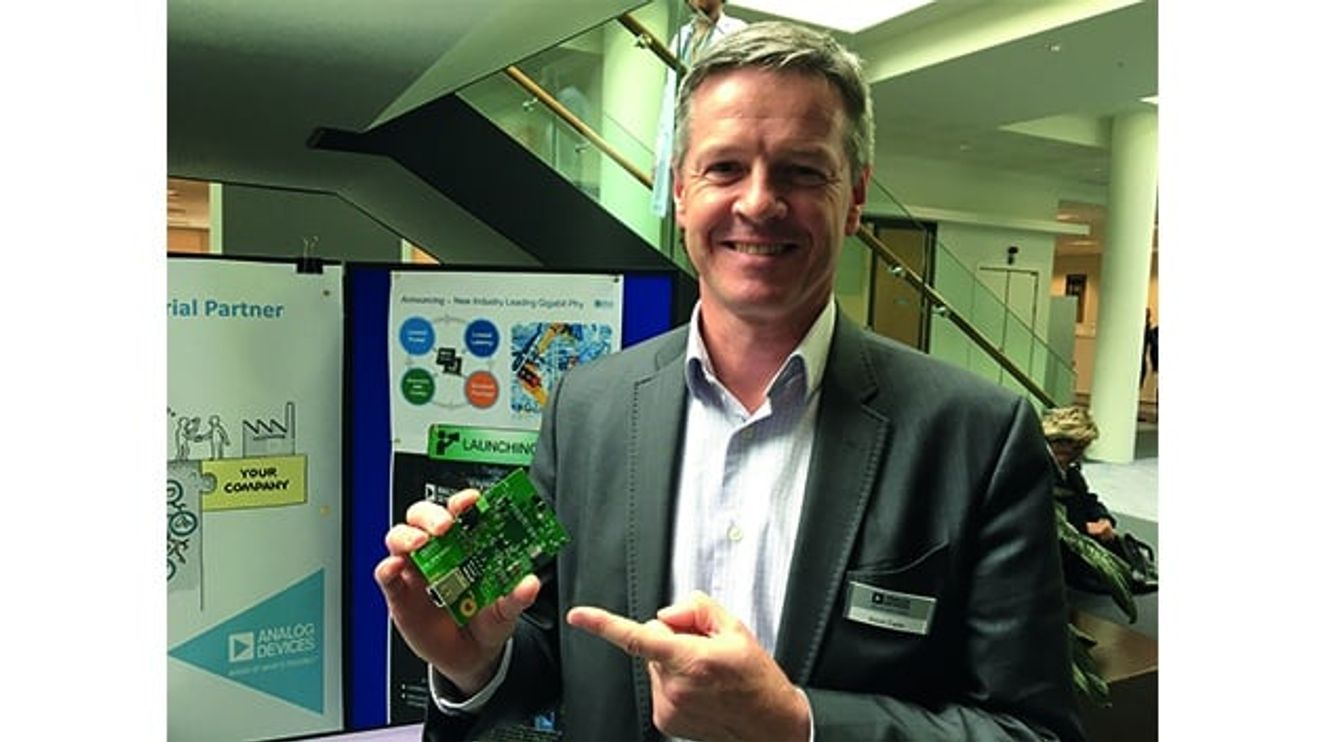
Mr. Carlin, at the SPS, ADI announced an increased commitment to Industrial Ethernet. What does this look like in concrete terms?
Kevin Carlin: Our new portfolio of solutions around the 'Cronous' brand, which we presented for the first time in Nuremberg, was specifically designed to meet the challenges of communication in the age of Industry 4.0, smart factories and digital transformation. This means that our aim is to enable the efficient development of robust, scalable Ethernet connectivity solutions that address today's industrial networks and the TSN-based systems of tomorrow.
What specific innovations are you bringing to the market?
Carlin : We initially presented our first Industrial Ethernet PHY technology under the names ADIN1300 and ADIN1200. These are products that are designed for use in industrial applications and offer speeds of 1 Gbit and 100 Mbit respectively. With these two new products, which are already fully released and available to order directly, we are simultaneously reducing the power consumption and latency of the system and significantly shrinking the dimensions of the Ethernet PHY technology to enable robust Industrial Ethernet for time-critical applications.
We have also introduced our tested embedded reference design for networking that supports 10/100 Mbit connectivity. The solution includes verified schematics and layout recommendations and can be used in conjunction with our embedded switches, PHYs and processors directly by customers in any system design. The reference design comes complete with verified networking software that supports most of today's industrial protocols as well as key TSN features required for deterministic network design.
The market for IE solutions is already heavily occupied by various providers - what specific added value can ADI offer as a 'newcomer'?
Carlin: ADI is the first semiconductor manufacturer to develop a prototype for 10BASE-T1L-PHY and this new technology will be an important tool for the deployment of Ethernet in the field. By solving the challenge of distance and power while being suitable for use in intrinsically safe applications, this technology overcomes the hurdles that previously limited the use of Ethernet in field applications with low power sensors.
We also presented a prototype of our new scalable Ethernet switch at the SPS. This supports the entire range of TSN functions and is simultaneously scalable in terms of bandwidth from 10 SPE to 1 Gbit as well as the number of ports - i.e. from three to six ports. This portfolio will provide the flexibility and scalability to support virtually any topology and network architecture in the factory of the future. This solution has also been developed to allow flexibility in the choice of TSN functions while supporting all major Industrial Ethernet protocols - keyword backwards compatibility.
ADI recently acquired the company Test Motors. Can you tell us more about the background to the acquisition?
Carlin: Test Motors is a company that specializes in predictive maintenance of electric motors and generators. This acquisition builds on our purchase of OtoSense last year - a start-up company that has developed sensing interpretation software that is able to learn and recognize noise or vibration and identify potential problems in a factory machine or motor before they become dangerous. We plan to combine the OtoSense software with the monitoring functions of test engines. In this way, we aim to create solutions that provide an advanced, holistic snapshot of machine health by capturing a wider range of potential faults.


You might also be interested in
SPS Connect 26.11. - 14:00 - 14:20
Delivering the Connected Enterprise for Industry 4.0
Industry 4.0 future scenarios in 2025: Industry 4.0 migration process in large companies. The benefits of Industry 4.0 are obvious: more data, better analysis capabilities, informed decisions, all leading to increased productivity.
 read more...
SPS Connect 26.11. - 11:40 - 12:00 a.m.
The Next Cyber-Attack Could Be At Your Factory
As the surface of cyber attacks changes, the security risk and need for security solutions increases. It is imperative that factories adopt a resilient stance against cyber attacks.
read more...Follow-up with Dr. Jochen Schlick
Bogged down in individual projects
For the sixth time, the management consultancy Staufen has compiled the 'German Industry 4.0 Index' and surveyed more than 300 German industrial companies on the topic of digitalization. Dr. Jochen Schlick from Staufen Digital Neonex explains the...
read more...The Internet of Production
The Internet of Production (IoP) is based on the idea of enabling a new level of cross-domain collaboration. The Cluster of Excellence IoP at RWTH Aachen University is working to realize this vision. Rahman Jamal, member of the Industrial Advisory...
read more...Follow-up with Benjamin Häfner
The autonomous production system
Researchers from the fields of mechanical engineering, electrical engineering, information technology and computer science are developing an agile production system at KIT that adapts autonomously to changing product specifications. Project...
read more...Follow-up with Dr. Thomas Kuhn
An operating system for Industry 4.0
The three-year BMBF project 'Basic System Industry 4.0' came to an end on June 30, 2019. What goals were achieved? What can be transferred into practice? Where do we go from here? Project manager Dr. Thomas Kuhn gives his opinion.
read more...The interface to the motor
A year and a half ago, the encoder manufacturers Baumer, Hengstler and Kübler joined forces to establish an open single-cable solution between motor and drive with 'SCS open link'. What has become of it? Jonas Urlaub from Kübler takes a stand.
read more...The face of the FLC initiative
At SPS IPC Drives 2018, the OPC Foundation presented the 'Field Level Communication' initiative - FLC for short. Since the Hannover Messe, the initiative has had a director, Peter Lutz, who explains the background to the OPCF's new management...
read more...AI in the industry
How widespread is artificial intelligence in industry today? The ARC Advisory Group is currently getting to the bottom of this question with a study. Ebele Maduekwe explains the upcoming results in advance.
read more...