

Technology & Finance
Data economy powered by TSN, OPC UA and 5G
While the stock market rankings were dominated by oil companies ten years ago, companies in the digital industry are now setting the pace. But for data to flow and create added value, pipelines in the form of standardized communication protocols are required.

German politicians and industry leaders repeatedly emphasize in a mantra-like manner that we really slept through the first half of digitalization in Europe and especially in Germany. The reason for this is certainly that German industry, as the 'supplier to the world', but also due to the booming automotive industry, has hardly seen any reason to change its successful business model. Or to put it bluntly: as long as the fax machine keeps spitting out new orders, there's no need to worry about new business models - especially if they are disruptive and could potentially cause you to lose your job.
Over ten years ago, the term 'Industry 4.0' was coined at the Hannover Messe trade fair and has become a global synonym for data-supported industrial value creation. Europe and Germany want to successfully tackle the second half of digitalization and create a strong industrial foundation and basis for our future prosperity. The latest Industry 4.0 Barometer from management consultancy MHP and Ludwig-Maximilians-Universität (LMU) in Munich concludes that the DACH region is lagging far behind China in the use of digital technologies. In their analysis, the authors of the study point out that Chinese companies have a 20% higher use of digital twins and twice as high automation and remote control rates for systems. The automotive industry, which is under high international competitive pressure, is a welcome exception: Almost two thirds of the automotive companies surveyed stated that they had implemented communication architectures such as 5G - 13% more than the reference industries.
Importance of open communication architectures
Open communication standards fuel innovation and create new value-added services with high value creation potential. This was the case in the 1980s with the introduction of digital telephony via ISDN and the GSM standard. Europe was a leading telecommunications supplier in both technologies. However, hardware increasingly became a by-product with low margins: although Ericsson and Nokia are still leaders in the field of mobile network infrastructure, as the expansion of 5G networks shows, Europe only plays a subordinate role in the field of end devices or digital value-added services. The Internet with its TCP/IP protocol is considered a prime example of open communication architectures: thanks to the 'World Wide Web' protocol, the foundation stone of which was laid by Tim Berners-Lee at CERN in Geneva, a completely new digital economy was able to emerge on this standardized data pipeline, including the currently much-discussed metaverse.
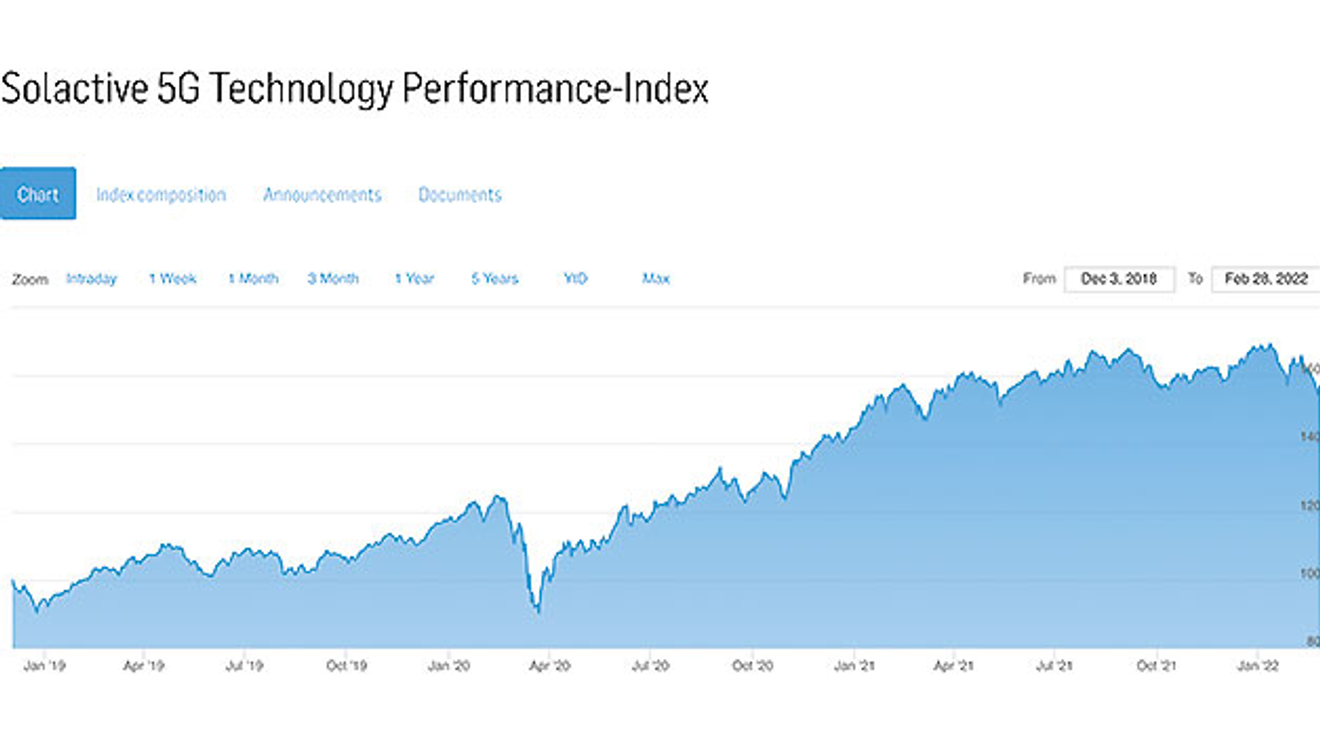
With the 5G Technology Performance Index (ISIN: DE000VA9H372 ) from Vontobel, investors can invest in the 20 most important shares of leading companies in 5G technology via an index certificate. The index covers the entire value chain with companies from the Device Manufacturer, Mobile Network Operator, Mobile Network Tower Infrastructure Provider, Mobile Network and Optical Network Hardware Manufacturer and Antennas, Semiconductors, Chips and Signal Processing Equipment sectors.
© Solactive/Thomas RappoldThe same dynamic is now playing out in the industrial communication landscape. The Industry 4.0 communication standards TSN and OPC UA as well as the new 5G mobile communications standard are creating an exciting pairing: while TSN / OPC UA stands for real-time wired network communication, 5G enables real-time wireless network communication.
Germany has an important locational advantage: while it still lags far behind other countries in the expansion of commercial 5G networks for end customers, Germany is one of the world leaders in the allocation of licenses for industrial 5G radio frequencies. According to the latest figures from the responsible Federal Network Agency (BNetA), 170 applications for the allocation of local 5G networks, so-called campus networks, have now been granted. These include names such as Accenture, Airbus, BMW, Porsche, Kuka, Mercedes Benz, Siemens and VW.
TSN / OPC UA and 5G - the perfect pairing
In addition to the quick and cost-effective granting of 5G licenses to industrial partners by the responsible Federal Network Agency, it is also an advantage that two important standardization bodies, the OPC Foundation and the 5G ACIA Association, are strongly anchored in Germany. Stefan Hoppe, the Managing Director of the OPC Foundation, comes from Germany, while 5G ACIA was founded by the ZVEI and has developed into the leading international association for industrial 5G communication.
Both associations recognized early on that strategic cooperation is of great importance for the breakthrough in the field of standardized and integrated industrial data communication. Last year, the OPC Foundation and the 5G-ACIA consequently signed a memorandum of understanding "to identify synergies on how OPC UA can best run over 5G for the benefit of industrial applications". Andreas Müller, Chairman of 5G-ACIA, summarized the cooperation as follows: "The integration of OPC UA and 5G brings together two important building blocks and thus forms the basis for a highly flexible and powerful connectivity fabric for intelligent manufacturing".
Industrial value-added services through 5G
3GPP version 16 introduces Ultra Reliable Low Latency Communication (URLLC). This increases the reliability of end-to-end connections to 99.999% compared to Release 15. In addition, positioning accuracy has been significantly improved, which is particularly interesting for parcel delivery. With these properties, 5G URLLC can score particularly well in industrial applications. ABI Research also sees the enormous potential: the market researchers assume that the market for 5G URLLC will amount to 18.9 billion US dollars by 2026. The main areas of application will be mobility and transportation, manufacturing and healthcare.
Specific fields of application with a major impact are likely to be driverless cars, intelligent goods transportation, remote-controlled vehicles in production and, above all, next-generation factories. Using TSN / OPC UA and 5G, an omnipresent network can be created in the factory that connects machines, cloud and analysis services and processes. In the industrial environment, areas of application with a time-critical process background such as real-time robot control, virtual reality applications, motion control machines and factory automation are particularly worth mentioning here.
Industrial data economy and EU Data Act

Thomas Rappold: "Germany is in a very good starting position for the industrial data economy. Rapid and consistent adaptation of modern communication standards such as OPC UA, TSN and 5G is crucial for this."
© Thomas RappoldAt the end of February 2022, the EU Commission presented the "EU Data Act". The Act is intended to regulate legal, economic and technical issues relating to access to data generated by the use of networked devices. According to EU Commissioner Breton, 33 zettabytes of data were generated in 2018 - this figure is set to rise to 175 zettabytes by 2025 - but 80% of the data generated in the IoT/Industry 4.0 sector is currently not being used or systematically analyzed. According to Breton, the aim of the Data Act is to make it easier for industry to use this data generated by machines so that they can better exploit the "growth and innovation potential" and compete with the large American and Chinese tech companies. In Germany, the automotive and chip industries in particular have quickly taken up the topic of 5G for factory automation in order to generate added value and new business models from the data.


You might also be interested in
Digital Twin Consortium / OPC Foundation
The digital twin in production
The Digital Twin Consortium (DTC) and the OPC Foundation have now announced a collaboration to accelerate the development and adoption of digital twin technologies.
 read more...
Investments in next generation technology
Economists agree: drastic measures are needed to put a stop to runaway inflation. Bold and targeted investment decisions in next-generation technology innovations are needed right now.
read more..."A path through the zoo of standards"
The OPC Foundation used its traditional press conference at SPS to call for more cooperation between OT and IT. The implementation of OPC UA cloud interoperability by AWS and Microsoft shows where the path needs to go.
read more...No digital (industrial) future without artificial intelligence
High energy costs, uncertainties in the energy supply chain and the strong focus on China as an export country are calling into question the future viability of Germany's (export) business model. The transition to a smarter, more intelligent...
read more...New specification for mechanical engineering
A new version of the OPC UA for Machine Tools Companion Specification is now available. The Joint Working Group with the OPC Foundation, which is supported by the VDW, has developed a supplement that makes it possible to integrate existing systems...
read more...Digital and sustainable - rethinking infrastructure 4.0
The digitalization and decarbonization of our economy presents us with major challenges. The consequence is that infrastructure needs to be rethought. A plea for a redefinition of the term 'infrastructure'.
read more...5G entry without high initial costs
The Fraunhofer IPT wants to help small and medium-sized companies get started with 5G. A mobile 5G test system that can be tested in the company's own production halls is intended to allay any fears.
read more...Patents for communication technology
China overtakes USA
According to an analysis by the German Patent and Trade Mark Office (DPMA), China has greatly increased its pace of innovation in digital technology. China has even overtaken the USA in digital communication technology.
read more...Digital security of the future
The digital transformation of industrial processes and critical infrastructures also increases their vulnerability: increasing networking encourages hackers to commit sabotage. Intelligent cybersecurity solutions are an inherent part of the security...
read more...