

ZVEI annual kick-off 2026
Electrical industry expects growth again in 2026
After three weak years, the German electrical and digital industry expects real production growth of 2% again in 2026. Exports to Europe are stabilizing business, while customs duties, network expansion and AI regulation remain key challenges.
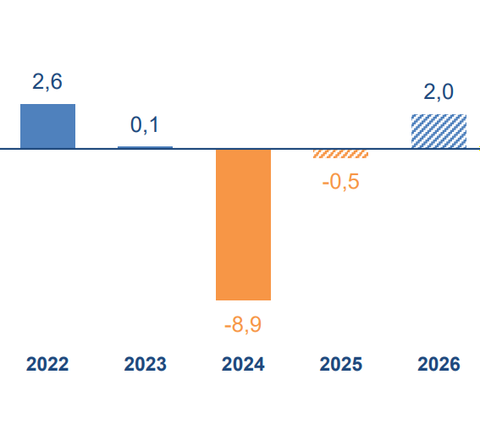
After three years of stagnation and decline, the German electrical and digital industry is cautiously optimistic about the future. "The German electrical and digital industry is likely to grow again in 2026 for the first time after three years of stagnation and decline," said ZVEI President Dr. Gunther Kegel at the industry association's annual kick-off press conference.
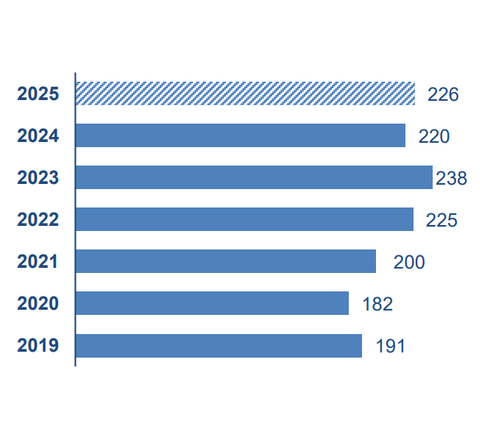
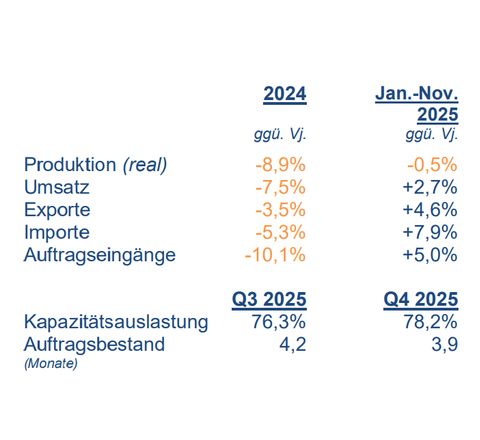
For 2025, the ZVEI still anticipates a real decline in production of 0.5%, after originally fearing a decline of 2%. In nominal terms, industry turnover is likely to have risen to around 226 billion euros in 2025, an increase of 2.7% compared to the previous year. Employment remained relatively stable at around 877,000 employees, but fell by 1.7%. Incoming orders increased by 5%.
Europe supports export growth
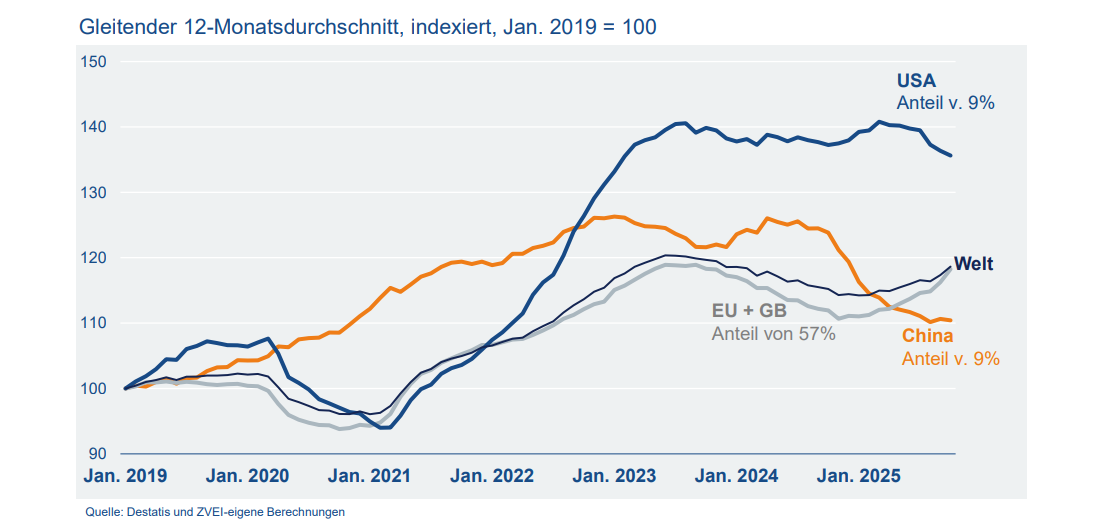
Exports developed robustly in 2025 with an increase of 4.6% to 236.2 billion euros (January to November). Declines in the USA (-8%) and China (-3%) were offset by deliveries to the European domestic market and the UK. Including the UK, Europe now accounts for 57% of electrical exports; eight of the ten most important target countries are in the EU, with the Netherlands leading the way. China and the USA nevertheless remain the most important individual markets with around 9% each.
The ZVEI sees the European single market as a strategic safeguard in times of geopolitical uncertainty. At the same time, the association is calling for the dismantling of internal trade barriers, which, according to the International Monetary Fund, can correspond to a tariff effect of up to 44%, as well as an end to special national regulations in environmental and resource protection.
Industrial AI as a growth driver
The industry has high expectations for industrial AI applications in manufacturing, product development, quality control and maintenance. Hybrid systems consisting of traditional algorithms and AI methods are being used here. According to a study by IW Consult, Germany could generate additional added value of 144 billion euros by 2035. However, the ZVEI is calling for adjustments to the EU AI Act and advocates excluding industrial B2B systems from the regulations.
Microelectronics, networks and storage
Following supply bottlenecks at the end of 2025, the association is calling for an expansion of European microelectronics production, particularly in PCBs and electronics production, where Europe only has a global market share of 2% and 10% respectively. The ZVEI sees opportunities in advanced packaging.
In terms of electrification, stationary battery storage grew by almost 30% to 6.6 GWh in 2025. The expansion of transmission grids has accelerated, but distribution grids and smart meter gateways are lagging behind. In order to support the ramp-up of electromobility, the association is calling for lower electricity prices, a reduction in the electricity tax and faster grid expansion.
Defense, customs and location issues
According to the ZVEI, impetus from security and defense policy is only gradually arriving. Many companies are repositioning themselves, but large orders in the double-digit billion range are not to be expected in the short term.
US tariffs of around 15% since summer 2025, plus surcharges on steel and aluminum in individual cases, are having a negative impact. This is putting pressure on margins for electric motors in particular. Further tariffs, for example on semiconductors, are being examined. At the same time, industry representatives cite products such as Profibus/Profinet industrial communication systems - used in around 40% of US industrial networks - or sensor technology and connectors as hardly substitutable in the short term.
With regard to the relocation of production, the ZVEI points to the international division of labor that has existed for decades: only 3% of global electrical and digital production still takes place in Germany, almost half in China. It is mainly innovation-driven products with low production volumes that remain in Germany.
Hannover Messe with new hall concept
Finally, the association presented changes to Hannover Messe 2026. A new hall structure is intended to better direct visitor flows and relieve overcrowded areas. Despite reduced exhibitor space due to the pandemic and economic downturn, the trade fair remains the industry's most important international showcase.


You might also be interested in
International Federation of Robotics
U.S. Robotics Industry Sees Double-Digit Growth
In the U.S., sales of industrial robots rose by 11% compared to the previous year: 38,000 units were newly installed in 2025. This significant recovery is driven by robust growth in the food industry and other non-manufacturing sectors. However, the...
 read more...
Hans Seifert to Become Chief Sales Officer
Sigmatek has appointed Hans Seifert as Chief Sales Officer (CSO). His area of responsibility includes international sales, marketing, application engineering, and support.
read more...International Federation of Robotics
The 2026 IERA Award was presented
The 2026 “Award for Innovation and Entrepreneurship in Robotics & Automation” (IERA) goes to the Swiss deep-tech company Verity for its fully autonomous indoor drone system. The flying robots support the logistics and retail sectors by...
read more...Increased revenue and expanded production capacity
The Fraba Group, a manufacturer of sensors for industrial motion control, looks back on a successful 2025, during which both revenue and the number of employees increased.
read more...Rosenberger joins the EBO MSA initiative
Rosenberger has joined the newly formed Expanded Beam Optical Multi-Source Agreement (EBO MSA). This industry initiative is developing open and interoperable standards for optical connectivity in next-generation AI data centers.
read more...Benoît Thooris takes over as president
Benoît Thooris is taking over as head of UniversalAutomation.Org. The organization is also adding two new members to its Board of Directors.
read more...Triton Partners takes over Flender
Global investment firm Carlyle has signed an agreement to sell Flender, a provider of mechanical drive technology, to Triton Fund 6, advised by Triton. The terms of the transaction were not disclosed and is expected to close in the fourth quarter of...
read more...Schaeffler expands its Defense division
Celia Pelaz becomes CEO of STech Defense
Schaeffler is making new appointments to the management of its subsidiary STech Defence GmbH. Celia Pelaz will take over the position of CEO "Defence & New Space" on October 1, 2026 and will manage the business of the Munich-based company.
read more...6 Criteria for the objective comparison of humanoid robots in industry
A new benchmark from Fraunhofer IPA is intended to enable the first standardized and neutral analysis of humanoid robots for industrial use based on six key criteria.
read more...