

Sustainability and climate
Humanity lives largely beyond the boundaries of the Earth system
On Earth, there is feedback that absorbs and dampens disturbances. But the system has limits. A large research team is now defining which values can still be considered safe - and which are still fair for all people worldwide.
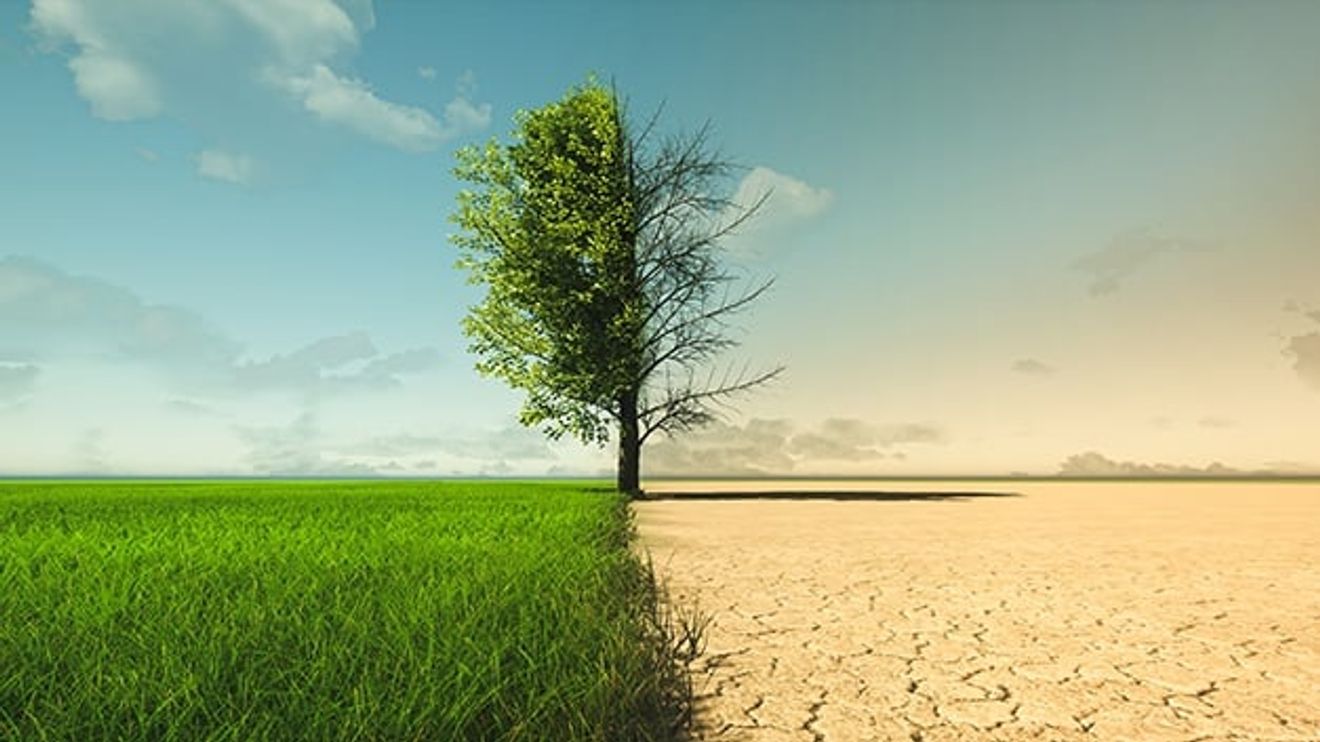
It is not only global warming that threatens life on earth as we know it, but also other developments influenced by humans. These include dwindling freshwater reserves, environmental pollution and the reduction of species diversity (biodiversity). The Earth Commission, an international association of scientists, has now identified safe and fair limits to the Earth system and put them into figures. In their study published in the journal Nature, the group led by Johan Rockström from the Potsdam Institute for Climate Impact Research (PIK) writes that seven out of eight safe and just limits have already been exceeded.
In the view of the more than 40 scientists, humans are endangering the stability and resilience of the entire planet with their current way of life. "This is why, for the first time, we are presenting quantifiable figures and a sound scientific basis to assess the state of our planet not only in terms of the stability and resilience of the Earth system, but also in terms of human well-being and justice," explained Rockström. The basis is formed by scientific findings from recent years and computer modeling.
The balance of the earth
The study is based on the concept of planetary boundaries presented by Rockström and colleagues in 2009, which, if exceeded, endanger the stability of the Earth's ecosystems. Aspects of the donut economy were supplemented with boundaries for a safe and just space for action for human civilization, as described by the British economist Kate Raworth in 2012. The United Nations' 17 Sustainable Development Goals are also important for the concept of safe and just Earth system boundaries.
On a stable and resilient Earth, there are feedback loops that cushion and dampen disturbances. If this balancing system is permanently disrupted, there is a risk of significant damage, which the study defines as widespread, severe, existential or irreversible negative impacts on countries, communities and individuals due to changes in the Earth system. As examples, the researchers cite the loss of human life, livelihoods or income, the displacement of people, the loss of food, water or food security as well as chronic diseases, injuries or malnutrition.
In the case of biodiversity, for example, the authors of the study believe that two safe and fair limits have already been exceeded: 50 to 60% of the land area would have to be left in its natural state or managed sustainably in order to preserve the natural services of ecosystems such as pollination, fresh water and fresh air. At present, this only applies to 45 to 50 % of the land area. And the requirement that 20 to 25 % of every square kilometer should be covered by largely natural vegetation is only met on a third of the land area influenced by humans.
In order to preserve the ecosystems in and around rivers and inland waters, the analysis shows that their water levels should only fluctuate by around 20 % of the water volume. This is not the case on around a third of the land area. In addition, only as much groundwater should be withdrawn as can be recharged. This limit is currently being breached on 47% of the world's land area. The levels of nitrogen and phosphorus, which are introduced into soil and water systems via artificial fertilizers, are also far too high. This leads to algae blooms, the death of fish stocks and ammonia particles in the air.
The justice concept of the new approach encompasses three aspects of justice in the use of the global commons: towards other living beings and ecosystems, towards the next generations and towards the globally distributed members of the current generation. "Our safe and equitable boundaries can guide goal setting, but must also be realized through equitable transformation processes that ensure people have a minimum level of access to resources," said Joyeeta Gupta of the University of Amsterdam, co-author of the study.
Safe versus fair - study focuses on the habitability of all regions
The concept of justice comes into play in the case of climate change, for example: while the scientists still classify a warming of 1.5 degrees compared to the pre-industrial age as "safe", they consider a maximum warming of one degree to be "fair". The authors of the study write that tens of millions of people are already massively affected by climate change today. This number will increase drastically with every tenth of a degree of greater warming.
"The previous focus on global mean values, for example the global mean temperature, treated all regions equally, but this is not the case," explained Christian Franzke from Pusan National University in South Korea, who was not involved in the analysis himself. "This study now focuses on the fact that all regions should remain habitable, which is only fair, as the areas most affected by global climate change have contributed the least to global warming."
The influence of aerosols on the weather
According to the research team, man-made aerosols in the air are the only criterion for which the safe and equitable limit of the Earth system has not yet been exceeded. It is known from volcanic eruptions that aerosols can strongly influence the monsoon, which supplies many regions of the world with the necessary rain. In particular, a large difference in aerosol quantities in the northern and southern hemispheres can change the monsoon. According to the researchers' calculations, this limit has not yet been reached - however, the uncertainty surrounding this question is particularly high.
Rockström and colleagues also mention the local and regional risk posed by aerosols: 85% of all people are exposed to particulate matter pollution above a value of 15 µg per cubic meter of air for the particle size PM2.5. Millions of people worldwide die every year as a result of persistent particulate matter pollution. This means that the fair value has already been exceeded locally, but due to a lack of data, the researchers do not state the current level of global aerosol pollution.
According to the researchers, nothing less than a fair global transformation of all Earth systems is required to ensure human well-being. "Such transformations must be systemic in the energy, food, urban and other sectors, address the economic, technological, political and other drivers of Earth system change, and ensure access for the poor by reducing and redistributing resource use," the study authors say.
Feedback from other scientists and researchers
Researchers who were not involved in the study themselves recognize the scientific merit of the study: "In general, the extremely complex approach of bringing these very different categories and data into a simple and comparable scale is very helpful," said Johannes Emmerling from the RFF-CMCC European Institute on Economics and the Environment in Milan. The study is "a wake-up call for policymakers on how many areas we risk losing control - possibly irreversibly - over fundamental Earth subsystems".
Helmut Haberl from the University of Natural Resources and Life Sciences in Vienna agreed with this. However, he critically noted that the limit values stated by the authors of the study are not necessarily based on a solid foundation: "Although the limit values are supported by current literature, this also suffers from the fact that the enormously complex and often locally specific interactions in ecosystems are insufficiently understood, so that ultimately only rather sweeping and generalizing assumptions can be used."


You might also be interested in
Christiane Benner starts with historically high approval ratings
There were no opposing candidates, but the election result for the first female chairwoman of IG Metall is nevertheless strong. Difficult tasks await Christiane Benner and her team.
 read more...
Digitalization in factories has two sides
Digitalization in factories has a downside when it comes to climate protection. Without a sustainable approach, it can lead to an increase in CO2 emissions, as digital processes generally require considerable amounts of energy.
read more...People living beyond their means from Wednesday
People are overexploiting nature. From the beginning of August, they are living on credit. Some things could be changed quite easily, say environmental and climate activists.
read more...Pilot project on CO2-optimized production
Siemens and BayWa are driving forward CO2-optimized industrial production in a pilot project. To this end, they are linking the Siemens Sigreen emissions management software with the BayWa Carbon Connect emissions offsetting software.
read more...Up to 25 percent less greenhouse gases through digitalization
According to a study, 20 to 25 percent of greenhouse gas emissions can be avoided in Germany alone through consistent digitalization and electrification. This would correspond to 150 to 180 megatons of CO2.
read more...With a focus on sustainability
The e-paper of issue 01/02
The climate crisis is omnipresent and everyone must make their contribution to greater sustainability. If there are many opportunities to save resources in the private sphere, what contribution can companies make? Assessments and models in the new...
read more...Interview with Judith Herzog-Kuballa VDMA
Sustainability must be part of the core business strategy
In order to survive on the market, companies need to focus on sustainability. Judith Herzog-Kuballa from the VDMA explains why sustainability is not a project that an employee "does on the side".
read more...Monitoring for more sustainability
Beverage bottling plants are highly complex systems. In order to optimize planning and process reliability, Krombacher relies on a modern monitoring system for twelve of its bottling plants. At the same time, the brewery is increasing the potential...
read more...Digital and sustainable - rethinking infrastructure 4.0
The digitalization and decarbonization of our economy presents us with major challenges. The consequence is that infrastructure needs to be rethought. A plea for a redefinition of the term 'infrastructure'.
read more...