

VDMA on machinery exports
Exports fell by 12% in 2020
Exports in the mechanical and plant engineering sector fell by 12% in 2020. Brexit was also already noticeable.

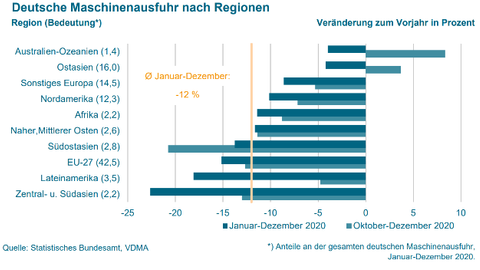
Last year will go down in history as the year of the coronavirus - with all its consequences. The mechanical and plant engineering industry is also feeling the effects. The VDMA has now published the figures for machinery exports last year. The 12% decline last year is hardly surprising. In total, machinery and equipment worth 160 billion euros was exported from Germany and 67 billion euros was imported. This means that exports were 12.0% and imports 13.4% below the 2019 figure, according to preliminary figures from the Federal Statistical Office. "Machinery exporters from Germany thus recorded the highest year-on-year declines since the financial and economic crisis in 2009," said VDMA Chief Economist Dr. Ralph Wiechers.
Second quarter particularly weak
A look at the quarterly figures for 2020 confirms the expected picture of the timeline: machinery exports recorded a comparatively moderate year-on-year decline of 5.1% in the first quarter. In the second quarter, 22% fewer machines and systems were exported before a gradual improvement set in. Lower declines of 12.4% and 8.2% were recorded in the third and fourth quarters respectively.
"The second quarter of 2020 was the peak of the coronavirus crisis for machine and plant manufacturers. Many companies were confronted with unexpectedly severe shortfalls on the supply and demand side. Supply chains were temporarily interrupted and customers postponed or even canceled orders at short notice. However, the developments of the last few months of last year are encouraging: the export year 2021 will be better and bring growth, even if the pre-crisis level will not yet be reached again," summarizes Wiechers.
USA and China strongest sales markets
Between January and December, exports to the United States, the number one destination for machinery exporters from Germany, fell by 9.3% to 18.2 billion euros. This means that the USA accounts for 11.4% of total machinery exports. In the same period, machinery and equipment worth EUR 18.1 billion (-3.6%) was exported from Germany to China, the second largest foreign market with a share of 11.3%.
"The economic recovery in China began in the second quarter of 2020. The positive momentum was also reflected in companies' order books shortly afterwards," says Wiechers. "Machinery exports from Germany to the People's Republic increased by 7.2% in the fourth quarter of 2020 and are entering the new year with momentum. However, the strength of the Chinese economy is not only noticeable in German exports to the country. According to figures from Chinese customs, exports of machinery from China amounted to a total of 165 billion euros. Revisions are still pending. But Germany's lead as the world's largest exporter of machinery and equipment is likely to be lost," added the VDMA chief economist.
42.5 % of exports went to Europe - Poland in the top 5
Exports to EU countries amounted to €68 billion last year, 15.2% below the previous year's level, which was a worse result than overall exports. EU countries accounted for 42.5% of total machinery exports from Germany.
To France, number 3 in the export ranking, companies supplied machinery and equipment worth 10.6 billion euros (-15.2%). In the export business with Italy , mechanical engineering companies recorded a drop of 18.1% to 6.8 billion euros. Poland climbed to fifth place in the ranking, taking in machinery and equipment worth 6.8 billion euros (-9.9%) from Germany last year, overtaking both the Netherlands (6.8 billion euros, -11.2%) and the UK (6.0 billion euros, -20.5%). The United Kingdom fell two places to 8th place due to the hard lockdown, but above all as a result of Brexit.
Machine tool manufacturers particularly affected
Not all specialist sectors were equally affected by the double-digit decline in exports. Machine tool manufacturers recorded a sharp drop of 29.4%. In contrast, agricultural machinery increased exports to the world by 1% compared to 2019.


You might also be interested in
"Noticeably more bureaucracy and burden"
The coalition has reached a compromise on the Supply Chain Act. The VDMA sees this as an additional bureaucratic burden for companies.
 read more...
Warning against the compartmentalization of global supply chains
Germany's prosperity is crucially dependent on the international division of labor. The VDMA warns that isolating global supply chains in the wake of the coronavirus crisis will harm everyone.
read more...Slight tailwind for mechanical and plant engineering
Despite a good Q4 2020, four out of five companies report a drop in turnover. Slight sales growth in sight for 2021, but no reason to sound the all-clear.
read more...More predictable trade policy expected
The Senate elections in Georgia have been lost in the chaotic scenes from the US Capitol. However, they are an important success for President-elect Joe Biden. The VDMA now expects a more predictable trade policy.
read more...ebm-papst is growing again thanks to AI and data centers
ebm-papst returned to a growth trajectory in fiscal year 2025/26. Air Technology, data center applications, and artificial intelligence are driving revenue and investments.
read more...Authorized distributors made visible online
Lapp is expanding its digital service portfolio and is the first B2B industrial company to provide its authorized distributors with a verifiable online seal from authorized.by. The company aims to create more transparency and security for buyers and...
read more...Flexible analog mix module
The analog mix module 'AM 821' from Sigmatek's S-DIAS series has eight analog differential inputs with 16-bit resolution and two analog outputs.
read more...Technology and innovation center opened in Chengdu
Balluff has opened a technology and innovation center at its production site in Chengdu, China. The aim is to provide even more targeted support to local and international customers with solutions and expertise.
read more...Wago takes over 'Zaphire' building management software
The Wago Group is further expanding its building automation business and has acquired the 'Zaphire' building management system (BMS) from the Scandinavian group Granitor.
read more...