

Problems at Gamesa again and again
Record loss for Siemens Energy
The problems with wind power are causing Siemens Energy record losses. Perhaps too much speed is also to blame, they say. Many answers about the future will now take until November.
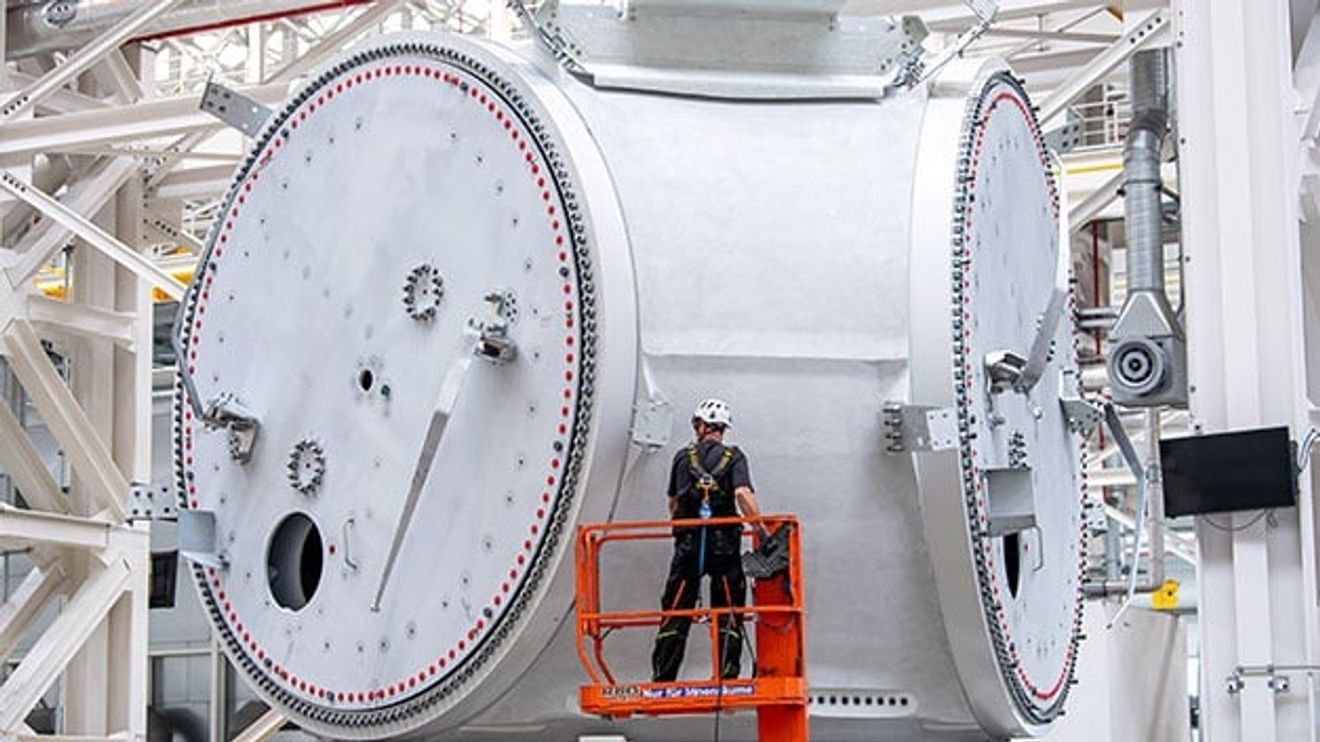
Munich (dpa) - The wind power subsidiary Gamesa has dragged Siemens Energy deeper into the red than ever before. In the third quarter, the Munich-based energy technology group reported a loss of over 2.9 billion euros, as announced on Monday. This is by far the largest loss in the Group's short history. Problems at Gamesa and a negative tax effect triggered by them are primarily to blame. Energy now expects a loss of 4.5 billion euros for the financial year as a whole - another record. An overview of the situation at Energy:
The problems
The largest item - amounting to around 1.6 billion euros, as Energy has now specified - is quality defects in onshore wind turbines. These can fail more frequently as a result. This is still rare, according to Energy, but the repairs to prevent this will cost a lot of money, especially in the next two years. However, because provisions are being made for this, the sum is already putting pressure on the result.
There are also problems in the offshore business. Energy is suffering from old, unprofitable contracts and problems in ramping up its production. The resulting burdens amount to around 600 million euros.
The burdens are also triggering a negative tax effect, as CFO Maria Ferraro explained. It is putting a further 700 million euros of pressure on the result.
Open questions
Energy had already made the renewed difficulties at problem child Gamesa public at the end of June. At that time, however, the Group remained vague in many areas. At the time, the charges were stated to be at least one billion euros.
Even now, not all questions have been answered. Group CEO Christian Bruch does not intend to answer the question of when Energy hopes to return to profit until November. Some time ago, this target was still in the forecast for the coming year.
The causes
Among other things, there are shortcomings in the bearings and rotor blades. Particles can occur in the bearings and the huge rotor blades sometimes have small creases, as Gamesa CEO Jochen Eickholt explained. Energy also sees suppliers as being at least partly responsible here. Cooperation with some of them has been terminated, he said, and compensation is also being discussed in some cases. However, the liability of suppliers is often limited in amount - and in any case smaller than the damage, as Eickholt explained.
Gamesa is not making as much progress as desired with the ramp-up of production for offshore turbines. On the one hand, this involves the construction of the factories, on the other hand, the search for employees.
In addition, both Games CEO Eickholt and Group CEO Christian Bruch suggested that too much emphasis had been placed on speed in the wind industry. "You have to ask yourself how quickly a business like this can grow," said Bruch. Apparently, he now wants to take things a little slower: The sequence for Gamesa is stabilization, profitability, growth, he said.
According to Eickholt, the new turbines of the problematic series that are now being delivered are more robust. However, technical risks in turbine construction cannot be completely ruled out.
The rest of the Group
Beyond Gamesa, Energy performed significantly better. The three other divisions, Gas Services, Grid Technologies and Transformation of Industry, improved their results compared to the same period of the previous year. And at Group level, incoming orders and sales also increased. Bruch said that the performance of the other divisions gave him "confidence in our company's ability to successfully rebuild our business".
This pattern has been evident for several years now. While many still saw the conventional business with fossil fuel plants as a problem when Siemens was spun off and Energy went public in 2020, it has been Gamesa that has been causing problems and profit warnings for some time now. As a result, Energy has not yet closed a financial year and only a few quarters with a profit.
The outlook
In order to get a better grip on the problem child, Energy has now completely taken over its wind power subsidiary, which for a long time was only a majority holding. The future of Group CEO Bruch is likely to depend on whether and how quickly the problems are resolved.
The share took a rollercoaster ride on Monday. In the morning, they initially fell by up to 7 percent, then temporarily turned significantly positive before trading at a discount again in the late morning.


You might also be interested in
Siemens drives Industrial Metaverse forward
Siemens is investing one billion euros in Germany. A new campus for development and high-tech production will be built in Erlangen for 500 million euros. It will also become the "nucleus for technology activities for the industrial metaverse".
 read more...
Innomotics launches as a Siemens subsidiary
Siemens is bundling its range of motor and large drive systems under the name Innomotics. The company was launched in Germany on July 1, 2023 as a wholly owned Siemens subsidiary.
read more...First control cabinet made of green steel
The Siemens subsidiary Alpha Verteilertechnik claims to offer the first control cabinet for industry made entirely of green steel.
read more...Siemens quarterly figures Q3-2024
Siemens confirms forecast with a "but"
Siemens is struggling with a weakening automation market in the third quarter. The software business, on the other hand, is developing strongly. It remains to be seen whether this will continue after the switch to a SaaS model.
read more...Edge rack server in robust
The trend towards hyper-convergent infrastructures is not stopping at the manufacturing and automation industry. Siemens has now launched the first edge rack server in robust industrial PC quality. How is the inner workings of the server designed?
read more...The e-paper of issue 07/2024
Read in the current issue of Computer&Automation how ChatGPT can provide support in the conception phase, how LLMs are used in code analysis and whether TSN can be considered as a backbone for virtualized control systems.
read more...For personal use
Siemens operates vertical farming for its own use at its site in Frankfurt. Siemens technology is used here. What works here on a small scale is also a future field for agriculture in general.
read more...Siemens sells Innomotics for 3.5 billion euros
Siemens sells Innomotics to KPS Capital Partners for 3.5 billion euros. Preparations for an IPO of the manufacturer of electric motors and large drives were announced in November.
read more...The e-paper of issue 05/2024
Strategies for the future are one of the topics covered in the current issue of Computer&Automation. Read about the reforms that associations are demanding from politicians, the opportunities offered by technologies such as ChatGPT and SPE and...
read more...